If you're visiting Porto — or living there and looking to cool off this summer — you may be surprised by the number of fantastic beaches within 40 minutes by car or train. After years exploring Portugal's coastline, we've found that the coastal corridor between Matosinhos and Espinho is one of the country's best-kept secrets: over 30 kilometres of Atlantic beaches, many holding Blue Flag 2026 status, served by train, each with its own distinct character — from traditional fishing villages to natural rock pools.
In this guide, we've compiled the best beaches north and south of Porto — with GPS coordinates, transport options, practical tips, and what makes each one unique. Whether you're looking for a surf session, a family beach day, or a scenic coastal walk, you'll find the right beach here.
Beaches North of Porto: Matosinhos
North of Porto, the municipality of Matosinhos concentrates some of the most accessible beaches from the city — especially via Metro. The Line A (Blue) connects Matosinhos Sul station to Porto city centre in just 27 minutes for €1.80.
Praia de Matosinhos
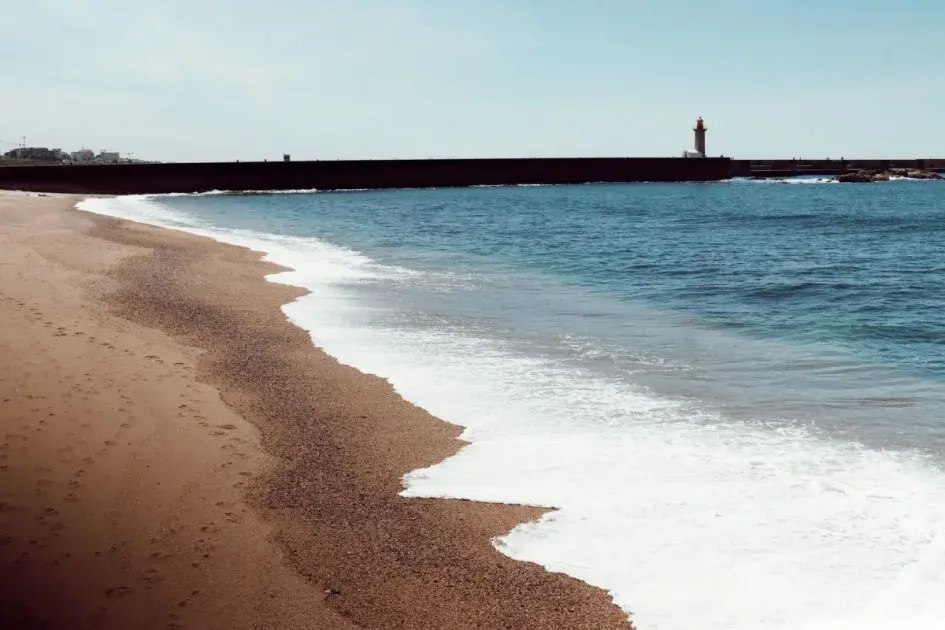
The most popular beach near Porto, and for good reason. Four kilometres of open Atlantic sand, consistent surf and bodyboard waves, and the celebrated Rua Roberto Ivens a stone's throw from the waterfront — one of Portugal's best streets for grilled fish restaurants. Praia de Matosinhos holds Blue Flag 2026 status and has lifeguards throughout the entire bathing season. Free parking exists near the beach, but fills quickly in summer; the Metro (Matosinhos Sul) is always the better option.
- GPS: 41.1855, -8.7003
- Access: Metro Line A — Matosinhos Sul (27 min, €1.80)
- Surf: Beach break, works year-round; best in autumn and winter
- Best for: Surf, seafood, full beach day with all services
This beach is covered in depth in our complete Matosinhos & Leça guide, which also covers the Álvaro Siza Tidal Pools and the Casa de Chá da Boa Nova (2 Michelin stars).
Praia de Angeiras
About 12 kilometres north of Matosinhos, Angeiras is one of the most authentic beaches on the Porto coast. The wide sandy beach is dotted with rock formations that create sheltered pockets of sand — ideal for families — and at low tide, the schist ledges reveal natural rock pools teeming with marine life. The working fishing village maintains its traditional boats on the beach, and several fresh-fish restaurants line the seafront to welcome post-swim visitors.
Angeiras Norte and Angeiras Sul both hold Blue Flag 2026 status. The surf works particularly well with a northerly swell, and the beach is popular with Porto locals who prefer something calmer than Matosinhos.
- GPS (Angeiras Norte): 41.2880, -8.7270
- By car: IC1 north, Lavra/Angeiras exit — approx. 20 min from Porto city centre
- By bus: STCP line 501 or Transdev da Maia (check summer timetables)
- Best for: Families, photography, fresh fish, authentic atmosphere
Beaches South of Porto: The Gaia Coastal Corridor
Cross the Arrábida Bridge into Vila Nova de Gaia and the coastline changes character entirely. The municipality holds an impressive 19 Blue Flag beaches in 2026 — one of the highest counts in Portugal — and a wooden coastal boardwalk (passadiço) connecting Lavadores to Espinho over more than 20 km of Atlantic coast.
The CP Porto–Aveiro train line (departing from Porto Campanhã or Porto São Bento) runs the entire length of this coast, stopping at Miramar, Madalena, Aguda and Granja, making this coastal corridor genuinely accessible without a car.
Praia de Lavadores
The first major beach south of the Douro estuary, Lavadores is an urban beach with full services: beach bars, lifeguards, showers and toilets. Waves are moderate, sand is fine, and parking is plentiful. It holds Blue Flag 2026 status. It's also the northern starting point of the Gaia coastal boardwalk, making it a natural base for a coastal walk southward.
- GPS: 41.1244, -8.6703
- Train: CP — Porto-Devesas station + bus; or car (IC1 south, 10 min)
- Best for: Families, starting the boardwalk walk
Praia de Salgueiros
An urban beach with a neighbourhood feel. The Salgueiros shoreline is interspersed with rock formations and has a distinctly local atmosphere — heavily frequented by Gaia residents. It holds Blue Flag 2026 status and connects to the coastal boardwalk. It's a good access point for the walking trail linking Lavadores to Espinho, and lies close to the centre of Vila Nova de Gaia.
- GPS: 41.1207, -8.6653
- Access: Bus or car from Gaia
- Best for: Walks, local atmosphere, beginner surf
Praia de Miramar and Praia do Senhor da Pedra
Miramar is perhaps the most photogenic beach on the entire Porto coast. Its icon — the Chapel of Senhor da Pedra, built in 1686 on a rocky outcrop in the middle of the beach — is one of the most shared images on Portugal's Atlantic shoreline. The small hexagonal chapel has withstood the tides for over three centuries, and it's especially striking at sunrise or sunset, when low-angle light paints the surrounding rocks gold.
Praia de Miramar and Praia do Senhor da Pedra are adjacent beaches, both holding Blue Flag 2026, plus Gold Quality and Accessible Beach designations. The sand is fine and golden, waves are moderate, and beach bars, lifeguards and parking are all available at the beach access points.
By train, Miramar station is just 600 metres from the beach. The journey from Porto (São Bento or Campanhã) takes about 28 minutes and costs €1.50 (Zone 2). By car, it's 22 km from Porto centre via A1/IC1, around 25 minutes.
- GPS (chapel): 41.0691, -8.6579
- GPS (Miramar station): 41.0676, -8.6497
- Train: CP Porto (São Bento/Campanhã) → Miramar, ~28 min, €1.50
- Best for: Photography, families, sunset, cultural visit
The best time to photograph the chapel is between 7:00–9:00 (sunrise) or 19:00–21:00 (sunset) in summer months — low tide exposes the surrounding rocks and allows you to walk around the chapel base.
Praia da Madalena
At 1.5 km in length with fine golden sand, Praia da Madalena is one of the most complete beaches in Gaia. It holds Blue Flag 2026 status (both Madalena-Norte and Madalena-Sul), and offers a beach volleyball court, restaurants along the seafront promenade, lifeguards and accessible beach access. It connects to the Gaia coastal boardwalk, which at this section offers panoramic Atlantic views. Popular with families from both Gaia and Porto arriving by bus or car.
- GPS (Madalena-Norte): 41.1004, -8.6603
- Train: Madalena station (~30 min from Porto Campanhã, €1.50)
- Best for: Families, beach volleyball, boardwalk walks
Praia da Aguda
Praia da Aguda is frequently cited as the beach with the most character on the Gaia corridor — and for good reason. On one hand, it's an active fishing village: the fishing boats rest against the sand and by late afternoon the fishermen return with the day's catch. On the other, it hosts the Estação Litoral da Aguda (ELA) — a University of Porto marine research and environmental education centre with a local-species aquarium and artisanal fishing exhibition (entry: €5, open 10:00–18:00).
The beach holds Blue Flag 2026 status, has waves over a good rocky seabed that attract surfers, and exposes natural rock pools at low tide that children love to explore. The Portinho da Aguda — a small harbour wall running parallel to the coast — shelters the local fishing vessels and creates a calmer zone immediately to the north of the beach.
- GPS: 41.0650, -8.6540
- Train: Aguda station (~35 min from Porto Campanhã, €1.50)
- ELA (Marine Station): Entry €5 | 10:00–18:00 (closed 12:30–14:00 weekdays)
- Best for: Surf, families with children (natural pools), maritime culture, environmental education
Praia da Granja
South of Aguda, Praia da Granja is a historic seaside resort with roots in the 19th century, when wealthy Porto families built summer villas along this coast. The wide beach has pale sand and dense dune vegetation separating it from the old residences. It holds Blue Flag 2026 status with lifeguards on duty. The atmosphere is quiet and family-oriented, and the Granja Casino — a beautifully preserved 19th-century villa — keeps alive the belle époque spirit of the place.
- GPS: 41.0280, -8.6480
- Train: Granja station (~38 min from Porto Campanhã)
- Best for: Families, tranquil atmosphere, historic architecture
Praia da Granja is also the gateway to Espinho (4 km south), covered in our complete Espinho guide.
The Gaia Coastal Boardwalk
One of Porto's best-kept secrets is Vila Nova de Gaia's coastal boardwalk (passadiço costeiro) — a network of wooden and concrete paths following the shoreline from Lavadores to Espinho over more than 20 km. The route is accessible, mostly flat, and passes through every beach described in this guide.
The most scenic and popular section is the stretch linking Salgueiros to Miramar (~8 km, 2 hours at a leisurely pace), with Atlantic views, beach bar access along the way, and the Senhor da Pedra chapel as the highlight. For those wanting just one section, the Madalena–Aguda stretch (~5 km) passes through preserved dunes and is particularly recommended early in the morning.
Getting to Porto's Beaches: Transport Guide
By Train (CP)
The CP Porto–Aveiro line is the most convenient way to reach the beaches south of Porto (Gaia). Key stops:
| Station | Nearby Beach(es) | Time from Campanhã | Approx. Fare |
|---|---|---|---|
| Porto-Devesas | Lavadores, Salgueiros | ~15 min | €1.50 |
| Miramar | Miramar, Senhor da Pedra | ~28 min | €1.50 |
| Madalena | Madalena | ~30 min | €1.50 |
| Aguda | Aguda | ~35 min | €1.50 |
| Granja | Granja | ~38 min | €1.50 |
Trains depart regularly from Porto Campanhã and Porto São Bento. In summer, frequency increases at weekends. Check timetables at cp.pt.
By Metro (to the north)
For Matosinhos, Metro Line A (Blue) is the most comfortable option from Porto city centre. The Matosinhos Sul stop is a 5-minute walk from the beach. The ticket costs €1.80 (Zone 2) and the journey from Trindade takes about 27 minutes.
By Car
The IC1/A29 follows the entire Gaia coast. Exits for each beach are well signposted. Free parking exists at most beaches, but at peak summer (July–August weekends) it can fill up before 11:00. Arrive before 10:00 or take the train.
Water Temperature and Best Time to Visit
Porto's coastline is washed by the North Atlantic, with cooler water temperatures than the Algarve or Alentejo. The upwelling phenomenon — cold deep water rising to the surface driven by dominant northerly winds — is common between June and August, and can temporarily drop water temperature to 14–17°C. Outside upwelling periods, typical temperatures are:
| Month | Water Temp (approx.) | Notes |
|---|---|---|
| June | 16–18°C | Start of season; long days; fewer crowds |
| July | 16–19°C | Peak season; busiest at weekends |
| August | 18–21°C | Warmest water; beaches at their most crowded |
| September | 18–20°C | Best month: warm water, quieter beaches |
| October | 17–19°C | Excellent for surf; still mild air temps |
Our recommendation: September is the best month to visit Porto's beaches. Water reaches its peak temperature, beaches are quieter than August, and the weather remains sunny and settled.
Quick Comparison: Which Beach to Choose?
| Beach | Blue Flag 2026 | Surf | Family | Car-free access | Highlight |
|---|---|---|---|---|---|
| Matosinhos | ✓ | ★★★★ | ★★★ | Metro | Restaurants, easy access |
| Angeiras | ✓ | ★★★ | ★★★★ | Bus | Authentic fishing village |
| Miramar/Senhor da Pedra | ✓ | ★★ | ★★★★★ | Train | Iconic chapel, photography |
| Madalena | ✓ | ★★ | ★★★★★ | Train | Boardwalk, beach volleyball |
| Aguda | ✓ | ★★★★ | ★★★★ | Train | Marine station, natural pools |
| Granja | ✓ | ★★★ | ★★★★ | Train | Historic resort, tranquil |
Beach Safety on the Porto Coast
Porto's coastline is exposed Atlantic coast, with waves that can be powerful even on summer days. Essential safety rules:
- Respect the flags: Green (safe swimming), yellow (moderate hazard, caution required), red (no swimming), blue and white chequered (no lifeguard). Never enter the water with a red flag.
- Beware of rip currents: If you feel yourself being pulled offshore, do not swim against the current. Swim parallel to the shore until you escape the current, then return to land.
- Children must stay close to adults across the entire Porto Atlantic coast — even with a green flag, waves can be unexpectedly strong.
- Sun protection: Porto's latitude doesn't mean weaker sun. Use SPF 50+ sunscreen, especially between 11:00 and 16:00.
FAQ — Frequently Asked Questions About Beaches Near Porto
What is the closest beach to Porto city centre?
The closest beach to Porto's centre is Praia de Matosinhos, reachable by Metro Line A (Matosinhos Sul) in about 27 minutes from Trindade. To the south, Praia de Lavadores (Gaia) is 15 minutes by train from Porto Campanhã.
Can I reach the Gaia beaches without a car?
Yes, easily. The CP Porto–Aveiro train line stops at Miramar, Madalena, Aguda and Granja, all within easy walking distance of the beach (600 m to 1.5 km). Tickets cost around €1.50 and trains depart regularly from Porto Campanhã or São Bento.
Which beach is best for families with young children?
Miramar/Senhor da Pedra and Madalena are the most recommended for families — full facilities, Blue Flag status, fine sand and moderate waves. For older children who enjoy exploring, Aguda is excellent for its natural rock pools and the Estação Litoral da Aguda marine education centre.
Do Porto's beaches have Blue Flag status in 2026?
Yes. In 2026, Vila Nova de Gaia holds 19 Blue Flag beaches — one of the highest counts of any Portuguese municipality. All beaches listed in this guide (Miramar, Senhor da Pedra, Madalena-Norte, Madalena-Sul, Aguda, Granja, Lavadores, Salgueiros) carry Blue Flag 2026 certification.
When is the best time to visit Porto's beaches?
September is the best month: the warmest water of the year (18–20°C), quieter beaches than August and generally settled weather. June is ideal for those wanting to avoid crowds — long days and warm weather are already in place, but international tourists have not yet arrived in full force.
Conclusion
Porto has one of the most accessible and varied coastal regions on Portugal's entire northern shore. From the energy and convenience of Matosinhos to the historic tranquillity of Granja, through the photogenic magic of Miramar's chapel and the authentic maritime life of Aguda — there is a beach for every type of visitor, and most are less than 40 minutes from the city centre by train or metro.
Plan your visit for September, take the CP train, bring your SPF 50+ and enjoy the best of Porto's coastline. For more inspiration, explore our Cascais guide and the Sintra Moon Coast guide for other great beach destinations near major Portuguese cities.