Portugal has a rare quality among European beach destinations: the light. The so-called "Atlantic light" — soft, golden, with a diffuse quality that photographers from around the world travel specifically to capture — combines with a coastline of extraordinary geological variety to create photographic conditions that few countries can match. After many years travelling the Portuguese coast with a camera in hand, we have identified the spots that consistently deliver the most memorable images: not just the most shared on social media, but those that reveal dimensions of the Portuguese coast that most tourists never discover.
This guide covers the best beach photography spots in Portugal from north to south, including the islands, with precise guidance on the best time of day, the best season, how to access each location, and what kind of images each spot allows. Whether you are a professional photographer, a travel enthusiast or simply someone who wants the best holiday memories, this guide was written for you.
Algarve: The Most Photographed Cliffs in Europe
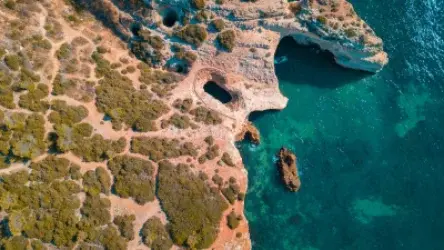
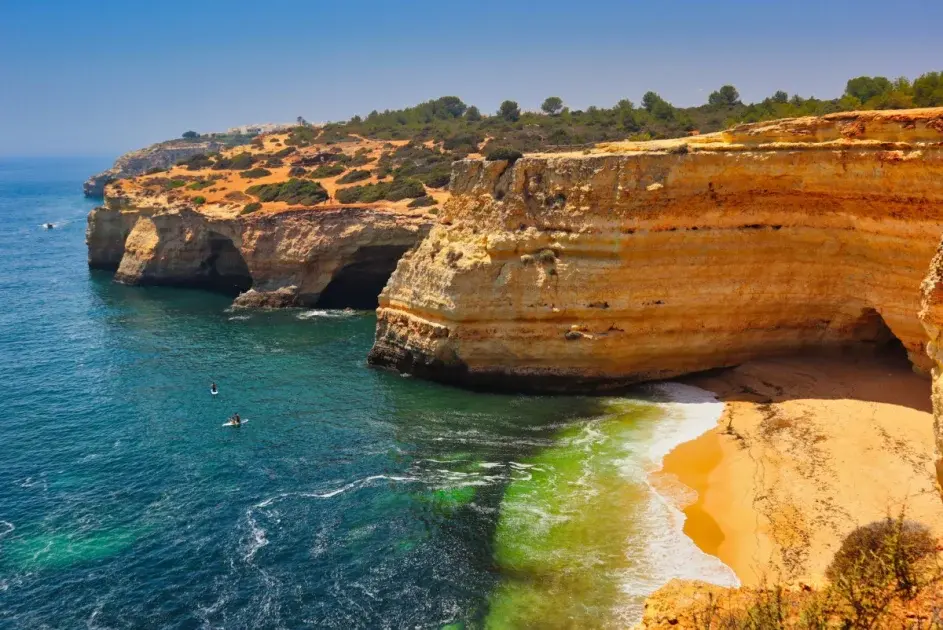
The Algarve is, without question, the most photographed region on the Portuguese coast — and for good reason. The combination of orange and ochre limestone, sea caves sculpted by the Atlantic and intense turquoise water creates compositions that rarely disappoint. But within the Algarve, certain spots stand clearly above the rest.
Praia da Marinha — The Algarve's Most Iconic Photography Spot
Praia da Marinha, in Lagoa, is consistently rated one of the most photogenic beaches in Europe. What makes it singular is the combination of natural limestone arches, rock pillars emerging from the sea, and a horseshoe beach with wooden staircase access that creates a unique descending perspective. The best photography position is the top of the western cliffs: in the late afternoon, when raking light illuminates the honey-coloured rocks and the sea takes on shades of emerald and turquoise, the result is one of the most recognisable compositions in European travel photography.
- Best time: 1.5–2 hours before sunset (side lighting on the cliffs); sunset from the top for sea reflections
- Equipment: Wide angle (16–24mm) for arches and panoramas; telephoto (70–200mm) to isolate individual rock pillars; circular polarising filter to saturate the blue of the sea
- Composition tip: Position yourself at the upper right corner of the cliffs to include both the natural arches and the access staircase in the same frame
- Access: Via the N125 road towards Benagil/Carvoeiro. Free car park at the top; 10-minute walk down
Benagil Cave — Marine Interior Photography
Benagil Cave is probably the most photographed sea cave in the world. The "oculus" in the ceiling — a circular opening that lets in a shaft of light illuminating the golden sand inside — creates an almost surreal composition that has become a visual symbol of the Algarve. The classic shot is taken from inside the cave, with the light shaft dominating the frame. Access is by boat or kayak from Praia de Benagil (200 metres away), or by SUP for the more experienced.
- Best time: 11am–1pm in summer, when the sun is highest and the light shaft is most intense and precise
- Equipment: Waterproof camera or waterproof housing essential; wide angle to capture the full interior; HDR mode if your camera supports it
- Tip: Boat trips to the Benagil caves depart from Portimão, Armação de Pêra and Lagos — from Praia de Benagil itself, kayak and SUP are the only options if you prefer not to take a motorised boat
Praia do Camilo and Praia de Dona Ana (Lagos) — Intimate Cliff Photography
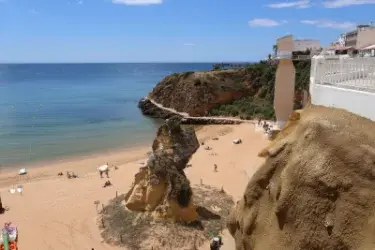
Lagos has a concentration of small beaches nestled between cliffs that create intimate, detailed compositions. Praia do Camilo, with its staircase carved from the rock, and Praia de Dona Ana, with its natural arches and rock formations, allow closer, more detailed photographs of the rocky landscape. Camilo is particularly notable in the late afternoon: the raking sunset light enters laterally into the caves and creates effects of shadow and depth that are hard to replicate elsewhere.
- Best time: One hour before sunset for Praia do Camilo; sunrise for Praia de Dona Ana (east-facing)
- Access: On foot from Lagos town centre (20 minutes) or by car with nearby parking
Costa Vicentina: Pure Atlantic Photography
If the Algarve offers the spectacle of golden cliffs, the Costa Vicentina offers something radically different: the Atlantic without filters. Kilometre-long beaches of fine sand, dark rock cliffs, perfectly formed waves, and an almost total absence of tourist infrastructure that allows photographs that seem to belong to another century. The light on the Costa Vicentina, especially on the Atlantic coast of Alentejo Litoral, has a unique quality — colder, more dramatic, with sharper contrasts than the Algarve light.
Praia do Amado — Waves and Surfers in Golden Light
Praia do Amado, in Aljezur, is the quintessential surf photography spot in Portugal. The combination of consistent waves, a wide beach with white sands, and the natural northern cliff that creates an elevated viewpoint results in surf images with a natural composition that other locations rarely offer. The northern cliff has a path leading to a viewpoint about 20 metres above beach level — from there, with a 200–400mm telephoto, it is possible to capture surfers with wave backgrounds, using the empty beach as a third compositional plane.
- Best time: Sunrise (front light on the beach) or 2 hours before sunset (side light on surfers)
- Equipment: 200–400mm telephoto for surf; wide angle for empty beach panoramas in golden hour
- Season: Autumn and winter for bigger waves; summer for softer light and calmer seas with swimmers as a visual element
Praia do Castelejo and Cordoama — Black Cliffs at the Edge of the World
Praia do Castelejo, near Vila do Bispo, and Praia da Cordoama are two of the most photogenic spots on the Costa Vicentina, with an aesthetic completely different from the southern Algarve: dark schist rock, powerful waves, and an immensity that communicates the sense of "end of Europe" in a visceral way. Long exposure photography with a tripod, capturing wave movement over black rocks at dusk, is the style that best serves these locations. For more on the beaches of this extraordinary coast, see our complete Costa Vicentina guide.
- Best time: Sunset (west-facing orientation allows direct light) and blue hour
- Equipment: Tripod essential for long exposure; ND (neutral density) filter to expose wave motion; wide angle 14–24mm
- Access: Municipal road from Vila do Bispo; free car park; 5–10 minute walk
Arrábida: Turquoise Water in the Portuguese Mediterranean
The Serra da Arrábida and its beaches represent a unique case in Portugal: the combination of a ridge covered in dense Mediterranean vegetation, white limestone cliffs, and water of a turquoise blue that looks more like the Mediterranean than the Atlantic. Arrábida produces photographs of exceptional chromatic quality — the contrast between the deep green of the vegetation, the white of the cliffs, the deep blue of the sea and the white or golden sand creates colour palettes rarely found at this latitude.
Praia de Galapinhos and Portinho da Arrábida — The Perfect Frame
Praia de Galapinhos is frequently voted the most beautiful beach in Portugal in independent rankings — and the reasons are obvious at first glance. The beach nestled between white cliffs and dark-green vegetation, with an improbably coloured sea, offers the most immediate and perfect composition in Arrábida. Portinho da Arrábida has a different perspective: the fishing village beach with its colourful boats, the historic restaurant in the background and the arching cliff allow images of an authenticity and narrative quality that conventionally photogenic beaches often lack.
- Best time: Early morning (9–11am) for front light on Galapinhos beach; late afternoon for warm light at Portinho
- Restricted access: Between 1 June and 30 September, access to Praia de Galapinhos is limited to a maximum number of people per day — book entry in advance at the ICNF website or arrive before 9am
- Drone: Arrábida is one of the highest-potential regions for aerial photography in Portugal, but is subject to airspace restrictions — always check with ANAC before flying
For the complete profile of Arrábida's beaches and how to access them, see our complete guide to the Natural Park of Arrábida.
Lisbon Coast: Sunset over the Atlantic
The Lisbon coast — from Cascais to Caparica — has a photographic advantage that no other region of Portugal offers in the same way: the combination of Lisbon's urban backdrop with Atlantic beaches facing west. The westward orientation of most beaches on this coast means sunsets are photographed over the sea, with the sun dropping directly into the ocean horizon — something that the south-facing Algarve beaches rarely permit.
Praia do Guincho — Storm and Wind in Photographic Format
Guincho is the most dramatic photography spot in the Lisbon region. The moving sand dunes, the Atlantic waves with no barrier to America, the kite-surfers with Cabo da Roca in the background, and the frequently variable light create conditions for photographs of an intensity rarely found on sandy beaches. Long exposure photography at Guincho, with waves breaking over the rocky outcrops to the north of the beach, is a classic of Portuguese landscape photography.
- Best time: Sunset (north-westward orientation) and days with high clouds at any time of day
- Tip: Strong wind days (frequent at Guincho, especially May to September) create unique light and atmospheric conditions — do not avoid the wind, photograph it
- Access: N247 road from Cascais; paid car park near the beach
For a complete guide to the beaches of this area, see our complete Cascais beaches guide.
The Azores: Volcanic Atlantic Photography
The Azores represent a completely different category of beach photography. Here there are no golden cliffs or turquoise water — there is black volcanic rock, natural lava pools, islands covered in blue hydrangeas, and an Atlantic light that changes minute by minute with passing clouds. Photography in the Azores requires patience, adaptability and a willingness to be in the right place when the light suddenly shifts — but the rewards are among the most extraordinary in European travel photography.
Natural Pools of Biscoitos (Terceira) — The Impossible Blue
The Natural Pools of Biscoitos on Terceira island are one of the most singular photography spots in Portugal. Formed by lava flows that created natural pools directly in the ocean, with black rock edges and deep, transparent blue water, they create a chromatic contrast of rare intensity. The late afternoon light, when the low sun creates golden reflections on the dark surface of the lava rock, is the most photogenic moment.
- Best time: 1–2 hours before sunset; early morning for front light with fewer visitors
- Season: July and August for calmer seas; days with more sea swell create dramatic spray over the pools but make swimming impossible
Porto Pim Beach (Faial) and the Capelinhos Lighthouse
Faial has two of the most distinctive photography spots in the Azores. Porto Pim beach, a golden sand beach nestled between two headlands with the Faial caldera behind, offers an unusual composition combining sea and volcano. The Capelinhos Lighthouse — partially buried by the 1957 volcanic eruption — is one of the most unique photography spots in Portugal: the juxtaposition of the white lighthouse against a landscape of volcanic ash, with the ocean in the background, creates images of geological narrative without parallel.
North Portugal: Schist and Granite Beaches
The beaches of Minho and Douro have a completely different aesthetic from the south: darker sands, rivers meeting the sea, historic fishing villages, and a more diffuse and less intense light that creates softer but equally valuable photographic conditions.
Praia de Moledo (Caminha) — Where the River Meets the Sea
Praia de Moledo, in Caminha, is photographically unique in Portugal: from here it is possible to frame in a single image the estuary of the River Minho, the Ínsua island with its seventeenth-century fort, the Galician coast behind with its mountains, and the open sea. It is one of the few spots in Portugal where "grand geographical narrative" photography is possible without specialist equipment — you simply need to be in the right place at the end of the day.
- Best time: End of day for warm light on the fort and river; early morning for morning mist over the estuary
- Access: Caminha town centre 3km away; ferry service to Spain (La Guardia) from the quay
Technical Tips for Beach Photography
Essential Equipment
For beach photography in Portugal, the equipment offering the best versatility includes:
- Wide angle lens (14–24mm or 16–35mm): Essential for cliffs, panoramic landscapes and cave interiors. The most-used lens on the Costa Vicentina and in the Algarve.
- Telephoto (70–200mm or 100–400mm): Indispensable for surf photography, compressing planes between distant cliffs, and photographing details of rocky formations.
- Circular polarising filter: Reduces reflections on the water surface and saturates the blue of the sea and the green of the vegetation. Effect is strongest when the sun makes a 90-degree angle to the direction of the filter.
- ND (neutral density) filter: For daytime long exposure, particularly useful on the Costa Vicentina and at Guincho to smooth wave motion.
- Lightweight carbon tripod: Essential for long exposure at sunset and in strong wind conditions.
Protecting Equipment at the Beach
Salt, sand and moisture are the enemies of photographic equipment. Fundamental practices: never change lenses on the beach — do so in a wind-protected location; use waterproof protection covers even in sunshine when there is sea spray; clean the polarising filter regularly (salt deposits reduce effectiveness); store equipment in a closed bag when not shooting; always carry a microfibre cloth to clean salt droplets from lenses.
Comparison: Best Spots by Photography Type
| Photography Type | Best Spot | Best Time | Access Difficulty |
|---|---|---|---|
| Cliffs and rock formations | Praia da Marinha (Algarve) | Sunset | Easy |
| Sea cave interior | Benagil Cave (Algarve) | 11am–1pm (zenithal light shaft) | Moderate (boat/kayak) |
| Turquoise water and white cliffs | Praia de Galapinhos (Arrábida) | Morning (9–11am) | Moderate (restricted access) |
| Surf and action | Praia do Amado (Costa Vicentina) | 2h before sunset | Easy |
| Long exposure / waves | Praia do Guincho (Cascais) | Sunset and blue hour | Easy |
| Volcanic landscape and natural pools | Biscoitos, Terceira (Azores) | Late afternoon | Moderate (flight to Azores) |
| Geographic narrative / estuary | Praia de Moledo (Caminha) | Late afternoon | Easy |
FAQ — Photography on Portugal's Beaches
What is the best beach photography spot in Portugal for beginners?
Praia da Marinha (Algarve) is the most accessible and consistently rewarding spot for photographers of all levels. Access is easy, compositions are immediate (the cliffs frame themselves), the late-day light is of exceptional quality, and parking is free. For the Lisbon region, Portinho da Arrábida offers a similar level of photogenic quality with the added authenticity of a fishing village atmosphere.
Is special permission required to photograph on protected beaches in Portugal?
For personal, non-commercial photography, no permission is required on Portuguese beaches, including protected areas (Arrábida, Costa Vicentina, Ria Formosa). For commercial use of images, authorisation from ICNF (Institute for Nature Conservation and Forests) may be required in Natural Park areas. For drone flight, prior ANAC approval and airspace verification are always required, regardless of personal or commercial purposes.
What is the best time of year to photograph Portugal's beaches?
It depends on the type of photography. May and June combine the best spring light quality with still-low crowds — ideal for landscape photography. July and August have the best golden light but more crowded beaches — for beach photography with people as an element, summer is the right season. October and November offer the best autumn light, bigger waves on the Costa Vicentina and in the Algarve, and an absence of tourists that allows iconic locations to be photographed without crowds. Winter is underrated: storms at Guincho and on the Costa Vicentina create conditions for nature photography of a dramatic quality that summer simply does not permit.
Can I use a drone to photograph beaches in Portugal?
Yes, but with important restrictions. In Portugal, drone flights (UAS) are subject to European Regulation 2019/947 and ANAC national regulation. The main restrictions for beach photography: CTR zones (air traffic control areas) require ATC authorisation; natural parks (Arrábida, Costa Vicentina, Ria Formosa) have their own ICNF restrictions; on beaches with active lifeguards, flying within 100m of crowds is generally restricted. Use the ANAC AIP app or platforms such as DroneXpert to verify airspace before each flight.
What camera settings should I use to photograph the sea in motion?
It depends on the desired effect. To freeze wave movement (action photography, surfing): shutter speed of 1/1000s or faster, aperture f/5.6–f/8, ISO as required. To smooth sea motion (silk effect on waves, long exposure): speed of 0.5s–30s (with tripod and ND filter), aperture f/11–f/16, ISO 100. To shoot in bright sunshine without an ND filter, use aperture priority mode at f/22 to achieve naturally slower speeds — but keep ISO at minimum to avoid noise.
Conclusion
Portugal is, for travel photographers, one of the most rewarding destinations in Europe — not because it has just one or two iconic landscapes, but because the variety is extraordinary: from the golden Algarve cliffs to the volcanic black of the Azores, from the impossible turquoise of Arrábida to the Atlantic drama of the Costa Vicentina, each region has its own visual language that justifies a dedicated visit.
Our final advice: wake up early. In Portugal, the difference between the morning golden hour and 9am with the sun already high is, photographically speaking, the difference between a memorable image and an ordinary one. The most photographed beaches in the world are captured before most tourists arrive — and Portugal's are no exception. Explore our Algarve beach directory and our guide to the best beaches of the Algarve to plan your next photography itinerary.