Why Sagres Is Unlike Anywhere Else in the Algarve
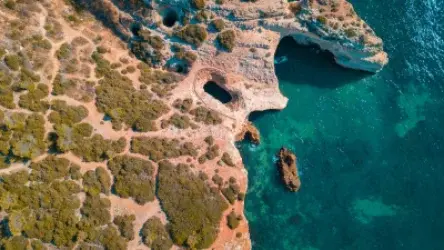
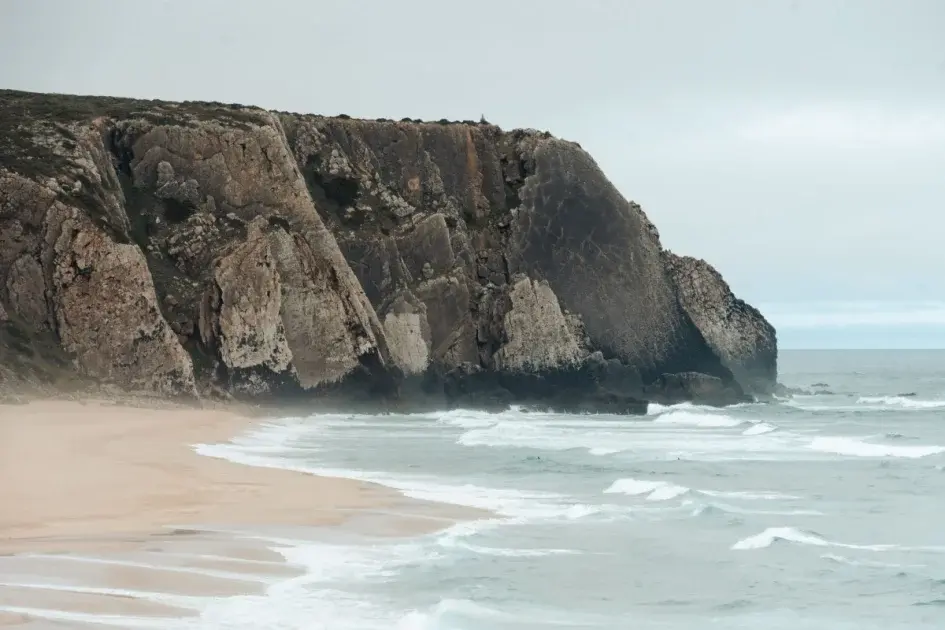
There is an invisible line that separates the resort Algarve — Albufeira, Vilamoura, Portimão — from the wild Algarve. That line runs somewhere to the west of Lagos. On the other side you find Sagres: a small, windswept village with no five-star beachfront hotels, where the landscape is dominated by cliffs darkened by salt spray, by Atlantic swells, and by a silence that surprises anyone arriving from the east.
Over several visits to Sagres — during a September surf trip, a birdwatching weekend in October, and an afternoon stop in July on the way to the Cape — we found that the village offers a completely different proposition from the classic Algarve beach resorts. There are no upgrades, no sun-lounger services at €15 a day. There are waves, wind, cliffs and a genuine sense of standing at the edge of the known world.
The phrase "where the land ends and the sea begins" — which the Portuguese associate with Camões and the epic age of Discoveries — has a real geographic referent here: Cape St. Vincent, 6 km northwest of Sagres, is the southwesternmost point of mainland Europe. Portugal's fifteenth-century navigators set out from here with incomplete maps. Today you set out with a camera and a wetsuit.
In this guide we cover everything: the four main beaches with detailed profiles, surfing (schools, seasons, levels), the Sagres Fortress, Cape St. Vincent, birdwatching (one of Portugal's most underrated experiences), how to get there from Lagos, Faro and Lisbon, where to eat and when to visit.
The Beaches of Sagres: A Beach-by-Beach Guide
Praia da Mareta — The Most Accessible for Swimming
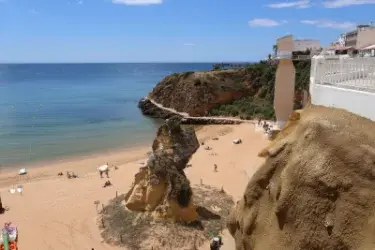
Praia da Mareta (GPS: 37.00534, -8.93948) is the closest beach to the centre of Sagres and the best option for swimming. Stretching nearly 800 metres of golden sand, it faces south and is partially sheltered from the strongest Atlantic currents by the headlands to the west. Its waters are the calmest and marginally warmer than those on the full Atlantic-facing beaches.
This is where most visitors spend their beach days in Sagres. It has a lifeguard on duty during the bathing season (June to September), a car park a five-minute walk away, a beach bar, and swimming conditions that are much more forgiving than the Atlantic beaches. Access is either on foot from the village centre in about ten minutes or by car with parking on the main road.
Best for: families, swimming, summer days, general visitors. Less suited for: surfing (small, irregular waves).
Praia do Tonel — The Heart of Sagres Surfing
Praia do Tonel lies to the west of the Sagres Fortress, facing west — which means it takes the full force of the Atlantic. It is the definitive surf beach at Sagres, with consistent waves virtually year-round and conditions that attract surfers from across Europe, particularly in autumn and winter when the northern Atlantic swell builds.
The main break is a left-hand point break that works best with a northeast wind. Recommended level: intermediate to advanced (the power of the waves and the rip currents are not suitable for beginners, especially in autumn and winter). In summer, when the swell is smaller, it can be manageable for beginner surfers accompanied by an instructor.
The beach has less infrastructure than Mareta — no permanent bar, no sun-loungers, far fewer non-surfing tourists. Access is via a path from the car park next to the Fortress.
Best for: surfing (intermediate to advanced), wave photography, crowds-free beach days. Less suited for: children, recreational swimming, heavy swell days.
Praia do Martinhal — The Most Family-Friendly
Praia do Martinhal (GPS: 37.01849, -8.92605) lies about 2 km east of Sagres in the sheltered Baleeira Bay. Facing south-southeast, it is the most protected beach in the area and the one with consistently calmest water — which makes it the best choice for families with young children. The water is almost always flat and shallow near the shore, and the beach offers a generous stretch of golden sand.
Martinhal is also home to the eponymous luxury resort (Martinhal Sagres Beach Family Resort), meaning the area has more services than the wilder beaches — a restaurant, beach bar and equipment rental. The atmosphere is quieter and more upmarket than Tonel or Mareta.
Best for: families with children, calm swimming, snorkelling, days when swell is large elsewhere. Less suited for: surfing.
Praia do Beliche — The Best-Kept Secret
Praia do Beliche (GPS: 37.02527, -8.96477) lies 3 km northwest of Sagres, tucked between 40-metre cliffs. It is arguably the most visually striking beach in the area — a small sandy cove surrounded by vertiginous cliff walls, with open ocean views and the jagged Costa Vicentina coastline as a backdrop.
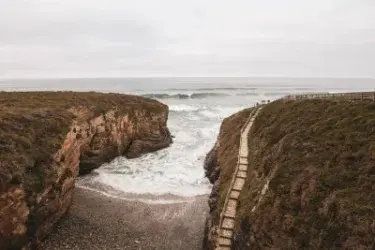
Access is on foot from the roadside car park via a steep descent of around 100 steps (and the equivalent climb back up). There are no services. That combination of difficult access and zero amenities means that even in August you can find the beach uncrowded.
The waves are suitable for intermediate surfing, and the beach has extraordinary photographic light — particularly in the late afternoon, when the setting sun illuminates the honey-coloured cliffs from the west.
Best for: photography, intermediate surfing, solitude, sunset light. Less suited for: people with limited mobility, families with very young children.
Surfing in Sagres: Schools, Camps and Seasons
Sagres has developed organically into the primary surf hub of the Algarve. While Ericeira holds the official title of Europe's only World Surfing Reserve and Peniche hosts the WSL Championship Tour, Sagres offers something different: year-round consistency and a more authentic, quieter surf culture that is less commercialised than either of its rivals to the north.
When to Surf in Sagres
Surfing in Sagres works year-round, but with distinct characteristics by season:
- Autumn (September–November): the best time. North Atlantic swells arrive with force, Tonel and Beliche are at their peak, the beaches are nearly empty of tourists, and air temperatures sit at 20–25 °C. For experienced surfers, this is the golden season.
- Winter (December–February): consistent and often powerful swell. Water around 16–17 °C (a 4/3 mm wetsuit is needed). Best suited to advanced surfers comfortable with Atlantic conditions.
- Spring (March–May): variable but frequently good conditions. A fine time to learn or improve, with fewer people than summer.
- Summer (June–August): smaller, more irregular swell, but enough for lessons and beginners. Water warmer (19–21 °C), beaches busier but still far from the saturation levels of eastern Algarve resorts.
Surf Schools and Camps in Sagres
Sagres has a solid offer of surf schools and camps:
- Sagres Natura Surf Camp: one of the most established, based in the village centre in a classic Portuguese townhouse. Combines accommodation, lessons and complementary activities (yoga, massage). Weekly packages with accommodation and surf: €450–600 per person.
- International Surf School: founded in 2001, one of the oldest in the area. Offers individual lessons (€35–45 per 2-hour session) and weekly courses. Instruction available in English, German and Portuguese.
- 360° Surf Camp: a premium option with hotel accommodation. Surf weeks with 3-star hotel from €650 per person.
- Algarve Surf School: an operator covering the full coast, with a base in Sagres. Group lessons from €35 per session.
Most schools operate from March to November. In December and January the offer shrinks, but independent instructors work year-round. Book in advance for July and August — spots sell out.
Sagres Fortress and Cape St. Vincent
Sagres Fortress (Promontório de Sagres)
The Sagres Fortress occupies the entire Sagres Promontory — a limestone platform that juts into the ocean like the prow of a vast ship. This is where, according to tradition, Prince Henry the Navigator established his School of Sagres in the fifteenth century, gathering cartographers, mathematicians and navigators to transform the art of navigation and launch the Portuguese Age of Discoveries.
The main attraction inside the fortress is the Rosa dos Ventos (Wind Rose or Stone Compass) — a vast wind compass inscribed in the ground, 43 metres in diameter, whose exact origin and date remain subjects of historical debate. There is also a small church (Igreja Nossa Senhora da Graça), an interpretive centre, and cliff-top paths with sweeping views of the ocean and coastline.
Opening hours (2026): 9:30–17:30 (October to April) / 9:30–20:00 (May to September). Last admission 30 minutes before closing.
Prices: €3 per adult; €1.50 for over-65s; free for under-12s and on Sunday and public-holiday mornings for residents in Portugal.
GPS: 37.00195, -8.94387
Cape St. Vincent — The End of the World
Six kilometres northwest of Sagres stands Cape St. Vincent — the southwesternmost point of mainland Europe. The cliffs here rise 75 metres above sea level and the view to the west is, literally, open ocean all the way to the Americas. The Cape St. Vincent Lighthouse, painted white, has been operating since 1846 with a range of 32 nautical miles — it was for decades the most powerful lighthouse in Europe.
The lighthouse grounds are free to enter during daylight hours. The interior (maritime museum with replica sixteenth-century atlas folios and navigation history) has restricted access and variable hours — confirm on-site or on the official website. The headland itself is open at all times, making it one of the finest places on the entire Algarve coast to watch the sunset: on clear days the sun drops into the ocean with black cliffs as a frame.
Getting there from Sagres centre: car — 6 km (10 minutes); Vamus bus 47 — stops at the cape (check timetables at vamus.pt); bicycle — partially flat road with some cycle paths, around 30 minutes.
GPS Cape St. Vincent: 37.02316, -8.99601
Wind warning: Cape St. Vincent is one of the windiest points in Portugal — even in August a strong breeze is common. Bring an extra layer and hold on to your hat.
Birdwatching in Sagres — An Exceptional Experience
Few visitors know that Sagres is one of the most important raptor migration watchpoints in Western Europe. Every year, between August and November, tens of thousands of birds of prey make their autumn migration through the southwestern Iberian Peninsula — and Sagres, being the southwesternmost point of mainland Portugal, acts as a natural funnel for these movements.
At Monte da Cabranosa, 5 km from Sagres centre, it is possible to observe on peak days (typically in October with a northeast wind) more than 100 Booted Eagles in a single day. Other regular species include Egyptian Vulture, Griffon Vulture, Marsh Harrier, Black Kite, Merlin and Peregrine Falcon. More than 20 different raptor species have been recorded in this area during migration.
The Birdwatching Sagres Festival typically takes place in October and includes guided visits, scientific counts and lectures — an excellent entry point for anyone wanting to understand the scale of this phenomenon. Along the coast, Cape St. Vincent is also excellent for seabirds during Atlantic winter storms.
Even without being a birdwatcher, a morning at Monte da Cabranosa in October — with vultures soaring above the cliffs and the ocean below — is one of the most surprising and completely free experiences that Sagres has to offer.
How to Get to Sagres
By Car (The Most Flexible Option)
From Lagos: 40 km via the EN125 and N268, around 40 minutes. This is the most comfortable option and the one that gives you the most freedom to explore the beaches and the Cape at your own pace.
From Faro (and Faro Airport): approximately 120 km, around 1 hour 30 minutes via the A22 (Via do Infante, toll road) and EN125. Uber from Faro: €80–110.
From Lisbon: approximately 300 km, around 3 hours via the A2 and A22. Flying to Faro and hiring a car is the most common approach for those arriving by air.
By Bus
Vamus line 47 runs from Lagos to Sagres, with eight to nine departures per day on weekdays and five at weekends. Journey time: 50–80 minutes. Price: approximately €4 each way. Main stops are Lagos (bus station), Salema, Vila do Bispo and Sagres (central square).
From Faro to Sagres by bus requires a connection in Lagos (line 57 Faro–Lagos + line 47 Lagos–Sagres). Total journey time: approximately 3 hours. The Faro–Lagos train (nine daily services, ~1 hour 45 minutes) combined with the Lagos–Sagres bus is often faster and more comfortable.
From Lisbon: there is one direct daily bus (Rede Expressos or Vamus) from Lisbon to Sagres, taking approximately 3 hours 10 to 3 hours 30 minutes.
By Bicycle (Ecovia do Litoral)
The Algarve Coastal Greenway (Ecovia do Litoral) includes the Lagos–Sagres section. It is a scenic route but technically demanding in places (tracks and unsurfaced paths). Experienced cyclists on suitable bikes (MTB or gravel) complete it in 3–4 hours.
Where to Eat in Sagres
Sagres does not have the gastronomic density of Lagos or Portimão, but what it has is quality: ultra-fresh fish and seafood caught on the Atlantic coast, and some of the best percebes (goose barnacles) in the Algarve — served in Vila do Bispo, 10 km north.
Percebes from Cape St. Vincent and the Costa Vicentina have national renown. They grow on rocks exposed to Atlantic waves, which gives them a texture and sea flavour far more intense than those from the eastern Algarve. Order them boiled, with nothing but seawater and salt — they are the regional dish par excellence.
Other dishes not to miss: fresh tuna (in August and September, when bluefin tuna pass offshore near the Cape), fish caldeirada in the Alentejo style (reflecting the proximity to Alentejo Litoral), and caracóis (snails) with beer on cooler October evenings.
Notable restaurants in and around Sagres:
- A Tasca (Sagres): small, unpretentious, with the best grilled fish in the area. Book ahead in July and August.
- Mum's (Sagres): relaxed atmosphere, good fish tapas, popular with the international surf community.
- O Dromedário (Vila do Bispo): the right place for percebes, prawns and fresh shellfish — 10 km away but worth the detour.
- Martinhal Resort Restaurant: a step up in terms of setting and service, with quality cooking and sea views. Premium prices but justified for a special meal.
Sagres vs. Lagos: How to Decide
A question many visitors ask is whether to base themselves in Lagos or Sagres — or to visit Sagres as a day trip from Lagos. Here is the summary:
- Stay in Sagres if: you surf, want wild beaches without crowds, enjoy nature and birdwatching, value authenticity and quiet, and are visiting in spring, autumn or winter.
- Stay in Lagos if: you want photogenic cliff beaches with easy access, nightlife, a wide range of restaurants, boat tours through the Ponta da Piedade caves, and are visiting in July or August.
- Day-trip to Sagres from Lagos if: you have fewer than three nights in the Algarve and want to see Cape St. Vincent and the beaches without basing yourself there.
The two are 40 km apart — an hour by bus or 40 minutes by car. They complement each other perfectly on a trip to the wilder Algarve: Lagos for the logistical base and cliff beaches, Sagres for the end of the world and the Atlantic surf. For internal links, see our complete Lagos guide and the Costa Vicentina full guide.
Frequently Asked Questions about Sagres
When is the best time to visit Sagres?
September and October are the ideal months: air temperature 20–26 °C, water still warm (~21 °C), beaches without tourist crowds, and the start of the surf and bird migration season. For peak surfing, October to November. For families with children, July and August are more comfortable in terms of water temperature and beach services.
Can you visit Sagres and Cape St. Vincent in one day from Lagos?
Yes, comfortably. Leave Lagos in the morning (bus 47 or car), spend the day in Sagres (Fortress + Mareta beach), head to Cape St. Vincent in the late afternoon for the sunset, and return to Lagos in the evening. It works well as a day trip with good time management.
Are the beaches in Sagres suitable for young children?
It depends on the beach. Praia do Martinhal is the most suitable for children — calm, shallow water. Praia da Mareta also works well on calm sea days. Avoid Praia do Tonel with young children, especially outside summer, because of the waves and currents. Cape St. Vincent requires supervision with children — the cliffs are not fenced along their full length.
Do you need a car to visit Sagres?
Not strictly, but it makes things much easier. The main beaches (Mareta, Tonel, Martinhal) are walkable or reachable by taxi/Uber from the centre. Cape St. Vincent is 6 km away — bus 47 stops there, but with limited timetables. For freedom to explore, including more remote beaches and Vila do Bispo, a car or bicycle hire is recommended.
Is surfing in Sagres suitable for beginners?
Through surf schools, yes — instructors take beginners to beaches with appropriate conditions. Praia da Mareta and, in summer, some conditions at Tonel are used for lessons. For independent surfing, at least an intermediate level is recommended, particularly in autumn and winter. Tonel on a heavy swell day is not for beginners.