Editorial note: We have personally visited this bay across several summer seasons, including 2026. Prices and schedules reflect information available in July 2026 — we recommend confirming before your visit.
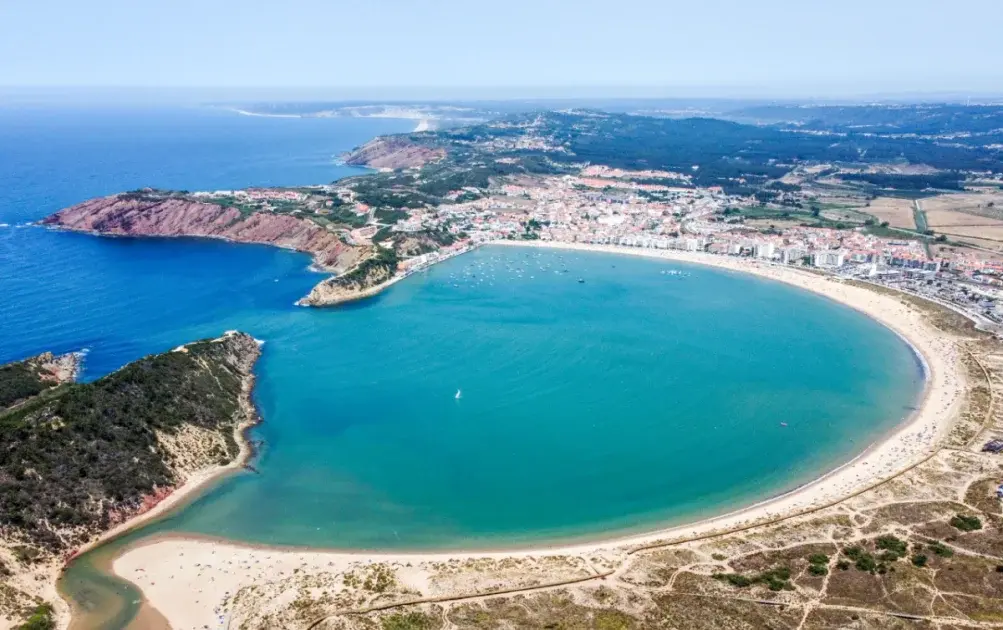
Some beaches in Portugal exist for chasing waves. Others exist for swimming without a second thought. São Martinho do Porto belongs entirely to the second category, and it is, without exaggeration, one of the safest in the country. Its shell-shaped bay, almost enclosed against the open ocean, turns a stretch of Atlantic coastline on the Costa de Prata into something closer to a saltwater lake, where small children swim without fear and inexperienced swimmers lose their apprehension of the sea. With a 2026 Blue Flag and the Accessible Beach — Beach for Everyone distinction, this is one of the few places in Portugal where calm and coastline coexist without contradiction.
In this complete guide we cover the bay of São Martinho do Porto in detail: the beaches that make it up, the water sports that its calm makes possible, the tallest sand dune in Portugal reachable via a wooden boardwalk, how to get there by train or bus, where to eat the freshest fish in the village, and why this is the right choice for anyone looking for the opposite of the giant waves at neighbouring Nazaré.
Shell-shaped bay, Alcobaça municipality, Costa de Prata
2026 Blue Flag + Accessible Beach — Beach for Everyone
Calm water, virtually no swell, average summer temperature around 19°C
Train station 2 minutes on foot from the beach (Linha do Oeste)
Ideal for: families with small children, inexperienced swimmers, SUP and kayaking
Distances: Nazaré 11.3 km / Óbidos about 20 km / Lisbon 104 km
São Martinho do Porto: A Shell-Shaped Bay
The bay of São Martinho do Porto is what remains of an ancient gulf that, until the 16th century, extended inland as far as Alfeizerão. Progressive silting closed most of that inlet, leaving behind the current almost-circular cove, connected to the Atlantic by a narrow bar roughly 250 metres wide, between the Santana headland to the south and the Farol headland to the north. It is this unusual geography — a natural amphitheatre of cliffs embracing the water on nearly every side — that makes the bay one of the most sheltered spots from wind and swell on the entire Portuguese coast.
The practical result is water with almost no waves, even when the open sea just a few minutes away is churned up. In summer the average temperature hovers around 19°C, slightly above the Costa de Prata average, because the bay warms faster than the open ocean and cold-water circulation is slower here. When the nortada — the typical Portuguese summer north wind — blows hard in July and August, São Martinho do Porto stays calm, shielded by the cliffs that surround it.
Why It Is Considered One of the Safest Beaches in Portugal
The combination of factors is rare: almost no swell, a gently sloping seabed (the water deepens slowly, without abrupt drop-offs), natural shelter from the wind, and lifeguards on duty during the bathing season. It is little surprise that paediatricians and swimming instructors often recommend it as the ideal place for a child's first real experience of the sea. The Alcobaça municipal council reinforces this reputation with the Accessible Beach — Beach for Everyone distinction, certifying adapted access for people with reduced mobility.
The Beaches of the Bay
Although best known for its main beach, the bay of São Martinho do Porto is actually made up of several distinct zones, linked by foot or by short drives.
Praia de São Martinho do Porto
GPS: 39.5085, -9.1350. The main beach occupies the entire waterfront of the village, with a long stretch of sand running alongside a promenade lined with terraces, restaurants and shops. It holds a Blue Flag in 2026 and the Accessible Beach — Beach for Everyone distinction. During the bathing season (typically June to September) it has lifeguards, a first-aid post, toilets, showers, a children's playground, and sunbed and umbrella rental. Parking along the promenade is paid and limited in August — arriving after 11h in peak summer usually means struggling to find a spot near the beach, so it is worth using the car parks slightly further from the centre and walking about 10 minutes.
Praia de Salir do Porto
Salir do Porto beach sits on the opposite side of the bar, already within the neighbouring municipality of Caldas da Rainha, and connects to São Martinho do Porto via a wooden boardwalk crossing the salt marsh that separates the two shores. This is where Portugal's tallest sand dune stands, at roughly 50 metres — an impressive dune ridge separating the bay from the open ocean, well worth the climb for the panoramic view over the entire cove alone. The atmosphere at Salir do Porto is wilder and less developed than at the main beach, which appeals to those seeking quiet without straying far from the centre.
Praia da Legoa and the Gralha Area
For those wanting to escape summer crowds entirely, the Alcobaça municipality has smaller, lesser-known beaches on the fringes of the bay and along the nearby coast, such as the Legoa and Gralha areas, usually frequented by people who know the region well. These make good alternatives for a quiet picnic, though without the full infrastructure of the main beach.
Water Sports in Portugal's Calmest Bay
The absence of waves that makes São Martinho do Porto a haven for families also makes it perfect for anyone looking to try water sports without the challenge of open Atlantic swell. The Clube Náutico de São Martinho do Porto (CNSMP) is the local reference point, offering kayak and stand-up paddleboard (SUP) rental plus support for light sailing, with lessons for beginners and equipment for more experienced visitors. Kayak rentals commonly carry a minimum usage time of around three hours, which encourages a full exploration of the bay rather than a quick loop.
From Salir do Porto, small guided kayak tours also depart by prior booking, timed with the tide to explore the salt marsh and inner channels of the bay — a different way to experience the landscape, among wading birds and cliff reflections on still water. For those wanting more wind, the Escola de Vela da Lagoa at the nearby Óbidos Lagoon offers kitesurfing, windsurfing and sailing in very different conditions from São Martinho — worth combining both destinations in the same trip if staying in the region.
Beyond the Beach: A Giant Dune, Trails and Heritage
The Salir do Porto Dune
Already mentioned above, the Salir do Porto dune — Portugal's tallest at roughly 50 metres — deserves its own mention as a standalone point of interest. The climb follows a well-marked sand path and rewards visitors with one of the best free aerial views on the entire Costa de Prata: the open ocean on one side, the whole shell-shaped bay on the other.
PR3 ACB Trail — São Martinho do Porto, Serra e Mar
The Alcobaça municipal council has waymarked the PR3 ACB walking route, named "São Martinho do Porto, Serra e Mar" ("mountains and sea"), linking the seaside village to the nearby slopes of the Serra dos Candeeiros, combining coastal and rural scenery in a single trail. It is a good option for a day of moderate walking without straying far from the bay.
Birdwatching in the Bay
The salt marsh and channels between São Martinho do Porto and Salir do Porto are a regular habitat for wading and water birds, especially outside peak season, when low tide exposes feeding grounds rich in small invertebrates. It is a growing point of interest for birdwatchers visiting the Costa de Prata.
Alcobaça Monastery and Óbidos: Day Trips
About 10 km away lies Alcobaça, the municipal seat, home to the imposing Alcobaça Monastery, a UNESCO World Heritage Site since 1989 and one of the finest examples of Cistercian Gothic architecture in Europe. About 20 km away, the walled medieval town of Óbidos — with its castle, cobbled streets, and the nearby Óbidos Lagoon — completes a two-to-three-day itinerary around the region, combining beach, history and nature without long drives.
How to Get to São Martinho do Porto
By Train
São Martinho do Porto railway station, on the Linha do Oeste (CP regional and inter-regional trains), sits about two minutes on foot from the main beach — one of the most convenient rail connections of any beach in Portugal. It is an excellent option for travellers without a car coming from Lisbon, usually with a change at Caldas da Rainha.
By Bus
Rede Expressos operates direct connections between the Sete Rios bus terminal in Lisbon and São Martinho do Porto, with departures roughly every two hours and a journey time of about 1h30.
By Car
Via the A8 motorway, the distance from Lisbon is about 104 km, with an estimated travel time of 1h10 to 1h20 depending on traffic. Access runs directly into the village centre, but in August it is worth arriving early given the limited parking along the promenade.
Distances to Nearby Destinations
Nazaré is about 11.3 km away, reachable by local bus in roughly 20 minutes or a 15-minute drive. Óbidos is about 20 km away. Caldas da Rainha, where the Linha do Oeste connecting train station is located, is about 10 km away.
Where to Eat in São Martinho do Porto
The promenade and the streets of the village centre concentrate a good selection of fish and seafood restaurants, most with views over the bay. Prices below are approximate and may vary by season.
Pesca no Prato
On Rua Cândido dos Reis, this is a reference point for freshly grilled fish over charcoal, with sea bass a highlight, alongside starters like clams in garlic and white wine sauce. Average price: 20 to 35 euros per person.
Boca do Mar
A restaurant with a direct view over the beach, a more polished setting, and standout dishes such as grilled octopus and fried ray with roe açorda. Average price: 25 to 40 euros per person.
Nova Caravela
A traditional seafood and fish house with good value for money and a central location in the village. Average price: 18 to 30 euros per person.
Taberna Marginal
A modern, welcoming setting with bay views, a more informal format of small plates and tapas — a good choice for a light dinner in the late afternoon. Average price: 15 to 25 euros per person.
When to Visit: Monthly Table
| Month | Air Temp (°C) | Sea Temp (°C) | Crowds | Recommendation |
|---|---|---|---|---|
| January | 14 | 14 | Very low | Dune walks and total quiet |
| February | 15 | 14 | Very low | Walks along the Salir do Porto boardwalk |
| March | 17 | 15 | Low | PR3 ACB trail in good weather |
| April | 19 | 16 | Medium | Easter, good value for money |
| May | 21 | 17 | Medium | Water already pleasant, beach uncrowded |
| June | 24 | 18 | High | Bathing season begins, lifeguards on duty |
| July | 26 | 19 | Very high | Best month for water sports |
| August | 27 | 19 | Peak | Arrive early, limited parking |
| September | 25 | 19 | High | Best month: warm water, fewer crowds |
| October | 22 | 18 | Low | Still pleasant for kayaking |
| November | 18 | 16 | Very low | Autumn walks and gastronomy |
| December | 15 | 15 | Very low | Quiet Christmas on the Costa de Prata |
Our advice: September combines the best of both worlds, with the water already warmed by a full summer of sun and a much calmer village than in August. June is also worthwhile, with lower accommodation prices and the bay already in full bathing season.
São Martinho do Porto vs. Nazaré vs. Foz do Arelho — Which to Choose?
These three beaches sit just a few kilometres apart on the Costa de Prata, yet offer almost opposite experiences. It is worth understanding the differences before deciding where to base yourself.
| Criterion | São Martinho do Porto | Nazaré | Foz do Arelho |
|---|---|---|---|
| Swell | Virtually none (enclosed bay) | World-class giant waves | Ocean swell + calm lagoon |
| Best for | Families, small children, beginners | Experienced surfers, wave spectators | Kitesurfers and mixed families |
| Standout activity | Worry-free swimming | Watching or surfing giant waves (off-season) | Kitesurfing on flat water |
| Distance apart | — | 11.3 km from São Martinho | About 25 km from São Martinho |
| Atmosphere | Quiet seaside village | Lively fishing town | Coastal residential area |
Frequently Asked Questions About São Martinho do Porto
What is the best time to visit São Martinho do Porto?
September is the most balanced month, with the bay water already warmed by the summer (around 19°C) and the village considerably calmer than in August. June is also a good option, with lower accommodation prices and the bathing season already underway.
Is São Martinho do Porto safe for small children?
Yes. The bay's enclosed shape virtually eliminates swell, the seabed slopes very gently, and lifeguards are on duty during the bathing season. It is frequently cited as one of the safest beaches in Portugal for a child's first experience of the sea.
How do you get to São Martinho do Porto without a car?
The most practical option is the train on the Linha do Oeste, with the station just two minutes on foot from the beach. Alternatively, Rede Expressos connects the Sete Rios terminal in Lisbon to São Martinho do Porto in about 1h30, with departures every two hours.
What is Praia de Salir do Porto and how do you get there?
It is the beach on the opposite side of the bay's bar, within the Caldas da Rainha municipality, connected to São Martinho do Porto by a wooden boardwalk over the salt marsh. It is the starting point for climbing Portugal's tallest sand dune, at around 50 metres.
Can you kayak or paddleboard in the bay?
Yes, it is one of the best beaches in Portugal for beginners in these sports, precisely because of the lack of waves. The Clube Náutico de São Martinho do Porto rents equipment and runs lessons, typically with a minimum kayak rental time of around three hours.
Conclusion — The Bay Everyone Should Know
São Martinho do Porto does not try to compete with the giant waves of Nazaré or the nightlife of the Algarve — and that is precisely its strength. It is a beach designed for anyone who wants to walk straight into the sea without hesitation, for families seeking quiet without giving up good infrastructure, and for anyone who likes to end a day of kayaking with a plate of fresh fish on the promenade. Combined with the giant dune at Salir do Porto and the proximity of Alcobaça Monastery and the medieval town of Óbidos, this bay deserves a prominent place on any Costa de Prata itinerary.
To keep planning your trip around the region, also see our complete guide to Nazaré, our Óbidos Lagoon guide, our one-day itinerary around Óbidos and the lagoon, and our general guide to Central Portugal beaches.