Beaches with Natural Shade in Portugal: Where to Escape the Direct Sun in Summer 2026
It's mid-afternoon, the rented parasol barely covers anyone anymore, and the thermometer keeps climbing — anyone who has spent time in Portugal this year knows the feeling. Between February and July 2026, the country has already gone through six separate heatwaves, and the most recent one pushed highs to 43-44°C in the Alentejo and Tagus Valley, with the coast far from spared: Leiria, Aveiro, Porto, Braga and Setúbal all sat under IPMA red alerts. On days like these, a few hours under a rented umbrella simply doesn't cut it anymore. Having covered dozens of maritime and river beaches across this country over the years for this site, one pattern keeps repeating: beaches with genuine natural shade — centuries-old pine forests, limestone cliffs, wooded hillsides or tree-lined riverbanks — are consistently cooler, more comfortable for children and older visitors, and safer on days of extreme heat. This guide rounds up, region by region, where to find that real shade in Portugal, without relying on sunscreen alone.
Why Look for Physical Shade Beyond Sunscreen
IPMA's UV Index and picking the right SPF are essential, but they only solve part of the problem — they don't lower the temperature you actually feel, nor reduce the physical toll of six or seven straight hours in direct sun on the sand. On orange or red alert days, the temperature difference under a mature pine forest or a cliff can reach 5-8°C compared to exposed sand, and the perceived heat drops even further thanks to air movement between trees or along rock faces. For young children, pregnant women, older adults and people with cardiovascular conditions — groups the Portuguese Institute for Sea and Atmosphere (IPMA) flags as most vulnerable during heatwaves — natural shade isn't just comfort, it's prevention.
Natural shade also has one advantage a rented parasol doesn't: it doesn't need booking and doesn't move with the tide. A mature pine forest or a cliff face provides roughly the same protection at 10am and at 5pm, which rarely holds true for a fixed beach umbrella, whose shadow rotates throughout the day.
Leiria Pine Forest: Portugal's Biggest Natural Parasol
Between Marinha Grande and Figueira da Foz stretches one of Europe's largest coastal pine forests — the Pinhal de Leiria, also known as the King's Pine Forest, traditionally credited to King Dinis in the 13th century, planted specifically to stabilise the dunes and shield inland farmland. Seven centuries later, the result is an almost unbroken band of maritime pines reaching nearly to the dunes at several points along the coast, creating pockets of shade just metres from the sand.
Where to stop and how to use it
In São Pedro de Moel, the pine forest drops almost to the boardwalk beside the beach, and the "Volta dos Sete" walking trail winds through roughly 7km of shaded woodland past springs and viewpoints — a great way to break up beach hours with a cool walk instead of forced downtime under an umbrella. Further south, in Vieira de Leiria and Praia de Pedrógão, the same forest offers shaded picnic areas a short walk from the surf, popular with families precisely because they let you switch between water and shade without a long trek. Continuing south to Mira, the Mira Dunes National Forest runs along the coast with the same effect. Free parking is usually available near the forest entrances at all these beaches, though spots fill fast on red-alert days — arriving before 10am is the safest bet for both shade and parking.
Serra da Arrábida: Hillside Shade Over the Sea
In Setúbal district, Arrábida Natural Park offers a landscape rare in Portugal: a Mediterranean scrub-covered mountain range that drops almost straight down to small coves of turquoise water. Beaches such as Galapinhos and Galapos, often ranked among Europe's most beautiful, sit right against this forested slope, meaning wide stretches of sand fall into hillside shade from early afternoon onward — unlike fully exposed beaches, where the sun beats down all day without interruption. Even the walk down from the car parks cuts through dense woodland, reducing sun exposure before you even reach the sand.
This combination of hillside shade and cooler water (sheltered from the warm inland wind that sometimes blows through the area) makes Arrábida a particularly sound choice on red-alert days, especially for anyone travelling with children or older relatives who wants to avoid Algarve or Costa da Caparica beaches at peak heat.
River Beaches: Guaranteed Shade from Wooded Banks
If there's one structural advantage Portugal's river beaches have over most maritime beaches, it's this: nearly all of them have riparian vegetation — alders, willows, ash trees — growing right at the water's edge, guaranteeing natural shade over at least part of the sand or access platforms throughout the day. This is especially clear at the river beaches of Gerês, the Alva river, the Mondego and the Douro, where cold spring-fed or river water combines with dense tree canopy to create a microclimate several degrees below what's recorded on ocean beaches on the same day.
For anyone living inland, or wanting to escape the heat without facing coastal traffic on peak days, this is often the most effective — and literally coolest — option during a heatwave. It's worth checking access conditions and water quality beforehand, since not every river beach has a permanent lifeguard.
Algarve and Costa da Caparica Cliffs: Shade from Mid-Afternoon
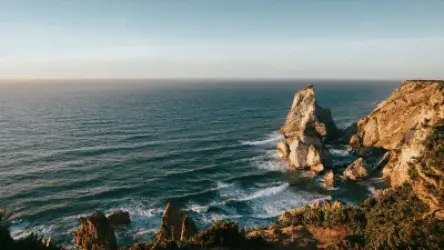
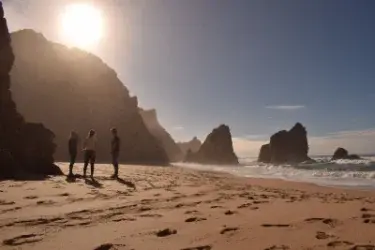
In the Algarve, the limestone geology that makes beaches like Marinha or Carvoeiro so photogenic also has a practical upside: tall, jagged cliffs cast shade over stretches of sand as the sun moves west, usually from mid-afternoon onward. On south-facing beaches with cliffs to the east, you can often find rock shade as early as 3-4pm, even in the middle of August. The same effect happens along several stretches of Costa da Caparica, where the Arriba Fóssil — the ancient, now-inland and vegetation-covered coastline — shades part of the beach in the late afternoon at spots like Fonte da Telha.
The practical rule is simple: look for the side of the beach facing the nearest cliff's eastern side rather than its western side — that's where shade arrives earliest and lasts longest until sunset.
Best Practices for Using Natural Shade Safely
Natural shade doesn't replace the usual precautions, and these locations come with specific rules of their own. Never camp, pitch fixed tents or light fires inside pine forests or protected woodland — most of these areas are managed by ICNF (Portugal's forest and nature institute) and subject to strict restrictions, especially during fire-risk season (typically June to September). Avoid trampling or damaging dune vegetation and shrubs near cliffs, since they stabilise the ground and prevent coastal erosion. On river beaches, always respect depth and current signage — tree shade doesn't necessarily mean calmer water. And even in the shade, keep applying sunscreen and drinking water regularly: UV radiation reflected off sand and water still reaches your skin even without direct sun exposure.
Frequently Asked Questions
Which beach has the most natural shade in Portugal? The Leiria Pine Forest, between São Pedro de Moel and Vieira de Leiria, is generally considered the largest continuous stretch of natural shade next to the sea in Portugal, thanks to centuries-old pines reaching almost to the dunes.
Are river beaches always cooler than sea beaches? Not always, but most offer more consistent shade throughout the day thanks to riverbank vegetation, plus spring-fed or river water that tends to run cooler than the sea on extreme-heat days, depending on the region and season.
Can I pitch a tent or awning inside the pine forest for extra shade? No — camping, fixed structures and open fires are not allowed inside protected pine forest areas managed by ICNF, particularly during the critical fire-risk period between June and September, and fines can be substantial.
Does cliff shade in the Algarve last all day? Usually not — cliffs mostly cast shade from early to mid-afternoon onward, depending on the beach's orientation, so most of the sand remains in direct sun during the morning.
Do I still need sunscreen if I'm sitting in the shade? Yes. UV radiation reflects off sand and water and still reaches your skin even in the shade, so sunscreen and proper hydration remain essential even outside direct sunlight.
Conclusion
With Portugal racking up increasingly frequent heatwaves in 2026, choosing a beach with genuine natural shade — whether it's the centuries-old Leiria pine forest, Arrábida's wooded hillside, an Algarve cliff or a tree-lined river bank — can be the difference between a pleasant beach day and an uncomfortable, even risky afternoon, especially for children and older visitors. Pair these choices with the precautions covered in our sun protection and UV Index guide, check out our article on the coolest beaches and river beaches during heatwaves, and discover more about the forest that runs down to the sea in our Arrábida beaches guide. For the Leiria area, our Central Portugal beaches guide helps you plan your visit to the pine forest.