Tavira: The Venice of the Algarve
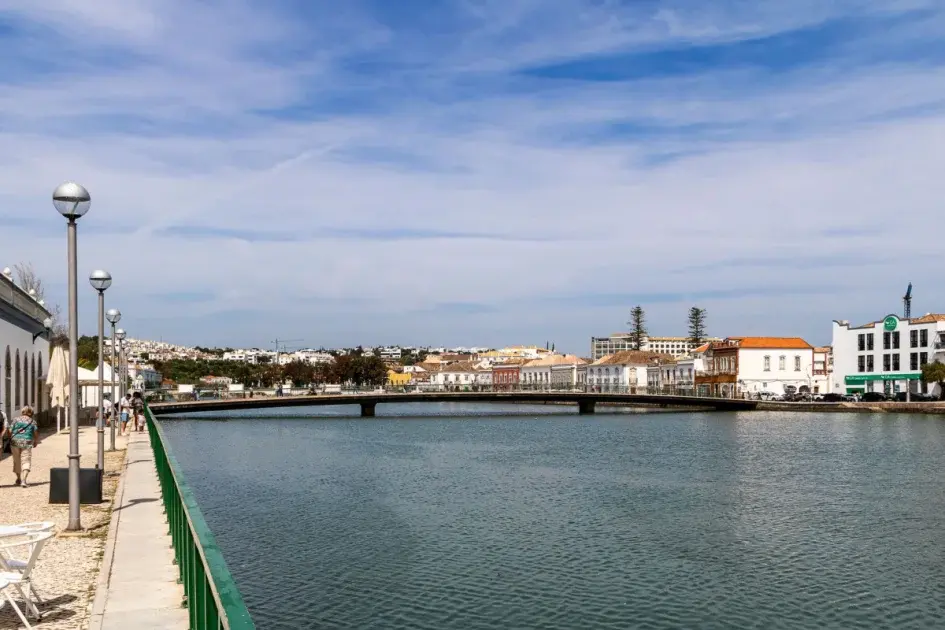
Over many years of exploring Portugal's southern coastline, we have returned to Tavira more often than to any other Algarve town — and always with the same sense of relief that it has not changed. While the western Algarve grew upward with resort towers and theme parks, Tavira stayed horizontal: whitewashed walls, cobblestone streets, pyramid-roofed houses in the Moorish tradition, orange trees scenting narrow lanes, and the River Gilão splitting the old town from the new in a series of mirror reflections.
The "Venice of the Algarve" label is not a travel-brochure exaggeration. The town is genuinely bisected by water, has centuries-old bridges, fishing boats moored at the quay, and a compact historic centre that walks in under an hour — but rewards two or three days when combined with the Ria Formosa barrier islands offshore.
This guide covers everything you need to plan your visit: the four beaches of Tavira with full access details, what to see in the historic centre, how to visit Santa Luzia and Cacela Velha, where to eat, how to get there, and practical tips for every season.
The Beaches of Tavira: Four Barrier Islands on the Ria Formosa
Tavira's beaches are not on the mainland — they sit on sand-dune barrier islands that form the natural wall between the Ria Formosa lagoon and the open Atlantic. Reaching them always requires a short boat crossing, which, far from being inconvenient, is part of the experience. The five-minute ferry glide across blue-green lagoon water, with grey herons stalking the shallows and flocks of flamingos pinking the horizon in winter months, is a journey worth making slowly.
Praia de Tavira (Ilha de Tavira) — The Main Beach
| Detail | Information |
|---|---|
| GPS (Quatro Águas pier) | 37.1216, -7.6472 |
| Ferry (Quatro Águas) | €1.70 adult return / €0.90 child — year-round |
| Ferry (Tavira town centre) | €2.20 adult return — March to October |
| Crossing time | under 10 minutes |
| Beach length | ~11 km of coastline on the island |
| Lifeguard | June to September |
| Blue Flag 2026 | Yes |
Praia de Tavira is the most popular and best-equipped of the island's beaches — and with good reason. The wide sandy shore runs for kilometres in both directions, the Ria Formosa lagoon side offers calm, shallow water perfect for families with young children, and the Atlantic-facing side provides enough wave energy for bodyboarders. Facilities include beach bars and restaurants, toilets, sunbed and parasol hire, and a beach volleyball net. Even at peak August, the island's scale means it rarely feels as packed as the big resort beaches further west.
The Quatro Águas pier (Estrada das 4 Águas, a 20-minute walk from the town centre or 5 minutes by car, with a free car park) operates year-round. From March to October, a second departure point operates from the town centre on Rua José Pires Padinha, next to the Mercado da Ribeira.
Praia do Barril — The Anchor Cemetery Beach
| Detail | Information |
|---|---|
| GPS (Pedras d'El Rei departure) | 37.1183, -7.6833 |
| Access | tourist train (€1.50 return) or 15-min walk across boardwalk from Pedras d'El Rei |
| Beach length | ~2 km of sand |
| Highlights | Cemitério das Âncoras (Anchor Cemetery), old tuna canning factory |
| Lifeguard | June to September |
| Blue Flag 2026 | Yes |
Praia do Barril has a distinction no other beach in Portugal can claim: visitors arrive to find over a hundred rusted anchors driven into the sand — the famous Cemitério das Âncoras (Anchor Cemetery). These anchors belonged to the tuna-fishing operations that worked these waters until the 1960s, when shifting migration patterns made the fishery unviable. The adjacent canning factory still stands, partially preserved as a testament to the industry that once fed the regional economy for centuries.
The beach itself is beautiful and considerably quieter than Praia de Tavira, with its own beach bars and restaurants on the sand. Access is from the Pedras d'El Rei development, where a charming little tourist train crosses the raised boardwalk over the lagoon. Alternatively, the 15-minute walk along the wooden boardwalk is a pleasure in itself, with uninterrupted views across the shallows to the salt marshes beyond.
Praia da Terra Estreita — The Hidden Middle Beach
Tucked between Praia de Tavira and Praia do Barril, Terra Estreita is Tavira's best-kept beach secret. At its narrowest points, a swimmer can look east to the open Atlantic and west to the calm lagoon simultaneously — the island is barely wider than the beach at this section. Access requires either a walk from one of the neighbouring beaches or a water taxi, which is precisely why it remains uncrowded even in August. Facilities are minimal: one informal bar and sunbed hire. The water is glassy and still on the lagoon side. The seasonal ferry from Santa Luzia (June to October) serves this beach.
Praia de Cabanas de Tavira
| Detail | Information |
|---|---|
| GPS (Cabanas pier) | 37.1502, -7.5886 |
| Ferry | irregular fishing boats, April to October, ~€2–3 return, ~5 min |
| Beach length | 7 km of continuous sand |
| Best for | families, long walks, quiet atmosphere |
| Blue Flag 2026 | Yes |
Cabanas de Tavira lies around 10 km east of Tavira town along the N125 and has its own distinct character: quieter, more local, with a picturesque waterfront of colourful fishermen's houses. The barrier island here is so narrow that, at some points, you can stand on the beach and see ocean on one side and lagoon on the other. With 7 km of sand that almost never fills up even in peak summer, it is the ideal choice for those who want space and silence. The small village has good fish restaurants along the quay, generally priced more reasonably than those in Tavira centre.
The Historic Centre: What to See in Tavira
Tavira is, above all, a town to explore on foot. The historic centre is compact — most points of interest lie within a 15-minute walk of the Roman Bridge — and the mix of Moorish, Renaissance, and Baroque architecture creates a visual richness rare in the rest of the Algarve.
The Roman Bridge (Ponte Romana)
The seven-arched Roman Bridge spanning the River Gilão is Tavira's most photographed landmark. The structure most likely dates to the Islamic period (9th–13th centuries), though its foundations may be older. Today it carries pedestrians only, and the riverbanks on both sides are lined with café terraces — the ideal spot for a late-afternoon coffee while the light turns gold on the water.
Tavira Castle (Castelo de Tavira)
Tavira Castle, of Moorish origin, played a central role in the 13th-century Christian Reconquista. What justifies the climb to the battlements today is the panoramic view over Tavira's characteristic pyramid-shaped rooftops (a Moorish architectural survival unique to this region), the River Gilão below, the Ria Formosa in the middle distance, and, on clear days, the barrier islands on the horizon. Entry is free; summer opening hours are 10:00–19:00.
Igreja da Misericórdia
Considered the finest Renaissance church in the Algarve, the Igreja da Misericórdia was built between 1541 and 1551. Its interior is a breathtaking expanse of 18th-century blue-and-white azulejo tiles covering walls from floor to ceiling, depicting scenes from the Life of Christ. The calm inside contrasts markedly with the buzz of Praça da República just outside. Entry costs a symbolic fee.
Praça da República
The heart of Tavira is Praça da República, a wide square ringed by café terraces and an open-air amphitheatre where concerts and events take place in summer. This is where locals have their morning coffee and where a visitor quickly realises that Tavira is not merely a tourist destination but a living city that moves at its own pace.
Mercado da Ribeira
The Mercado da Ribeira, by the central quay, is the best place in Tavira to buy fresh fish, regional cheeses, almonds, dried figs, rosemary honey and artisanal products. It opens early morning and closes by early afternoon. A visit before breakfast is, for many regulars, the best possible start to a day in Tavira.
Santa Luzia: The Octopus Capital
Just 3 km west of Tavira (following the Ria Formosa shoreline), the fishing village of Santa Luzia is a mandatory stop for any food-minded visitor. The title of "octopus capital" is entirely literal: the polveiros of Santa Luzia specialise in catching octopus using clay pots called covos — a technique that has remained virtually unchanged for centuries. At the quay on a late morning, fishermen can be seen unloading their night's catch, and the smell of grilled octopus drifts out from the restaurants long before noon.
The restaurants serve octopus in ways rarely found elsewhere in Portugal: polvo à lagareiro (oven-roasted with olive oil and smashed potatoes), grilled octopus, polvo frito em manteiga de porco (fried in lard), açorda de polvo (octopus bread soup), and, for the adventurous, raw marinated octopus. Mains run €12–18 at the more traditional spots.
The two reference restaurants are Casa do Polvo Tasquinha (home-style cooking, 15+ octopus preparations, lunch only) and Polvo e Companhia (contemporary fusion, ideal for dinner). Reservations are strongly advised in July and August — Santa Luzia's reputation has travelled well beyond the region.
Cacela Velha: The Village Suspended in Time
Twelve kilometres east of Tavira along the N125 (towards Vila Real de Santo António), Cacela Velha is one of the most photogenic and least altered villages in the entire Algarve. Its historic core — a handful of whitewashed houses, an 18th-century church, a small fort perched on a clifftop, and a lane of bougainvillea — hangs over the Ria Formosa as though time stopped here in the 18th century.
To reach the beach (Praia de Cacela Velha), walk to Sítio da Fábrica, about 1 km from the historic centre, where small fishing boats ferry visitors across the shallow lagoon for €1.50 return. The crossing takes under five minutes. The beach has a minimal bar but no tourist infrastructure — and that is precisely what makes it special. Water temperatures here are among the warmest in the entire Algarve: the lagoon acts as a natural heat accumulator, reaching 24–26 °C in August.
Note: Cacela Velha is also covered in our complete guide to VRSA and the eastern Sotavento corridor.
Kayaking and Birdwatching on the Ria Formosa
The Ria Formosa is the ecological heart of Tavira. This 18,000-hectare lagoon system (Ramsar Convention, Natura 2000, UNESCO Biosphere Reserve) supports over 200 bird species, including greater flamingos (visible in flocks of 50 to 300 between October and March), black-winged stilts, grey herons, little egrets, and the purple swamphen, the park's symbol. The red-crested pochard (Netta rufina) makes one of its rare Portuguese appearances here.
The best way to explore the lagoon is by kayak or canoe. Several local operators offer hourly hire (€10–15/hour) and guided half-day tours (€35–55 per person) that stop at sandbanks, oyster beds, and birdwatching viewpoints over nesting colonies. For specialist birdwatching, the CEAM environmental education centre (10 km west of Olhão along the EN125) offers free or low-cost guided walks through the lagoon edge.
The beaches of Tavira sit within the Ria Formosa Natural Park: the same conservation rules apply throughout — pack out all waste, do not disturb dune nesting areas (especially the Kentish plover, which nests on open sand between April and July), and stay clear of the dune vegetation lines.
Where to Eat in Tavira
Tavira has one of the best ratios of good restaurants to population of any Algarve town, and prices are generally more accessible than in Lagos, Albufeira or Portimão. Fish and shellfish dominate every menu — the lagoon is literally at the door.
Recommended Restaurants
- A Ver Tavira — rooftop terrace with town and river views, grilled fish, cataplana de marisco. Average €25–40. Reserve in July/August.
- Quatro Águas — right at the ferry pier, specialising in fresh grilled fish and razor clam rice with Ria Formosa views. Average €20–35.
- Casa do Polvo Tasquinha (Santa Luzia) — octopus in 15 preparations from €12. Lunch only.
- Polvo e Companhia (Santa Luzia) — contemporary octopus fusion. Mains €18–28.
- Tasca do Prego — neighbourhood tasca, peanuts, petiscos, snails, steak sandwich. Inexpensive and authentic.
- Mercado da Ribeira (morning only) — fresh fish, almonds, dried figs, rosemary honey, regional products at producer prices.
Signature Dishes of Tavira
- Polvo à lagareiro — oven-roasted octopus with olive oil, garlic and smashed potatoes, the signature dish of Santa Luzia
- Cataplana de peixe e marisco da Ria Formosa — clams, razor clams, prawns and white fish cooked in a copper cataplana
- Arroz de lingueirão — soupy razor clam rice, one of the region's least-known specialities outside the area
- Figo e amêndoa sweets — traditional Algarve confectionery made with figs and almonds; the market sells the best artisanal versions
How to Get to Tavira
By Plane
The nearest airport is Faro Airport (FAO), approximately 35 km / 30 minutes by car. From the airport you can take the CP regional train (Algarve line) directly to Tavira — the journey takes around 40 minutes and costs approximately €3.80. A taxi or private transfer from Faro airport to Tavira costs €35–50.
From Lisbon
The most comfortable option is by train: Alfa Pendular from Lisboa Oriente to Faro (2h30–2h45, €22.45–€28) + regional train from Faro to Tavira (~30 min, €2.85). Total journey time: 3h45 to 4h30 depending on the connection. Total fares start from €23.30 (IC + regional) or €24.65 (Alfa Pendular + regional).
By bus: Rede Expressos operates direct services from Lisbon (Sete Rios / Oriente) to Tavira in 3h55–4h40, from €22 (frequent online discounts available at rede-expressos.pt). Tavira's bus station is a 10-minute walk from the historic centre.
By car: A2 + A22 (Via do Infante). Lisbon–Tavira: ~300 km, ~3h, tolls ~€25–30.
From Faro
Regional CP train (Algarve line): Faro to Tavira in ~30 minutes, €2.85, approximately hourly service. Tavira train station is a 10-minute walk south of the Roman Bridge, on the edge of the historic centre.
When to Visit Tavira
| Season | Pros | Cons |
|---|---|---|
| June | Great beaches, moderate crowds, all ferries running | May still be cool at night |
| July / August | Maximum sun, warm water (22–25 °C), evening atmosphere | Highest crowds and prices; book well ahead |
| September | Excellent beaches, fewer people, prices falling, gastronomy at its best | Ferries reduce from October |
| October / November | Flamingos arrive on the Ria Formosa, authentic town life, low prices | Beaches closed, fewer ferries |
| December – February | Christmas market, Carnival, zero tourist crowds | Beaches closed, some restaurants shut |
| March – May | Almond and orange blossom, beautiful spring light, low prices | Ferries on reduced schedule, water still cold |
Frequently Asked Questions about Tavira
Which is the best beach in Tavira?
It depends on what you want. Praia de Tavira (Ilha de Tavira) is the most complete in terms of facilities and the easiest to reach by ferry. Praia do Barril has the unique draw of the Anchor Cemetery. Praia de Cabanas is the quietest and least crowded. For total seclusion, Terra Estreita is the best option.
Can you walk to the beaches from Tavira town?
Not directly — the beaches are on barrier islands separated from the mainland by the Ria Formosa lagoon. You always need to take a ferry or a fisherman's boat. The most practical departure points are Quatro Águas (for Praia de Tavira, year-round) and Pedras d'El Rei (for Praia do Barril). Santa Luzia has a seasonal ferry to Terra Estreita and Cabanas de Tavira.
How long should you stay in Tavira?
The minimum to see the highlights is 2 nights / 3 days: one day for the historic centre and the beaches of Ilha de Tavira, one day for Santa Luzia and Praia do Barril, and half a day for Cacela Velha. For a fuller experience including kayaking on the Ria Formosa and birdwatching, 4–5 days is ideal.
Are Tavira's beaches suitable for young children?
Yes — the Ria Formosa creates an exceptionally calm and shallow lagoon environment that is ideal for young children. Praia de Tavira and Praia do Barril both have lifeguards from June to September. The ferry crossing itself tends to be a highlight for younger visitors.
What are the must-see sights in Tavira's historic centre?
The four essentials are: the Roman Bridge over the Gilão (photograph at sunset), the Igreja da Misericórdia (finest Renaissance interior in the Algarve), Tavira Castle (free panoramic view), and the Mercado da Ribeira (best visited early morning). The castle climb at sunset offers one of the best photographs in the entire Algarve.
Conclusion
Tavira deserves far more time than most visitors give it — many drive through on the way to the beaches of Lagos or Albufeira without realising what they are missing. The combination of a historic centre of rare integrity, exceptionally calm lagoon beaches, the unique gastronomic experience of Santa Luzia, and the proximity to hidden gems like Cacela Velha makes it a complete, memorable destination for families, couples, solo travellers and nature enthusiasts alike.
If you are planning a visit to the eastern Algarve, pair Tavira with our complete guide to Faro and the Ria Formosa for a 5–7 day itinerary covering the best of the Sotavento coast. And if the barrier island beaches of the region have caught your interest, see also our dedicated article on the barrier islands of Tavira and the Ria Formosa.