Tides at Portugal's Beaches: Complete Guide to Planning Your Beach Day in 2026
Have you ever arrived at an Algarve beach ready to photograph a cave, only to find the sea crashing right at the rock entrance? Or booked a kayak trip to Ilha Deserta and discovered, once there, that you could have walked across the sand instead? In Portugal, few things change a beach day as much as the tide — and yet it's one of the most overlooked factors when planning a trip to the Portuguese coast.
At Praias de Portugal we track, beach by beach, the factors that shape a visit — from jellyfish to paid parking zones — and tides now join that list of practical guides. This article explains, in plain language, what spring and neap tides are, where to check the official table before leaving home, which Portuguese beaches are most affected by the tide, and how to avoid its main danger: getting cut off between the water and the rocks when the sea rises faster than it seems to.
What Tides Are and Why They Change Every Day
Tides result mainly from the Moon's gravitational pull (and, to a lesser extent, the Sun's) on the ocean's water masses. In mainland Portugal, as in most of the Atlantic, there are normally two high tides and two low tides every 24 hours and 50 minutes — which is why the tide schedule "moves forward" by about 50 minutes each day and is never exactly the same as the day before.
Tidal range — the difference in height between a high tide and the following low tide — also varies over the course of the month, depending on the relative position of the Moon and the Sun. Around Full Moon and New Moon, the Sun and Moon align and their gravitational pull combines, producing what are known as spring tides: higher highs and lower lows than usual. Near the first and last quarter, the forces partly cancel each other out, producing neap tides, with a smaller range. Tide tables translate this variation into a single number — the tidal coefficient, between 20 and 120 — which quickly shows whether a given day will have a spring tide (coefficient close to 100–120) or a neap tide (close to 20–45).
This isn't just scientific trivia: a high coefficient means exceptionally low low tides, ideal for exploring tide pools, caves and sandbanks that are only exposed on those days — but also higher high tides and stronger currents, something to bear in mind especially on ocean-facing beaches and river mouths.
How to Check the Tide Table Before Heading to the Beach
The official source in Portugal is the Instituto Hidrográfico, which publishes annual tide tables for the main ports on the mainland, Açores and Madeira, with predicted times and heights for high and low tide. For everyday use, most Portuguese rely on apps and websites that cross-reference this official data with the exact location of the beach — especially useful for anyone visiting areas with their own dynamics, such as Ria Formosa or the Douro, Tejo and Sado estuaries, where the tide arrives later and with a different range than in the open sea.
When checking a tide table, look at three numbers for each high and low tide: the time, the height (in metres) and the day's coefficient. As a general rule for making the most of the sand, the most comfortable window is roughly between two hours before and two hours after low tide — that's when the beach is widest and tide pools, caves and rock formations are most accessible. During high season, it's worth checking the table the day before and timing your arrival at the beach around the tide, not just traffic or the expected heat.
Portuguese Beaches Where the Tide Makes All the Difference
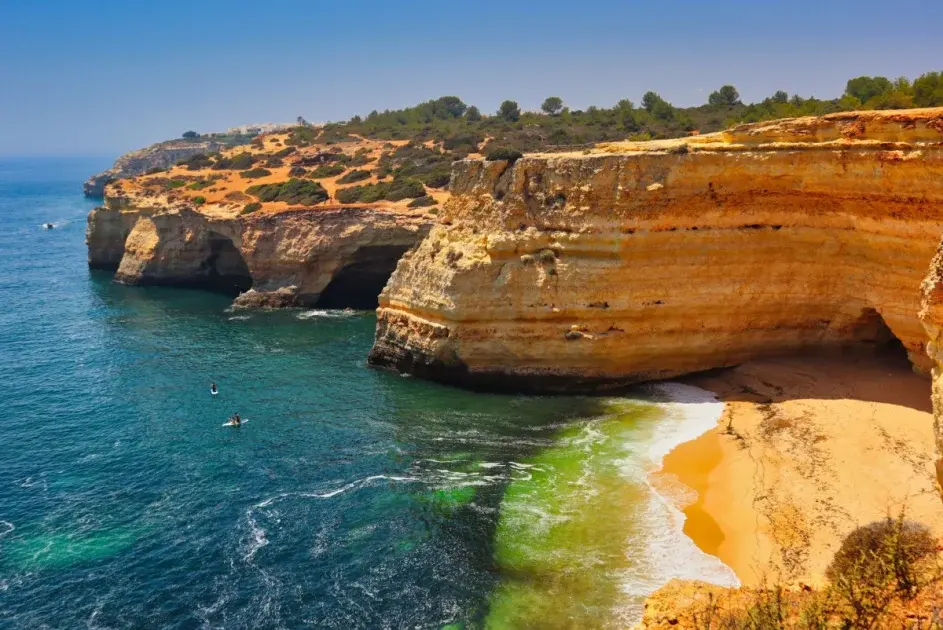
At some of the country's most photographed beaches, the tide isn't a minor detail — it's the condition that decides whether a visit is even possible. The best-known case is Algar de Benagil, on the coast of Carvoeiro e Lagoa: at high tide, or on days with rough seas, the cave's entrance can become submerged or dangerous even for those arriving by kayak or paddleboard, and local operators suspend the trips for safety reasons. At the neighbouring Praia da Marinha, the amount of exposed sand clearly varies between low tide (a wide beach, with access to several side caves) and high tide (a much narrower strip of sand).
At Ria Formosa, near Faro and Ilha da Culatra, the tide literally shapes what's accessible: at low tide, some sandbanks are exposed and it's possible to walk between barrier islands — something unthinkable a few hours later, once the water rises. The bay of São Martinho do Porto also changes shape with the tide, with a much larger stretch of sand and calmer, shallower water at low tide — one of the reasons it's considered one of the safest bays for children in the country. At other beaches in the centre and north, such as Foz do Arelho or Costa da Caparica, the receding tide exposes natural pools rich in marine life, popular with families and photography enthusiasts.
Safety: the Real Danger of Getting Trapped by a Rising Tide
The main risk associated with tides in Portugal isn't drowning in deep water — it's getting cut off between the rocks and the water when the tide rises faster than expected. This scenario repeats itself every year at beaches with cliffs and caves, especially in the Algarve and along the Costa Vicentina: visitors enter a cave or walk around a headland at low tide and, absorbed in exploring or taking photos, lose track of time. Since the next high tide approaches at a steady pace — and sometimes faster than it appears on very flat beaches — the way back can be covered by water before they even realise it.
The advice from Portugal's civil protection and maritime authorities is simple and effective: before exploring any cave, cliff or headland only reachable on foot, check what time the next high tide is and plan to be back in a safe area at least an hour before that. Never head into isolated areas between rocks without allowing enough time to return, avoid doing so alone, and tell someone your planned route. It's also worth checking our complete beach safety guide, with information on flags, currents and bathing rules that complement this focus on tides.
Different Tides by Region: Mainland, Açores and Madeira
Tidal range isn't the same across the whole country. Along the northern and central mainland coast — from Viana do Castelo to Peniche — spring tides can create differences of more than three metres between low and high tide, clearly visible on river and estuarine beaches, such as those at the mouths of the Douro, Mondego or Tejo, where the tide pushes salt water upstream and temporarily changes the current and the temperature. In the Algarve, the range tends to be slightly smaller, but is still enough to completely transform the look of beaches such as Marinha or Falésia over the course of a day.
In the Açores and Madeira archipelagos, being out in the open ocean and far from the continental shelf, the tidal range is normally smaller than on the mainland — which doesn't remove the need for caution near natural lava pools, such as those at Porto Moniz or Caloura, where ocean swell matters more than the tide itself when assessing risk. In every case, the same advice applies: always check the specific tide table for the island or region you're visiting, since times vary from place to place along the coast.
Best Time of Day for the Beach According to the Tide
There's no single answer as to whether low tide or high tide is "better" for the beach — it depends on what you're after. For anyone wanting the widest possible stretch of sand, to explore tide pools, walk to caves or hand-gather shellfish in authorised areas, low tide (and the two hours either side of it) is clearly preferable. For bodyboarding, surfing certain breaks, or simply swimming in deeper water close to shore, many surfers and swimmers prefer high tide or the rising tide, when waves tend to shape up better at certain spots.
For families with young children, the ebbing tide — the period when the water is going out — tends to be the calmest: the water gets shallower near the water's edge, shallow, safe pools form for playing in, and the amount of exposed sand keeps increasing through the afternoon. On spring tide days, this effect is even more pronounced, with an exceptionally wide beach during the low-tide hours. It's always worth cross-checking the tide table with the wind and swell forecast before deciding what time to leave home.
Frequently Asked Questions
Where can I check the official tide table in Portugal?
The official source is the Instituto Hidrográfico, which publishes annual tide tables for the main ports on the mainland, Açores and Madeira. For quick everyday checks, there are also apps and websites that cross-reference this data with the specific beach you plan to visit.
What is a spring tide and a neap tide?
A spring tide occurs near Full Moon and New Moon, when the difference between high and low tide is greatest. A neap tide occurs near the first and last quarter, with a much smaller range between the two tides.
Can I always get into Algar de Benagil, whatever the tide?
No. At high tide or on days with rough seas, local operators suspend kayak, paddleboard and boat trips to the cave for safety reasons. A visit is usually easier and safer close to low tide, on calm-sea days.
Is it true you can get trapped by the tide in a cave or a beach between rocks?
Yes, it's the main tide-related risk in Portugal. It happens when someone explores a cave or walks around a headland at low tide and loses track of time — the way back can be blocked by water once the tide rises. Always check the time of the next high tide before heading into isolated areas.
Are tides the same across the whole country?
No. The range tends to be greater along the northern and central mainland coast, slightly smaller in the Algarve, and normally smaller still in the Açores and Madeira, since they sit out in the open ocean. Always check the specific table for the region you're visiting.
Conclusion
On many Portuguese beaches, tides are just as decisive for your beach day as the weather or the time of year — they decide whether the sand is wide or narrow, whether a cave is accessible or dangerous, and whether a sandbank turns into a walking path or goes back to being sea. Before your next visit, take two minutes to check that day's tide table, especially if you're planning to explore caves, headlands or isolated rocky areas. To complete your planning, also see our beach safety guide and discover the best time to visit Portugal's beaches with fewer crowds and more time to safely enjoy the sea.