There is a photograph that almost everyone has seen, even without knowing the name of the place: a surfer on a tiny board facing a wall of green water that resembles a ten-storey building. That photograph was taken at Nazaré. More specifically at Praia do Norte, on the northern edge of this fishing village on Portugal's Silver Coast, where the Nazaré Submarine Canyon transforms North Atlantic swells into monsters that have no equal at any other beach in the world.
We have visited Nazaré at different times of year — in winter, when the giant waves attract elite surfers and television crews from across the globe; and in summer, when Praia da Nazaré fills with families and the village settles into the slow, colourful rhythm of traditional Portuguese beach life. These are effectively two destinations in one, and it is precisely this duality that makes Nazaré so compelling.
In this complete 2026 guide, we cover all three of Nazaré's beaches in detail, explain how the giant wave season works and when you are most likely to witness it, describe the Sítio district and funicular, the Fort of São Miguel Arcanjo and its surf museum, and finish with the local cuisine and best restaurants. We also include precise directions from Lisbon by car and by bus.
The Nazaré Submarine Canyon: Why the Waves Are So Big
To understand why Nazaré produces the largest waves ever surfed, you need to understand what lies beneath the water. The Nazaré Submarine Canyon is an underwater gorge 230 kilometres long and more than 5,000 metres deep at its deepest point — larger than the Grand Canyon by volume. This rare geological formation acts as a funnel that concentrates and amplifies swells arriving from the North Atlantic.
When an ocean swell generated by Atlantic storms encounters the outer edge of the canyon, the energy is refracted and focused toward the coast. As the water grows shallower near the beach, all that energy accumulated across thousands of kilometres of open ocean is released suddenly — producing waves that can exceed 25 metres in face height and reach spray peaks above 30 metres.
The first surfer to recognise Nazaré's potential was American Garrett McNamara, who in 2011 surfed what was then the world record wave here. Since then, Praia do Norte has become the stage for the greatest feats in big wave surfing, culminating in the official Guinness World Record: Sebastian Steudtner surfed a 26.21-metre wave at Nazaré in October 2020 — the equivalent of an eight-storey building.
The Giant Wave Season: When to Visit
The giant wave season runs from October to March, with the most intense swells typically in November, December and January. During this period, North Atlantic storms generate swells that arrive at Nazaré carrying energy accumulated over thousands of kilometres of open ocean.
| Month | Probability of Giant Waves | Notes |
|---|---|---|
| October | Medium | Season begins; frequent sunny days |
| November | High | First major swells; unsettled weather |
| December–January | Very High | Season peak; records most likely |
| February | High | Excellent conditions; fewer tourists than summer |
| March | Medium | Season end; first spring days |
| April–September | Low to None | Bathing season — summer beach, no giant waves |
To track real-time forecasts and know when professional surfers will be in the water, follow nazarewaves.com and the TUDOR Nazaré Big Wave Challenge social media channels (WSL). Big wave alerts are typically issued 24–48 hours in advance.
Praia do Norte: The Big Wave Beach
Praia do Norte is not a swimming beach. It is a spectacle beach — and must be treated as such. Even on summer days when the waves are small and the sand is wide, swimming is discouraged or outright prohibited by maritime authorities due to the underwater currents created by the canyon. On days of strong swell, access to the surf zone is absolutely forbidden.
The best viewpoint for watching giant waves is the Fort of São Miguel Arcanjo, a 16th-century fortification sitting directly above the beach, accessible via a steep cobbled path from the centre of Nazaré or from the Sítio. From here, with the right optics (a telephoto lens above 200mm for photography) and on the right days, you can watch surfers descend walls of water that seem physically impossible.
The Fort also houses the Nazaré Surf Museum (free entry), with surfboards belonging to Garrett McNamara, Maya Gabeira, Sebastian Steudtner and other athletes who have made history in these waters. The visit takes 20–30 minutes and leaves a lasting impression of the scale of what happens here.
GPS coordinates of Fort São Miguel Arcanjo: 39.6011, -9.0754
How to reach Praia do Norte: On foot from the centre of Nazaré (15–20 minutes along the seafront, turning left on Avenida Manuel Remígio). By car, there is free parking next to the fort — access via Rua do Forte.
Praia da Nazaré: The Heart of the Village
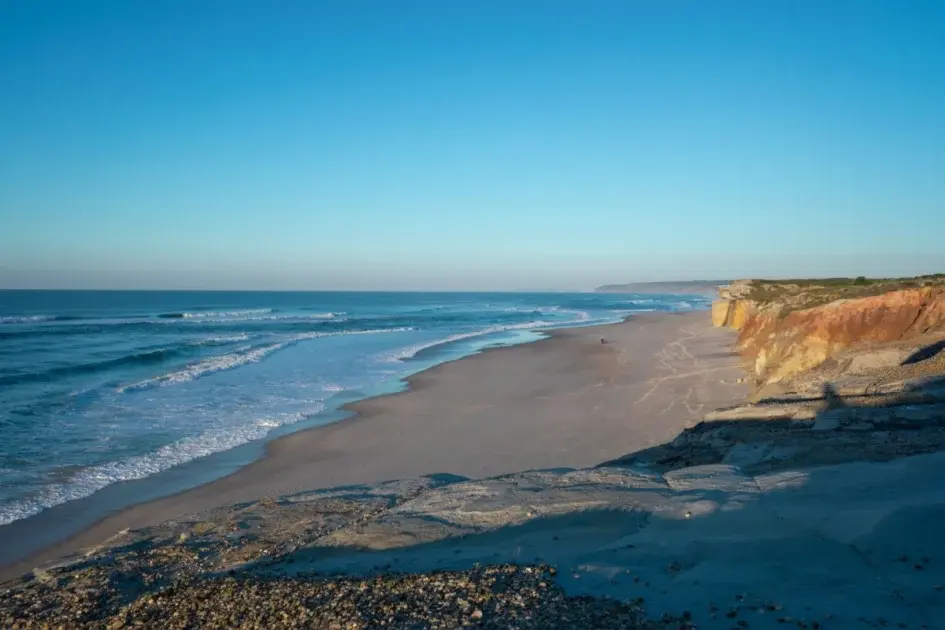
Praia da Nazaré — simply "the beach" to locals — is the large urban beach stretching through the centre of the village, approximately 1.5 km long with full southward exposure. This is where Portuguese families and international tourists spend their summer days, and where Nazaré shows its most animated and colourful face.
This is a fully-serviced Atlantic beach: lifeguards during the bathing season (15 June to 15 September, 9am to 7pm), car park, public toilets and showers, wheelchair-accessible access and a seafront promenade lined with restaurants and shops. The surf can be significant — this is the Silver Coast, and the Atlantic is rarely calm — but flag systems and rescue posts guide swimmers throughout the season.
A cultural note: until a few decades ago, it was common to see the women of Nazaré wearing their traditional dress of seven layered skirts — one for each day of the week, according to local tradition. Today the practice is mostly maintained by older women and on festival days, but you can still encounter it among the ladies selling tremoços (salted lupin beans) and pevides (salted pumpkin seeds) along the promenade.
Praia do Sítio: The Quiet Beach Below the Clifftop
Praia do Sítio — also known as Praia do Abalo or South Beach — is the least well-known of Nazaré's three beaches and, for that reason, the quietest. It lies to the south of the village, at the foot of the cliff where the Sítio neighbourhood stands, and has a more sheltered character: smaller in extent, fewer facilities, less foot traffic. It is an excellent alternative for those seeking a quieter beach in the height of August.
Access is via a steep path descending from the Sítio (around 10 minutes on foot) or by car along the southern seafront. The beach has a lifeguard in season and conditions are generally calmer than Praia da Nazaré because of the partial shelter provided by the cliff to the north.
The Sítio District and the Funicular
Nazaré has two distinct neighbourhoods: the Praia (the seaside village) and the Sítio (the historic clifftop quarter, 318 metres above sea level). The Sítio is the older, quieter Nazaré, with its lanes, chapels and the widest views over the Atlantic on the entire Silver Coast.
Climbing to the Sítio is almost obligatory on any visit to Nazaré, and the best way to do it is by the Nazaré Funicular — a century-old cable car (opened in 1889) that covers 326 metres of track at a 42% gradient in just 3 minutes. It is one of the oldest transport systems in Portugal still in operation.
Funicular timetable and fares (2026):
- Operating hours: daily, 7:00am–midnight (May to September); 7:30am–8:00pm (October to April)
- Single ticket (up or down): €1.50
- Return ticket: €2.90
- Walking down via the stairs: free, approximately 14 minutes
At the top, the Sítio Viewpoint offers a panoramic view over the village, the beach and the ocean that justifies the ascent in itself. At sunset, when the sun sinks into the Atlantic, this is one of the finest panoramic viewpoints on the central Portuguese coast.
The Sanctuary of Our Lady of Nazaré
At the heart of the Sítio stands the Sanctuary of Nossa Senhora da Nazaré, a baroque basilica from the 14th century and one of the most visited Marian shrines in Portugal. The legend associated with the site recounts that in 1182, Dom Fuas Roupinho, a Christian knight, was hunting on this cliff when his horse nearly plunged over the edge — stopped by the miraculous intervention of the Virgin. The sanctuary was built to commemorate the miracle.
Beside the basilica stands the tiny Ermida da Memória, where legend places the exact site of the miracle, its interior walls almost entirely covered in 17th and 18th-century blue and gold glazed tiles. Entry is free and open year-round.
Nazaré Gastronomy: Fresh Fish Straight from the Sea
Nazaré is, above all else, a fishing village — and that is reflected directly in the local cuisine. Fish arrives fresh daily from boats that go to sea along the coast, and fish stew, seafood rice and shellfish snacks form the backbone of a humble, flavourful and entirely authentic gastronomy.
Traditional Dishes of Nazaré
- Caldeirada à Nazarena: The most emblematic dish of the village. A layered fish stew that may include monkfish, skate, conger eel, squid, sardine and clams, cooked with potato, onion, tomato, pepper, white wine and coriander. Every tasca has its own recipe, and the result is always different.
- Arroz de Tamboril: Seafood rice with monkfish, a Nazaré speciality found in almost every restaurant in the centre.
- Black Scabbard Fish Fillets: Black scabbard fish is common along the Nazaré coast; battered fillets are a simple and much-loved dish, frequently served with tomato rice.
- Barnacles and Shellfish: In season, barnacles (percebes) from the Nazaré coast are excellent — served boiled with coarse salt.
- Açorda de Mariscos: A thick bread and shellfish soup with coriander, an Atlantic coast recipe with deep roots in the region.
Recommended Restaurants in Nazaré
- Mar Bravo (Praça Sousa Oliveira, 71) — Direct sea view, speciality in caldeirada and monkfish rice. Booking recommended in high season.
- A Celeste (Rua Mouzinho de Albuquerque, 54) — Very popular with locals, affordable prices, excellent seafood rice.
- Taberna d'Adélia (Rua Adrião Batalha, 54) — Traditional tasca atmosphere, Nazaré-style fish dishes, good local wine selection.
- O Casalinho (Rua do Elevador, 20, in the Sítio) — Terrace with Atlantic views, ideal for lunch after visiting the sanctuary.
Getting to Nazaré: All Your Options
By Car from Lisbon
Nazaré is approximately 120 km north of Lisbon via the A8 motorway (Via do Atlântico). The drive takes approximately 1 hour 20 minutes to 1 hour 30 minutes without traffic. Take the N242 exit toward Alcobaça/Nazaré. Tolls on the A8 amount to between €5 and €7 one way.
Parking in Nazaré: several free car parks exist in the residential areas north and south of the seafront. In high season, we recommend parking at the Parque de Estacionamento do Subido (free, a 10-minute walk from the centre) or at the car park next to Fort São Miguel Arcanjo (free, ideal for Praia do Norte).
By Bus from Lisbon
Rede Expressos operates direct buses from Lisbon (Sete Rios bus terminal) to Nazaré, with several departures per day. The journey takes approximately 1 hour 45 minutes and tickets cost between €9 and €15 depending on how far in advance you book. We recommend purchasing online at rede-expressos.pt.
Alternatively, you can travel to Alcobaça by bus (1h30 from Lisbon) and take a local bus or taxi to Nazaré (approximately 12 km). The Alcobaça Monastery, a UNESCO World Heritage Site, makes an excellent stop to combine with your Nazaré visit.
By Car from Porto
From Porto, Nazaré is approximately 170 km south via the A1+A8, a drive of roughly 1 hour 45 minutes to 2 hours. A good strategy is to combine the Nazaré visit with a stop at Óbidos (medieval walled town) or Batalha (UNESCO Monastery of Batalha), both of which lie along the route.
Nazaré in Summer vs. Winter: Which Season to Choose?
| Criteria | Summer (Jun–Sep) | Winter (Oct–Mar) |
|---|---|---|
| Giant Waves | No | Yes (Oct–Mar) |
| Swimming Beach | Yes (flags, lifeguards) | No (dangerous) |
| Air Temperature | 22–28°C | 10–17°C |
| Water Temperature | 17–20°C | 13–16°C |
| Crowds | High (Jul–Aug) | Low |
| Accommodation Prices | High | Low (−30 to −50%) |
| Gastronomy | Excellent | Excellent |
| Best For | Families, swimming, strolling | Giant waves, photography, tranquillity |
Our recommendation: September and October are Nazaré's sweet spot — the first autumn swells arrive, the weather remains pleasant, the village is less crowded than in summer and accommodation prices drop significantly. To witness the world's biggest waves, December and January are the key months, but be prepared for more unsettled weather and strong winds.
Frequently Asked Questions about Nazaré
How much time should I allow for Nazaré?
A full day is enough to visit all three beaches, the Sítio by funicular, the sanctuary and Fort São Miguel Arcanjo. For a more relaxed visit — including a long lunch, monuments in the surrounding area (Alcobaça or Batalha) and an overnight stay — we recommend two days.
Can you see giant waves all year round?
No. The giant wave season runs exclusively from October to March, with the greatest likelihood of seeing waves above 15 metres between November and February. From April to September, Praia do Norte has normal-sized waves and swimming is prohibited year-round for safety reasons related to the canyon currents.
Is Praia da Nazaré safe for children?
Yes, during the bathing season (15 June to 15 September), with lifeguards and flag warnings in place. Praia da Nazaré has a calmer swimming zone to the south, suitable for children. Always check the flag before entering the water and keep children under constant supervision.
What is the best way to get to Nazaré from Lisbon without a car?
The Rede Expressos bus from Sete Rios terminal is the best option — direct, comfortable and with multiple daily departures. Tickets cost between €9 and €15 (book online at rede-expressos.pt). The journey takes approximately 1h45. There is no direct train connection between Lisbon and Nazaré.
Can beginners surf at Nazaré?
Not at Praia do Norte, which is exclusively for experienced big wave surfers using jet-ski tow-in during the giant wave season. Praia da Nazaré does have beginner surf lessons available from several local schools during the bathing season. For the best beginner surf spots on the Silver Coast, see our Peniche guide or the Ericeira guide.
Conclusion: Nazaré, An Unrivalled Experience on the Silver Coast
Nazaré is a destination without parallel in Portugal — and in certain respects, without parallel in the world. There is no other fishing village where it is possible to witness the largest waves in the history of human surfing, ride a funicular to a 318-metre cliff and have lunch on a fisherman's caldeirada by the sea, all on the same day. It is a place that works in any season: in the animation of summer beach life or in the Atlantic silence of winter.
If you have not yet visited Nazaré, include it on your next Silver Coast itinerary — ideally alongside our central Portugal beaches guide to make the most of a region still underdiscovered by most international visitors. And if you are lucky enough to be there on a giant wave day, you will never forget it.