Editorial note: We have visited Figueira da Foz at various times of year, including the 2026 bathing season. Prices, schedules and awards reflect information available in July 2026 — we recommend confirming before your visit.
Some claim Figueira da Foz has the widest beach in Europe. There is no official record confirming this, but after walking it end to end on several visits — early in the morning, when the receding tide leaves a stretch of sand that seems to never end, and at dusk, when the sun sets behind Casino Figueira — we understood why the claim keeps ringing true to anyone visiting for the first time.
But Figueira da Foz is much more than its main beach. It is Buarcos, the fishing quarter where the smell of grilled sardines still lingers in the narrow streets. It is Cabo Mondego, with cliffs over 100 metres high and dinosaur fossils more than 150 million years old. It is Cabedelo, one of the most respected surf breaks on Portugal's central coast, right at the mouth of the Mondego river. And it is the oldest continuously operating casino on the Iberian Peninsula, open since 1884.
In this complete guide we cover everything you need to plan your 2026 visit: the ten Blue Flag beaches in the municipality, where to surf, where to eat the best seafood, how to get there by train or car from Coimbra and Lisbon, and the best time of year to come.
Seaside city at the mouth of the Mondego river, Costa de Prata, Coimbra district
10 Blue Flag beaches in 2026: Quiaios, Buarcos, Cova Gala, Cabo Mondego, Figueira da Foz-Relógio, Murtinheira, Tamargueira, Leirosa, Costa de Lavos and Cabedelo
2026 bathing season: 4 June to 20 September
Casino Figueira: the oldest continuously operating casino on the Iberian Peninsula, since 1884
Ideal for: families, surfers at Cabedelo, anyone seeking casino nightlife, geology enthusiasts at Cabo Mondego
Distances: Coimbra 38 km / Lisbon about 180 km / Aveiro about 90 km
Praia da Figueira da Foz: Europe's Widest Beach?
The main beach in Figueira da Foz runs along the entire waterfront of the city, between the mouth of the Mondego river and the Buarcos quarter, and is best known for its unusual width: at low tide, the distance between Avenida do Brasil and the waterline can exceed 300 metres in places, requiring long wooden boardwalks to cross the sand — boardwalks that have become one of the city's visual trademarks. There is no independent international certification confirming the title of "widest beach in Europe," but walking it fully justifies the reputation.
The seafront, with its long promenade, terraces, hotels and the standout Casino Figueira building, is the heart of the city's beach life. The beach is patrolled during peak season, has good water quality and fine sand, and its direct exposure to the Atlantic brings moderate to strong swell — enough to attract bodyboarders and beginner surfers, though flag warnings should be respected, especially outside lifeguard-patrolled zones.
Blue Flag and 2026 Bathing Season
The Figueira da Foz municipality leads the Central Region of Portugal in the number of Blue Flag beaches, the international certification awarded by the Foundation for Environmental Education and managed in Portugal by ABAE, which assesses water quality, safety, beach management and environmental education. In 2026, ten beaches in the municipality hold the award:
| Beach | Character |
|---|---|
| Figueira da Foz — Relógio | Main urban beach, next to the Casino and promenade |
| Buarcos | Fishing quarter, quieter beach to the north |
| Cabo Mondego | Cliffs, viewpoint and geological heritage |
| Cabedelo | Surf, wild dunes, south bank of the Mondego mouth |
| Cova Gala | Coastal residential area to the south, next to Cabedelo |
| Murtinheira | Quiet beach to the south, good for walks |
| Tamargueira | Extension of Murtinheira, less crowded |
| Leirosa | Long beach next to the pine forest, rougher sea |
| Costa de Lavos | Rural beach, wilder setting |
| Quiaios | Next to the National Dune Forest, pine-forest setting |
The 2026 bathing season at the municipality's patrolled beaches runs from 4 June to 20 September, with lifeguards and support services (toilets, showers, first-aid posts) guaranteed during that period. Outside these dates, the beach remains accessible but unpatrolled.
Buarcos: The Fishing Quarter With Soul
Until a few decades ago, Buarcos was a distinct fishing village, now absorbed into the urban fabric of Figueira da Foz but still holding on to its own identity. The narrow streets climbing up from the seafront, the parish church, and the remains of an old fort tell the story of a community that lived off the sea for centuries. This is where Figueira da Foz shows its most authentic side: fishing boats still moored by the beach, nets drying in the sun, and a concentration of fish and seafood restaurants along the streets facing the water.
Praia de Buarcos itself, holding a Blue Flag in 2026, is more sheltered and less exposed to the wind than the city's main beach, making it popular with families with young children and anyone seeking a calmer setting without straying from the centre. The seafront promenade links Buarcos to the main Figueira beach in a roughly 20-to-30-minute walk, with continuous views over the sand and Cabo Mondego in the distance.
Cabo Mondego: Cliffs, Fossils and the Region's Best Viewpoint
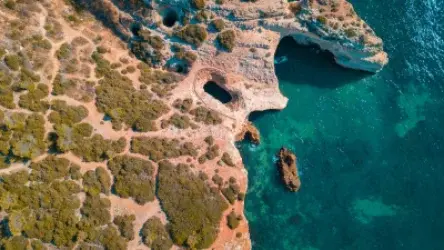
North of Buarcos, Cabo Mondego rises as a wall of cliffs over 100 metres high, formed from Jurassic-period limestone and clay layers. The area is one of the most studied geosites in the Lusitanian Basin, with fossil records — including dinosaur footprints and ammonites — that regularly attract researchers and visitors with an interest in geology. Part of the hillside was historically quarried for limestone used in cement production, an activity that left visible marks on the landscape but today coexists with the site's scenic and scientific value.
At the top of the headland, the old lighthouse and viewpoint offer one of the best views on the entire Costa de Prata: to the south, the city of Figueira da Foz and the mouth of the Mondego; to the north, the coastline stretching towards Quiaios. Access is via a well-maintained road, and there is also a walking trail climbing from Buarcos, recommended only for those in reasonably good physical shape due to the elevation gain.
Praia do Cabedelo: A Surfer's Paradise at the Mondego River Mouth
On the south bank of the Mondego river mouth, facing the city, lies Praia do Cabedelo — one of the most respected surf breaks on Portugal's central coast. The combination of the river bar, shifting sandbanks and direct Atlantic exposure produces consistent waves, with well-defined lefts and rights, attracting intermediate to advanced surfers virtually year-round. The area also retains an extensive dune system and a wilder feel than the urban Figueira seafront, and the beach itself carries a Blue Flag in 2026.
Cabedelo can be reached by road around the estuary, or by a small boat crossing the river from the Figueira da Foz riverside area during peak-demand months — a scenic way to reach the beach that avoids the longer drive. For non-surfers, Cabedelo is also a good spot for walks along the river and birdwatching in the estuarine zone.
Casino Figueira: The Oldest Casino on the Iberian Peninsula
Few buildings define the image of Figueira da Foz as much as Casino Figueira, opened in 1884 and considered the oldest continuously operating casino on the entire Iberian Peninsula. With a gaming floor of roughly 3,000 square metres, the casino houses around 500 slot machines and 20 gaming tables, alongside a show venue that regularly hosts concerts and revues, a piano bar, and its own dining options.
Beyond gambling, Casino Figueira serves as the city's main nightlife hub year-round, with programming that intensifies in summer. Its location right by the main beach and Avenida do Brasil makes it an unmissable landmark on any visit to the city, even for those with no interest in gaming.
Quiaios and the National Dune Forest: Nature Minutes From the Beach
In the north of the municipality, Praia de Quiaios sits within the Mata Nacional das Dunas de Vale de Íris, an extensive pine forest planted throughout the 19th and 20th centuries to stabilise coastal dunes and halt sand encroachment onto farmland — a forestry engineering project directly paralleling the better-known Pinhal de Leiria further south on the same coast. The result is an unusual landscape where dunes, pine forest and beach succeed one another within a few minutes' walk.
Inside the forest lie Lagoa da Vela and Lagoa das Braças, two freshwater lagoons surrounded by riparian vegetation, important for birdwatching, especially outside peak season. The area is also popular for walking and cycling along dirt trails, offering a complete contrast to the bustle of Figueira da Foz's urban seafront just a few kilometres away.
Where to Eat in Figueira da Foz
The region's fishing tradition is reflected directly in the local cuisine. Arroz de marisco (seafood rice) and caldeirada de peixe (fish stew), prepared with fish landed daily at the port of Figueira da Foz, are staples on menus along the seafront and in Buarcos. Grilled sardines remain the most popular summer dish, served simply with boiled potatoes and roasted peppers, much as in most fishing towns along the Portuguese coast.
Buarcos has the highest concentration of seafood taverns and family-run restaurants facing the sea, generally with more accessible prices than the more touristic main seafront. We recommend looking for places with a strong turnover of local customers — a good sign of fresh fish — and always asking what the catch of the day is before choosing a main course.
How to Get There and Where to Stay
By Train
Figueira da Foz railway station is connected to Coimbra-B by a CP regional line, with a journey taking around 35 minutes on the fastest service and up to about 1h45 on slower regional trains, with tickets starting at roughly 4 euros. From Coimbra-B there is a direct connection to the Linha do Norte, allowing travel from Lisbon or Porto with a single change.
By Bus
Regular bus connections run from Coimbra and Lisbon, operated by national coach companies, with journey times similar to or slightly longer than the train, depending on the number of intermediate stops.
By Car
From Coimbra, the distance is about 38 km via the A14, a 30-to-40-minute drive. From Lisbon, the distance is roughly 180 km via the A1 and A14, with an estimated travel time of 1h45 to 2 hours depending on traffic. From Porto, the distance is similar, around 130 km via the A1.
Where to Stay
The main seafront area, next to Casino Figueira, has the largest concentration of hotels and the closest proximity to the beach and nightlife. Buarcos is a quieter, more local-flavoured alternative, a short walk from the main beach. For those seeking peace and proximity to nature, the Quiaios area, next to the National Dune Forest, offers more rural accommodation, about a 15-minute drive from the centre.
Best Time to Visit Figueira da Foz
| Month | Air Temp (°C) | Sea Temp (°C) | Crowds | Recommendation |
|---|---|---|---|---|
| January | 13 | 14 | Very low | Cabo Mondego and winter walks |
| February | 14 | 14 | Very low | Total quiet on the seafront |
| March | 16 | 14 | Low | Good for walks in the Dune Forest |
| April | 18 | 15 | Medium | Easter, good value for money |
| May | 20 | 16 | Medium | Cabedelo already has good surf conditions |
| June | 22 | 17 | High | Bathing season begins 4 June |
| July | 24 | 18 | Very high | Busy beach, casino in full swing |
| August | 25 | 18 | Peak | Arrive early at the beach, busy seafront |
| September | 23 | 18 | High | Best month: water still warm, fewer crowds |
| October | 20 | 17 | Low | Good for surf and walks at Cabo Mondego |
| November | 16 | 16 | Very low | Autumn gastronomy, quiet casino |
| December | 14 | 15 | Very low | Festive atmosphere on the seafront |
Our advice: September combines the best of both worlds, with water still warm from a full summer of sun and a much calmer city than in August. Anyone chasing waves at Cabedelo will also find good conditions in spring and autumn, outside the peak summer heat.
Figueira da Foz vs. Nazaré vs. Aveiro — Which to Choose?
These three Costa de Prata cities sit close to one another but offer quite different experiences. It is worth understanding the differences before deciding where to base your stay.
| Criterion | Figueira da Foz | Nazaré | Aveiro |
|---|---|---|---|
| Beach | Very wide, urban, moderate swell | World-class giant waves | Lagoon + Barra/Costa Nova beach |
| Best for | Families, intermediate surf, casino | Watching or surfing giant waves (off-season) | Moliceiro boat trips, dune beaches |
| Nightlife | Casino Figueira, year-round entertainment | More low-key, gastronomy-focused | Moderate, lively historic centre |
| Distance to Coimbra | 38 km | about 75 km | about 60 km |
| Atmosphere | Seaside city with historic casino | Fishing village with international fame | Canal city, the "Portuguese Venice" |
Frequently Asked Questions About Figueira da Foz
Is Figueira da Foz really Europe's widest beach?
Figueira da Foz is often cited as having one of the widest beaches in Europe, with the distance between the seafront and the waterline exceeding 300 metres at low tide in places. However, there is no official independent international record confirming the title.
Does Figueira da Foz have Blue Flag beaches in 2026?
Yes. The Figueira da Foz municipality leads the Central Region with ten Blue Flag beaches in 2026: Quiaios, Buarcos, Cova Gala, Cabo Mondego, Figueira da Foz-Relógio, Murtinheira, Tamargueira, Leirosa, Costa de Lavos and Cabedelo. The bathing season runs from 4 June to 20 September 2026.
Where should I surf in Figueira da Foz?
Praia do Cabedelo, on the south bank of the Mondego river mouth, is the region's main surf break, with consistent waves virtually year-round and a recommended intermediate-to-advanced level. The main Figueira beach itself also welcomes beginner surfers and bodyboarders on days with more moderate swell.
How long does it take to get to Figueira da Foz from Coimbra and Lisbon?
From Coimbra, the distance is about 38 km, roughly 30 to 40 minutes by car or between 35 minutes and 1h45 by train, depending on the service. From Lisbon, the distance is approximately 180 km, with a driving time of between 1h45 and 2 hours.
Is Casino Figueira really the oldest on the Iberian Peninsula?
Yes, Casino Figueira, opened in 1884, is recognised as the oldest continuously operating casino on the entire Iberian Peninsula, with a gaming floor of around 3,000 square metres, roughly 500 slot machines and 20 gaming tables.
Conclusion — A Seaside City With Many Layers
Figueira da Foz is not just a wide beach next to a historic casino, though that alone would justify the trip. It is Buarcos and its fishing quarter, it is Cabo Mondego and its multi-million-year-old fossils, it is Cabedelo and its waves respected by surfers along the entire coast, and it is the National Dune Forest at Quiaios, just minutes from the urban bustle. Few Portuguese seaside cities pack this much variety into such a compact space.
To keep planning your trip along the Costa de Prata, also see our general guide to Central Portugal beaches, our complete guide to Nazaré, our Aveiro and Costa Nova guide, and our beginner's surf guide to Portugal.