What Is Óbidos Lagoon and Where Is It
Óbidos Lagoon (Lagoa de Óbidos) is Portugal's largest coastal lagoon system. Covering approximately 6.9 km² with an average depth of two metres, this saltwater lagoon is separated from the Atlantic by a narrow sandy spit at the village of Foz do Arelho, in the municipality of Caldas da Rainha.
For centuries the lagoon was the backbone of the local fishing community. Today it has evolved into an ecotourism and water sports destination that draws visitors from across Europe — while retaining a rare authenticity for somewhere so close to Lisbon.
The location is strategically convenient: just 80 km north of Lisbon (about 50–60 minutes via the A8 motorway) and only 15 km from the medieval walled town of Óbidos, making a lagoon-plus-castle combination the perfect weekend break.
GPS Coordinates and Access Points
The main reference point is Foz do Arelho beach: GPS 39.4418, -9.2161. Praia do Bom Sucesso, on the southern bank of the lagoon mouth, is at GPS 39.4281, -9.2303.
The Beaches of Óbidos Lagoon: Two Worlds Two Hundred Metres Apart
What makes Foz do Arelho unique is the coexistence of two radically different environments separated by a single dune ridge:
Atlantic Side — Praia da Foz do Arelho
The ocean-facing beach at Foz do Arelho stretches approximately 1.2 km westward, with regular Atlantic swells that attract surfers and bodyboarders. The beach holds a Blue Flag 2026, Quercus Gold Quality Award and an Accessible Beach certification — recognitions that confirm water quality, supporting infrastructure and accessibility for visitors with reduced mobility.
The wide sandy beach has full facilities: lifeguards from 15 June to 15 September (9h–19h), beach bar, toilets, showers and a paid car park in peak season. Atlantic water temperatures range from 18–20°C in June and September and 21–23°C in July and August.
Lagoon Side — Calm and Shallow Waters
The lagoon shore, accessed from Foz do Arelho's waterfront promenade, has a completely different character. The water is warmer — reaching 24–26°C at peak summer — and very shallow, ideal for young children and anyone who prefers a calm swim with no waves. The fine sand margins and the lagoon's flat horizon create an almost Mediterranean atmosphere, in sharp contrast to the Atlantic power just metres away.
Praia do Bom Sucesso
Praia do Bom Sucesso (also called Praia do Vau) sits on the southern bank of the lagoon mouth. More isolated with fewer facilities, it is the preferred launch point for kitesurfing schools. Access is via the A8 motorway, exit 14, through the villages of Amoreira and Vau.
Kitesurfing at Óbidos Lagoon: Portugal's Best Spot to Learn
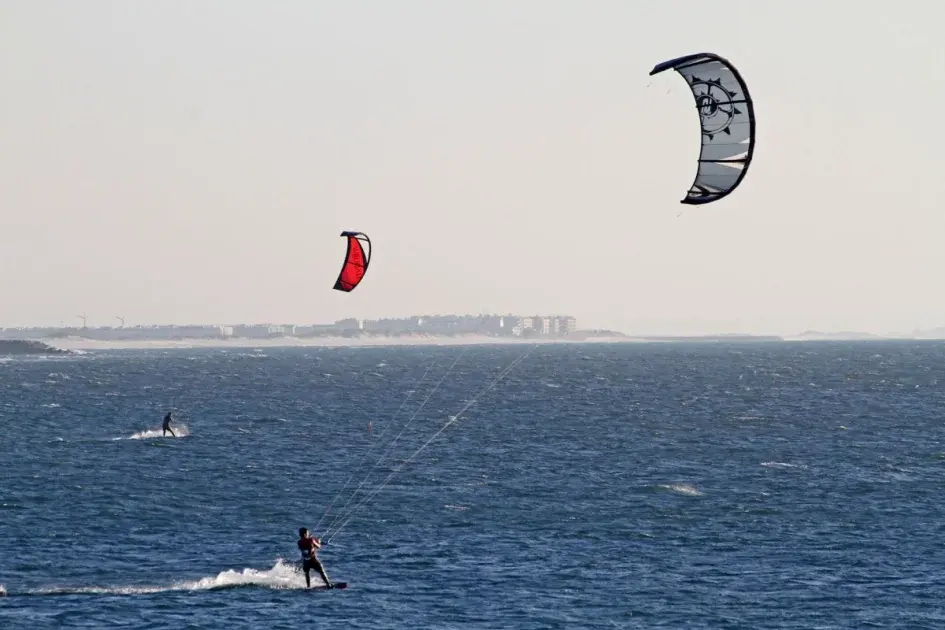
Among European kitesurfers, Óbidos Lagoon has a consistent reputation: it is considered one of the world's finest spots for learning and progression. The reason is straightforward — it combines every element that defines an ideal kitesurfing environment in one place.
Wind Conditions
From April to October, thermal northeast winds blow almost every afternoon, between noon and 6 pm, at 12 to 20 knots. This consistency is exceptional on the Portuguese coast, where wind can be unreliable. In May, June and September — outside the busiest tourist months — the wind is reliable, crowds are thinner and the overall experience is more relaxed.
Depth and Safety
The lagoon averages two metres in depth, with vast areas only 50 to 100 cm deep — meaning that in most falls the rider can simply stand up and walk. For a beginner still learning to control the kite, this removes much of the stress and danger present at open-sea spots.
Permitted Season and Rules
Kitesurfing at the lagoon mouth is subject to Maritime Authority regulations. The main Bom Sucesso kite area is authorised for kitesurfing from 15 September to 15 June, covering the months of best wind consistency and staying outside peak bathing season. In July and August — when beaches are most crowded — practice may be restricted. Always confirm current seasonal restrictions with local schools before your visit.
Kitesurfing Schools
Several certified schools operate on the lagoon:
- Pássaro Kite — established school at Foz do Arelho offering beginner courses from 2 days, equipment rental and a private training area on the lagoon shore
- Kite Control Portugal — school based at Bom Sucesso with IKO-certified instructors and intensive 9-hour courses
- Kitesurf Soul — specialising in kitesurfing and SUP, with integrated accommodation options
Average prices for a full beginner course (9 hours, equipment included) range from €280 to €380. Equipment rental for experienced riders costs around €60–€80 per session.
Other Wind Sports
The lagoon is equally suited to windsurfing and the rapidly growing wingfoil discipline, both benefiting from the same consistent wind and flat water. Several schools offer wingfoil lessons from €100 per two-hour session.
Kayaking, SUP and Other Activities on the Lagoon
For those not kitesurfing, the lagoon offers a rich range of activities at a more gentle pace:
Kayak and Stand-Up Paddle
Kayaking and SUP are probably the most accessible ways to explore the lagoon. Calm, shallow waters mean that children from age 8 can participate comfortably. Equipment can be rented along the lagoon waterfront at Foz do Arelho for roughly €10–€15 per hour per SUP board, or €12–€18 per double kayak.
Paddling inland reveals the lagoon's wilder face: deserted sandbars, saltmarsh vegetation, grey herons and wading birds that use the lagoon as feeding habitat. A popular route is the Foz do Arelho to Amoreira village paddle, approximately 5 km each way, passing through areas only 30–50 cm deep where the sandy bottom is clearly visible throughout.
Boat Tours and Birdwatching
The lagoon forms part of the Óbidos Lagoon Special Protection Area (SPA), designated under the EU Natura 2000 network. It is a critical habitat for migratory and resident birds: flamingos, grey herons, snipe, ringed plovers and, in winter months, mallards and coots in significant numbers. Local operators run guided boat tours focused on birdwatching during spring and autumn.
Cycling and Walking Trails
The southern shore of the lagoon has walking and cycling paths that follow the dune ridge and saltmarsh zones, with privileged viewpoints over the water. The best-known route, approximately 8 km long, starts at Foz do Arelho and heads south to the Bom Sucesso dunes, offering simultaneous views of the Atlantic and the lagoon.
Gastronomy: Fresh Seafood on the Lagoon Shore
Gastronomy is one of the highlights of any visit to Foz do Arelho. The village has a fishing tradition that is reflected in its restaurants — unpretentious, unfussy, but with quality produce delivered directly from local boats.
What to Eat
The standout dishes are lagoon clams (bulhão pato-style or à marinheira), grilled octopus, fish stew (caldeirada) with the catch of the day, and sautéed prawns. For shellfish lovers, Atlantic oysters from coastal aquaculture operations in the Oeste region are served fresh at several waterfront establishments — always ask staff what arrived most recently.
Recommended Restaurants
- Távola Lagoa — direct lagoon views, specialising in shellfish and grilled fish, relaxed terrace atmosphere. A project of the Cerqueira Gomes family with over 20 years of history in the area
- Restaurante Europa — located on the ocean beach with views of both sea and lagoon, speciality in charcoal-grilled fish; a local institution for decades
- Marisqueira Cabana do Pescador — seafood restaurant on the seafront promenade, ideal for live shellfish and fresh barnacles
- Cais da Praia — casual bar and restaurant with lagoon-side terrace, excellent for snacks and light meals at the end of the day
Prices are reasonable for the quality on offer: a main-course grilled fish with a drink costs between €15 and €25 at most establishments. Book ahead for weekend evenings in July and August.
How to Get to Óbidos Lagoon
By Car
The most direct route from Lisbon is via the A8 motorway (Autoestrada do Oeste). Take the A8 to the Caldas da Rainha Sul exit and follow the EN360 to Foz do Arelho (approximately 15 additional km). Total distance from Lisbon is 80 km, with a journey time of 50 to 65 minutes outside rush hours. A8 tolls cost approximately €3.50–€4.50 in the Lisbon–Caldas direction.
From Porto (190 km, ~1h50 via A1+A8), take the A1 to Leiria and then the A17 or EN1 to Caldas da Rainha.
By Bus
Rodoviária do Oeste operates regular services between Lisbon (Campo Grande bus station) and Caldas da Rainha, with journey times of approximately 60–75 minutes and tickets from €9.45. From Caldas da Rainha, a local bus connects to Foz do Arelho (20 minutes, ~€1.50–€2.50). Check current timetables at rodoviariadooeste.pt.
Alternatively, Rede Expressos serves Caldas da Rainha from Lisbon from €7. From Caldas da Rainha, a taxi or rideshare to Foz do Arelho costs approximately €10–€15.
By Train
The nearest railway line is the Linha do Oeste (CP), with a stop at Caldas da Rainha. Trains depart from Lisbon Santa Apolónia or Entrecampos and the journey takes approximately 1h30–2h, with tickets from €8. From Caldas da Rainha to the lagoon, a taxi, rideshare or local bus is required.
When to Visit: Month-by-Month Guide
| Month | Atlantic Beach | Lagoon Swimming | Kitesurfing | Water Temp |
|---|---|---|---|---|
| April | Cold, surf | Cool, good for paddle | Good wind, spot open | 15–17°C |
| May | Pleasant, few crowds | Good for swimming | Excellent (best month) | 18–20°C |
| June | Very good | Very good | Excellent | 19–21°C |
| July | Great, busy | Great (lagoon 24–26°C) | Restricted (check) | 21–23°C |
| August | Great, very busy | Great (warmest lagoon) | Restricted (check) | 21–23°C |
| September | Excellent, quieter | Excellent | Excellent (spot re-opens 15 Sep) | 20–22°C |
| Oct–Mar | Surf, cold | Not recommended | Good sessions, strong wind | 14–17°C |
Practical Tips for Visiting Óbidos Lagoon
- Parking: in peak season (July–August), arrive before 10h to secure a spot in the car park near the beach. Parking is paid in bathing season (~€1.50–€2/hour). Free outside season.
- Young children: the lagoon shore is the best option — calm, shallow and warmer water. Bring water shoes to protect feet from sand and possible rocks along the banks.
- Kitesurfing — bookings: schools fill up in June and September. Book at least two weeks in advance to secure a place on the most popular courses.
- Combine with Óbidos town: the medieval walled town of Óbidos is just 15 km away (20 minutes by car) and well worth combining in a two-day visit — lagoon in the morning, town in the afternoon.
- Wildlife and birdwatching: bring binoculars. The best hours for spotting birds are early morning (7h–9h) and late afternoon (17h–19h), when herons, waders and ducks are most active along the lagoon margins.
Óbidos Lagoon vs Other Portuguese Coastal Lagoons
| Feature | Óbidos Lagoon | Ria de Aveiro | Melides Lagoon |
|---|---|---|---|
| Area | 6.9 km² | 45 km (lagoon system) | ~3 km² |
| Kitesurfing | Excellent (flat water) | Good | Limited |
| Lagoon swimming | Yes (shallow, warm) | Yes (lagoon beaches) | Yes (more wild) |
| Ocean beach nearby | Yes (Blue Flag) | Yes (Costa Nova/Barra) | Yes (Melides beach) |
| Distance from Lisbon | 80 km (~55 min) | 255 km (~2h30) | ~145 km (~1h30) |
| Infrastructure | Good (restaurants, schools) | Excellent | Minimal (intentional) |
Where to Stay Near Óbidos Lagoon
The accommodation offer in Foz do Arelho and surroundings combines local charm with good conditions for stays of 2 to 5 nights:
- Água d'Alma Hotel — design hotel with lagoon views, swimming pool, breakfast included. The quality reference in the area, with prices from €120/night in high season.
- Quinta da Foz do Arelho — rural property with rooms and apartments, 500 m from the lagoon, ideal for family stays.
- Accommodation in Caldas da Rainha — 15 km away, Caldas da Rainha has a more varied and affordable hotel offer (from €50/night), with bus connections to Foz do Arelho.
- Camping: the Foz do Arelho campsite, managed by Caldas da Rainha council, accepts tents and campervans, less than 500 m from the beach.
Frequently Asked Questions — Óbidos Lagoon
Can you swim in Óbidos Lagoon?
Yes. The lagoon shore at Foz do Arelho has popular swimming areas, especially for families. The water is calm, shallow (30 cm to 1 m in most areas near the banks) and in peak summer reaches 24–26°C — warmer than the sea. There are no significant currents in the swimming areas close to the shore.
What is the best time for kitesurfing at Óbidos Lagoon?
May, June and September are the ideal months: consistent wind (12–20 knots), fewer practitioners and the spot is fully authorised. In July and August, kitesurfing may be restricted by seasonal bathing safety rules. Always confirm with local schools before your visit.
How much does a kitesurfing course at Óbidos Lagoon cost?
A complete beginner course (9 hours, equipment included) costs between €280 and €380 depending on the school and time of year. Most schools divide the course into three 3-hour sessions over three days, which fits well with a short trip itinerary.
Is there public transport to Foz do Arelho?
Yes, with connections from Lisbon to Caldas da Rainha by bus (Rodoviária do Oeste, ~€9.45, 60–75 min) or train (CP Linha do Oeste, ~€8, 1h30–2h). From Caldas da Rainha there is a local bus or taxi to Foz do Arelho (20 min, €10–15 by taxi). By car is always the most practical and fastest option.
Does the lagoon have protected ecological status?
Yes. Óbidos Lagoon is designated as a Special Protection Area (SPA) under the EU Natura 2000 network and the EU Birds Directive. It is a critical feeding and breeding habitat for over 40 bird species, including flamingos, grey herons and migratory waders. Fishing and hunting are regulated. Always respect saltmarsh zones and leave no waste behind.