Why Peniche is Portugal's Surf Capital
If Ericeira is the World Surfing Reserve that has preserved its fishing village character while welcoming the world's best surfers, Peniche is the town that lives surf more intensely and daily than anywhere else in Portugal. The Peniche peninsula — a tongue of land that juts into the North Atlantic, surrounded by water on three-quarters of its perimeter — creates a geographical rarity: the ability to find surfable waves on almost every day of the year, regardless of wind direction or swell angle.
This unique geometry is precisely why the World Surf League chose Peniche for one of its most anticipated Championship Tour stops. When swell and wind align at Supertubos, spectators witness one of the most spectacular events in professional surfing: waves that recall Pipeline in Hawaii, with barrel sections rolling at sand level, ridden by the finest surfers on the planet.
But Peniche is not only for the surfing elite. Having spent considerable time documenting the beaches and coastal destinations of Portugal, we find that few areas of the country manage to simultaneously satisfy a surfer in their first week of lessons and a competitor seeking the most challenging waves in Europe. That balance — between the gentleness of Baleal and the raw power of Supertubos — is what makes Peniche truly exceptional.
This guide covers all of Peniche's main breaks by difficulty level, the best season for each surfer profile, how to get here from Lisbon and Ericeira, surf school and camp options, and what to do when the ocean isn't calling.
Supertubos: Europe's Best Barrelling Beach Break
Supertubos sits on the southern coast of the Peniche peninsula, about 2 km from the town centre, and is the break that put Peniche on the global surf map. The name says it all: this is a sand-bottomed beach break that produces barrel sections of a power and quality rarely matched by a European beach break. Comparisons with Pipeline in Hawaii or Zicatela in Mexico are made frequently — and with good reason.
What makes Supertubos so exceptional is the combination of physical factors: a well-defined sandbank, the beach orientation that directly catches North and North-West Atlantic swells, and the way waves break over shallow water in an abrupt, cylindrical form. In good swell conditions (2 to 4 metres) with offshore east or north-east wind, Supertubos produces vertical walls that close into perfect sand-level barrels — a wave that demands instant reaction and total commitment.
Conditions and Difficulty
Supertubos is a wave exclusively for advanced and experienced surfers. The wave power, the speed at which the walls collapse, and the force of the rip currents make it dangerous for anyone without solid experience in powerful beach breaks. On bigger swell days (above 2 metres), the line-up is dominated by top Portuguese and international surfers, and hierarchy in the water is strictly enforced.
- Recommended level: Advanced (experienced in powerful beach breaks)
- Wave type: Beach break, tubular rights and lefts
- Best tide: Low to mid
- Ideal swell: 1.5 m to 4 m (best between 2 and 3 m)
- Best wind: Offshore east / north-east
- Best swell direction: North-West to North-North-West
Supertubos and the WSL Championship Tour
Since 2009, Peniche has hosted WSL Championship Tour (CT) events — the top tier of professional surfing — centred on Supertubos. The Portuguese event, known as the MEO Rip Curl Pro Portugal, typically takes place in October and November, when the North Atlantic autumn swells deliver the consistency and size ideal for competition format. In recent years the Peniche event has been the setting for some of the finest performances on the tour, with back-to-back barrels that define the best rides of the world year.
For the non-surfing spectator, watching a WSL competition at Peniche is a genuinely memorable experience: free entry, sandy viewing banks, and the closeness to the waves create an intimacy with elite surfing that very few competitions in the world can match.
Baleal: Paradise for Beginners and Intermediates
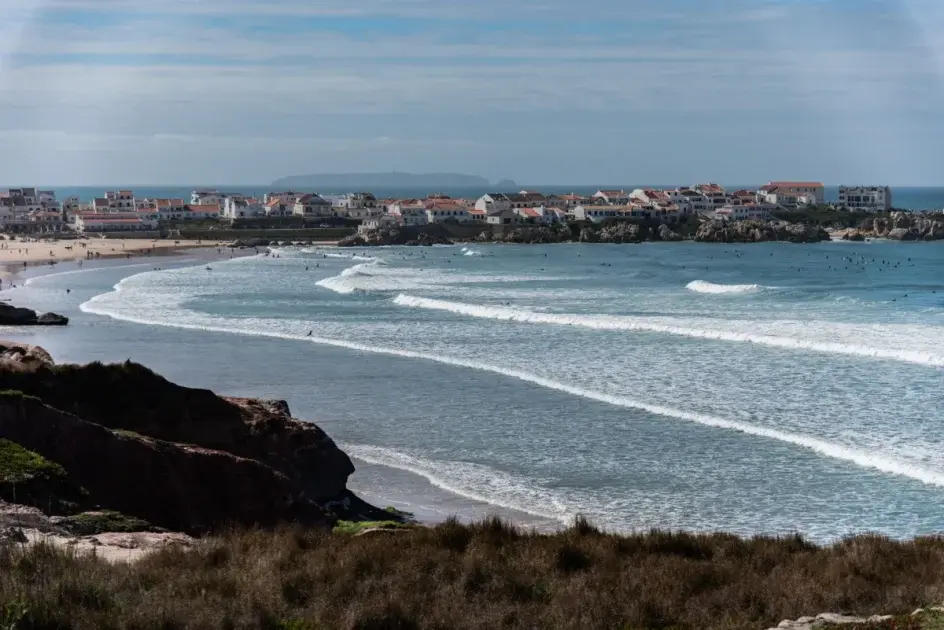
Six kilometres north of Peniche town centre, the island-peninsula of Baleal is where most Peniche surf stories begin. Baleal offers a set of beaches more sheltered than the southern coast breaks, with gentler and more predictable waves that make it the ideal location for first surf lessons and for progressing surfers in their first months of learning.
Prainha de Baleal — Peniche's Easiest Wave
Prainha sits at the northern tip of Baleal island and benefits from the natural shelter the island provides to the bay. It is the wave with the least power in the entire Peniche area, with gentle and forgiving surf ideal for the first time someone stands on a board. Most Baleal surf schools use Prainha for beginner lessons precisely because of its predictability and safety.
- Recommended level: Beginner
- Wave type: Sheltered beach break
- Best tide: All tides
Meio da Baía de Baleal — For Progression
The centre of Baleal bay picks up more swell than Prainha and offers waves with more power and variety — the natural next step after consolidating the first few take-offs. The rights and lefts here allow the progressing surfer to start working basic turns. On moderate swell days (1 to 2 metres), Meio da Baía is one of the most enjoyable breaks in Peniche for intermediate surfers.
- Recommended level: Progressing beginner to intermediate
- Wave type: Beach break, rights and lefts
- Best tide: Mid to high
Cantinho da Baía — Mellow Lefts
The northern end of the bay produces predominantly longer, mellower lefts over a sandbank that makes them more predictable than other Baleal sectors. It is a quieter break than the rest of Baleal and ideal for surfers looking for waves with time to manoeuvre without the pressure of a crowded line-up.
- Recommended level: Intermediate
- Wave type: Beach break, lefts
- Best tide: Mid
Lagido: The Best Reef Break for Goofy Foot Surfers
Lagido sits on the northern coast of the Peniche peninsula and is a left-hand reef break that many consider the best goofy-foot break in the entire area. The wave breaks over a flat rocky bottom and produces long lefts with manoeuvrable sections and, in good conditions, a quality barrel section at the start of the wall. It works best on north-west swells with a mid-to-high tide.
Lagido is noticeably less crowded than Supertubos and offers a calmer surfing experience without sacrificing wave quality. Intermediate surfers with good reef reading ability can enjoy Lagido on moderate swell days; on bigger swells the break demands experience in reef environments.
- Recommended level: Intermediate to advanced
- Wave type: Reef break, lefts
- Best tide: Mid to high
- Ideal swell: 0.5 m to 2.5 m
- Best swell direction: North-West
Consolação: Consistency in Any Condition
Praia de Consolação sits about 5 km south of Peniche in a more enclosed bay that provides natural shelter, making it one of the most consistent breaks on the entire central Portuguese coast. When wind ruins conditions at Supertubos and Baleal, Consolação is often still surfable — an invaluable quality when planning surf sessions on unsettled weather days.
The beach has two distinct sectors: the northern part, with a softer sand bottom and waves suitable for beginners and intermediates; and the southern part, where rocky reefs generate more powerful and unpredictable waves for experienced surfers. This duality makes Consolação a break that serves mixed groups with different skill levels.
- Recommended level: All levels (north: beginner; south: advanced)
- Wave type: Beach break (north) and reef break (south)
- Best tide: All tides
- Key advantage: Works when other breaks are blown out
Summary Table: Peniche Breaks by Level
| Break | Type | Level | Best Tide | Ideal Swell |
|---|---|---|---|---|
| Prainha de Baleal | Beach break | Beginner | All | 0.3–1 m |
| Meio da Baía Baleal | Beach break | Beginner–Intermediate | Mid–high | 0.5–2 m |
| Cantinho da Baía | Beach break | Intermediate | Mid | 0.5–1.5 m |
| Consolação Norte | Beach break | Beginner–Intermediate | All | 0.5–1.5 m |
| Consolação Sul | Reef break | Advanced | Mid–high | 1–3 m |
| Lagido | Reef left | Intermediate–Advanced | Mid–high | 0.5–2.5 m |
| Supertubos | Beach break | Advanced | Low–mid | 1.5–4 m |
Best Season to Surf in Peniche
Peniche is surfable year-round, but there are clearly better periods depending on your level and what you are looking for.
Autumn (September–November) is the golden season for intermediate and advanced surfers. The first powerful North Atlantic swells arrive with good direction (north-west to north-north-west) and growing size, morning offshore winds are frequent, and the water is still relatively warm (16–18°C). It is also WSL Championship Tour time at Supertubos — a spectacle worth the trip even for non-surfers.
Winter (December–February) brings the most powerful swells and the biggest waves of the year. Supertubos and Consolação Sul are at their peak. Water temperature drops to 13–15°C (a 4/3 mm or 5/4 mm wetsuit is recommended) and line-ups become noticeably less crowded. For advanced surfers seeking quality waves without crowds, winter in Peniche is hard to beat.
Spring (March–May) combines moderate swells with progressively warming water (14–17°C). Baleal and Lagido are at their best for intermediate surfers. Surf schools and camps begin their busiest season and the beaches come to life without summer crowds.
Summer (June–August) is the lowest swell period, but that means waves more suited to beginners and progression. Baleal is at its most active, with surf schools operating at full capacity. Water temperature rises to 17–19°C. With south-west swell, Supertubos and Consolação Norte continue to offer surfable sessions for all levels.
Surf Schools and Surf Camps in Peniche
Peniche has one of the highest concentrations of surf schools and surf camps in Portugal — most based in Baleal, where learning conditions are at their best.
Baleal Surf Camp is one of the most established operations, with weekly packages including shared house or hostel accommodation, daily lessons at Baleal, equipment and complementary activities from around €350–550 per week. Peniche Surf Camp and Peniche Surf House offer similar structures with private accommodation options.
For intermediate and advanced surfers who already have take-off and basic turns down, specialist operators offer guided sessions at Lagido and Consolação Sul with video analysis. These services are particularly popular with surfers visiting Peniche specifically to develop their reef break technique before attempting Supertubos.
Standalone lessons typically cost €30–50 per 90-minute session with equipment. Weekly surf camp packages with accommodation and daily lessons range from €350 to €650 depending on accommodation type and number of sessions.
How to Get to Peniche from Lisbon
By Car
Peniche is approximately 90 km north-west of Lisbon. The most direct route follows the A8 motorway (direction Porto) to the exit for Caldas da Rainha/Peniche (IC1/A8), with a journey time of 1 hour to 1 hour 15 minutes in normal traffic. On summer weekends, particularly in August, allow 1h30 to 2h. Free parking is available near most beaches outside peak periods. At Baleal, there is a dedicated beach car park with easy access.
By Bus from Lisbon
Rede Expressos and Rodoviária do Oeste operate regular connections between Lisbon (Campo Grande or Sete Rios terminals) and Peniche. The journey takes between 1h30 and 1h45, with tickets from €8–10 each way. Direct transfer services for surfers with boards are also available — Wavy Bus (launched in 2025) runs Lisbon–Peniche–Ericeira routes specifically designed for surfers travelling with bulky equipment.
From Ericeira to Peniche
Ericeira and Peniche are just 40–45 km apart via the EN247 and IC1. Many surfers visiting central Portugal combine both destinations in the same trip: Ericeira for the reef breaks and village surf culture, Peniche for Supertubos and the more urban surf-town atmosphere. Driving time between the two is 35–45 minutes.
For a complete guide to Ericeira and its seven World Surfing Reserve breaks, see our Ericeira guide.
What to Do in Peniche Off the Water
Peniche is an active fishing town with its own identity that goes well beyond surfing. The Peniche Fortress, built in the 16th century and used as a political prison during the Estado Novo dictatorship (from which communist leader Álvaro Cunhal famously escaped in 1960), is now an unmissable museum. The Municipal Museum, housed within the fortress, gives a complete perspective on the city's history and its relationship with the sea.
Peniche's fishing harbour remains one of the most active on the central Portuguese coast. In the early morning, when the night boats come in with their catch, the fish market at the harbour is a scene of authenticity rarely found in Portuguese coastal towns that have become heavily touristed.
Berlenga Island
The Berlenga Nature Reserve is a granite archipelago 10 km from Peniche — the natural jewel closest to the town and one of the best preserved marine reserves on the Portuguese mainland. The main island, Berlenga Grande, has virtually no permanent population, crystal-clear beaches with exceptional underwater visibility, a 17th-century fort (Fort of São João Baptista) and dramatic coastal walking trails. Boats to Berlenga depart from Peniche harbour from June to September, with a crossing of about 40 minutes. Daily visitor numbers are strictly capped to protect the ecosystem — book well in advance in summer.
Gastronomy in Peniche
Peniche is celebrated for the quality of its fish and shellfish. The Peniche shrimp — generously sized prawns caught in the cold Atlantic waters off the coast — is regarded by many Portuguese chefs as the finest in the country. The restaurants along the harbour and town centre serve fresh catch with a consistency and quality that is genuinely hard to find in other coastal towns of the same size.
- Restaurante Estamine — a local reference for shellfish and grilled fish, with views over the harbour. Frequented by both surfers and locals.
- A Cova Funda — specialist in Peniche barnacles and shrimp, in an informal setting beside the quay. Ideal for dinner after an evening surf session.
- Restaurante Beira Mar — for a more complete meal with fish caldeirada (stew) and razor clam rice, in a tranquil setting near the dock.
For a broader look at fish and seafood restaurants near Portugal's beaches, see our gastronomic guide to restaurants near Portuguese beaches.
Peniche vs. Ericeira: Which to Choose for Your Surf Trip?
This is the question surf travellers most frequently ask when planning a central Portugal trip. The honest answer is: depending on your level and what you are looking for, the choice may be clear — or it may well be both.
| Criterion | Peniche | Ericeira |
|---|---|---|
| Best advanced wave | Supertubos (powerful beach break barrel) | Coxos (long reef right) |
| Best for beginners | Prainha de Baleal | Foz do Lizandro / Praia do Sul |
| Authenticity | Active fishing city | Preserved historic village |
| Distance from Lisbon | 90 km (1h–1h15) | 50 km (40–50 min) |
| WSL competitions | Yes (CT, main event) | Yes (Challenger Series) |
| Nearby island | Berlenga (10 km) | Not applicable |
| Predominant wave type | Powerful beach breaks | Quality reef breaks |
For advanced surfers who want to experience both destinations, the ideal route is two or three days at each, taking advantage of the short distance between them. Our central Portugal beaches guide offers an integrated itinerary for anyone wanting to explore the central coast in greater detail.
Frequently Asked Questions about Surfing in Peniche
Is Supertubos suitable for beginners?
No. Supertubos is a wave exclusively for advanced surfers with solid experience in powerful beach breaks. The rip currents, the speed at which the walls collapse and the sheer wave power make it dangerous for inexperienced surfers. Beginners should start at Prainha de Baleal, just 6 km away, which offers completely different conditions in a sheltered, safe environment.
When is the best time to watch the WSL event at Supertubos?
The WSL Championship Tour event at Supertubos typically takes place in October and November (the official waiting period is usually two to three weeks in this window). The exact date of each competition round is confirmed 24–48 hours in advance based on the swell forecast. Follow the official calendar at worldsurfleague.com and subscribe to alerts for the Portugal event.
How long does it take to get from Lisbon to Peniche?
By car, the journey takes between 1 hour and 1 hour 15 minutes in normal traffic. By bus from Campo Grande or Sete Rios in Lisbon, the trip takes 1h30 to 1h45. In August and on summer weekends, allow an additional 20–30 minutes for the drive.
Can I visit Berlenga Island from Peniche?
Yes. Boats depart from Peniche harbour for Berlenga Grande from June to September, with multiple daily crossings in July and August. The crossing takes about 40 minutes. Daily visitor numbers are capped — book online in advance during summer. Snorkelling and diving at Berlenga are among the most impressive underwater experiences on the Portuguese mainland, with visibility up to 20 metres and abundant marine life.
Does Peniche have waves suitable for the whole family?
Yes, especially at Baleal. Prainha de Baleal has gentle waves suitable for children aged 8–10 with supervision, and Praia de Baleal has a calm swimming area clearly separated from the surf zone. In July and August, the Baleal beaches have lifeguards, facilities and beach bars. For children who have never tried surfing, local surf schools run beginner programmes from around age 7–8.
Conclusion
Peniche is a surf destination that operates on multiple registers simultaneously: the fishing town that has held on to its Atlantic identity, the stage for the finest WSL competitions in Europe, the most accessible surf school hub in central Portugal, and the gateway to Berlenga, one of the country's most impressive marine nature reserves.
For advanced surfers, Supertubos in October is an experience that belongs on any serious surfer's bucket list. For beginners and families, Baleal offers learning conditions that rank among the best on the Portuguese coast. And for those who simply want to explore the Atlantic coast with genuine character, Peniche delivers fishing-town authenticity and ocean views that rarely disappoint.
Explore our complete directory of Portuguese beaches and discover more coastal destinations for your next trip. For the northern part of the country, see also our guide to the beaches of northern Portugal.