Why Ericeira Stands Alone in European Surf
In 2011, the American conservation organisation Save The Waves Coalition awarded Ericeira the status of World Surfing Reserve — the first in Europe and only the second in the world, following Malibu, California. This designation is not merely honorary: it carries a legal and environmental commitment to preserving the natural conditions that make these waves so consistent and high-quality, protecting the rocky seabed, water quality and coastal environment from developments that could degrade them.
Having spent considerable time exploring and documenting Portugal's coastline, we find that Ericeira has a singular ability to satisfy both the most demanding surfer and the traveller who has never stood on a board. The village has retained its identity as a fishing community — whitewashed walls, nets drying in the sun, the smell of grilled fish drifting from the restaurants of the historic centre — while simultaneously hosting some of the world's best surfers during the competitions it regularly stages.
This guide covers everything you need to make the most of Ericeira in 2026: all seven Reserve breaks described by difficulty level, the best season for each type of surfer, how to get here from Lisbon (including by public transport), surf camps and surf schools, and what to do when the ocean isn't calling.
The 7 Breaks of the Ericeira World Surfing Reserve
The official World Surfing Reserve designation covers seven distinct waves within a stretch of just over 4 km of coast, from the mouth of the Lizandro river in the south to Pedra Branca beach in the north. Each break has its own characteristics that make it better suited to different levels and conditions.
Foz do Lizandro — The Gateway for Beginners
Foz do Lizandro is a beach break at the mouth of the Lizandro river, producing softer and more consistent waves than the rocky breaks to the north. It is the ideal location for first surf lessons — most of Ericeira's surf schools operate here — and for progressing surfers looking for waves without the unpredictability of reef breaks. It works best with swell between 0.5 and 1.5 metres and a mid-to-high tide.
Recommended level: Beginner to intermediate.
Wave type: Beach break, lefts and rights.
Best tide: Mid to high.
São Sebastião — The Family Beach with Accessible Waves
São Sebastião is a sandy beach with a relatively sheltered beach break that works well on moderate swell days. It is popular with families and intermediate surfers who want more predictable waves than the reef breaks in the northern section. On stormy days when other breaks are too unsettled, São Sebastião often provides surfable conditions.
Recommended level: Beginner to intermediate.
Wave type: Beach break.
Best tide: All tides.
Praia do Sul — Mellow Waves in the Village Centre
Praia do Sul is right beside Ericeira's historic centre and the most accessible beach on foot. Waves here are generally smaller and less powerful than at the northern breaks, making it well-suited for surf lessons and surfers in their first months of learning. On larger swell days it can generate quality intermediate-level rights.
Recommended level: Beginner to intermediate.
Wave type: Beach break with some reef influence.
Best tide: Mid.
Ribeira d'Ilhas — The Heart of the Reserve
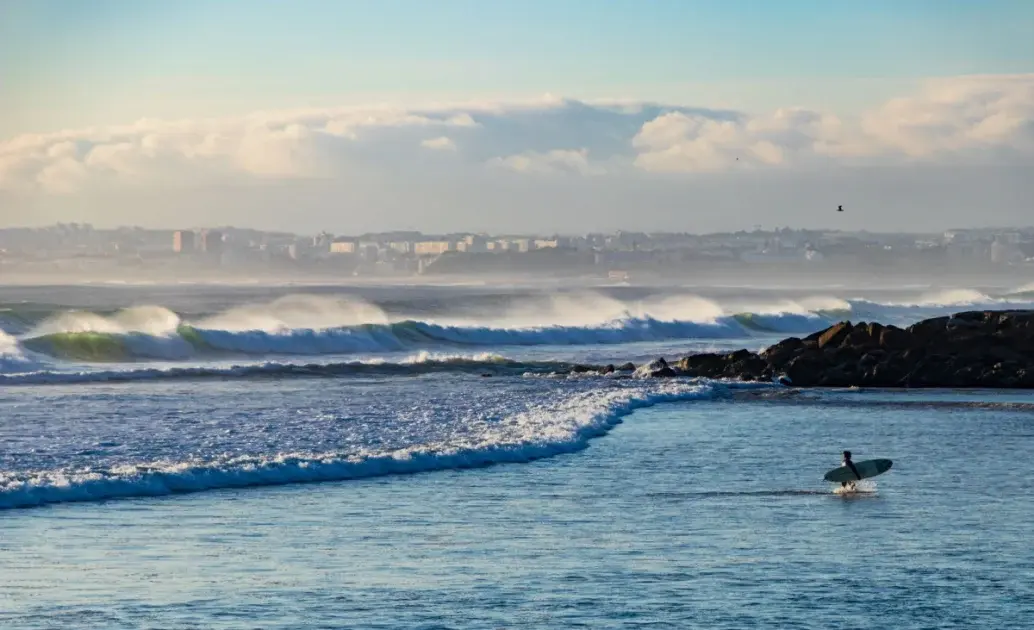
If there is one wave that defines Ericeira in the international surf imagination, it is Ribeira d'Ilhas. This is a world-class right-hand reef break that regularly hosts World Surf League (WSL) competition events, including Challenger Series rounds. The wave breaks over a rocky bottom and produces long rights with tubular sections and rideable shoulders — a rare combination that satisfies both the tube-hunter and the surfer who wants to work their turns.
Ribeira d'Ilhas's great advantage is its versatility: it works with swell between 0.5 and 3.5 metres and on all tides, though low-to-mid tide produces the most classic conditions. Intermediate surfers with a solid technical base can catch waves here without difficulty on moderate swell days; on bigger swells the line-up is dominated by experienced surfers.
There is parking near the beach and basic facilities. On competition days (typically October/November), access to the take-off zone may be restricted.
Recommended level: Intermediate to advanced (beginner in very small conditions with supervision).
Wave type: Reef break, predominantly rights.
Best tide: Low to mid.
Ideal swell: 0.5 m to 3.5 m.
Reef — The Central Intermediate Break
Known locally simply as "Reef", this is a reef break that produces fast rights with tubes when the conditions align. The seabed is a shallow rocky plateau that generates powerful and unpredictable waves. Intermediate surfers can enjoy it up to around 1 metre of swell; beyond that, the power and speed demand experience and solid reef break reading skills.
Recommended level: Intermediate to advanced.
Wave type: Reef break, rights.
Caution: Very shallow at low tide — always check the tide before paddling out.
Pedra Branca — Ericeira's Best Left
Pedra Branca is a left-hand reef break that many consider the best left within the World Surfing Reserve. The wave has a fast and steep take-off followed by a barrel section before opening onto a usable shoulder. The speed and power of the wave, combined with a sharp rocky bottom, make this break suitable for advanced surfers only.
It works best at mid-to-high tide with swell between 0.5 and 3 metres. With bigger swell (above 2.5 metres), Pedra Branca produces tube sections of a quality that is genuinely rare in the North Atlantic.
Recommended level: Advanced.
Wave type: Reef break, lefts.
Best tide: Mid to high.
Coxos — Portugal's Legendary Wave
Coxos is, for many European surfers, the best wave in Portugal — and there are credible arguments that it is one of the finest rights in the entire North Atlantic. This is a right-hand reef break producing long, fast and powerful barrels with swell between 1 and 3.5 metres. When the swell direction and wind align perfectly, Coxos delivers rides of 200 to 300 metres with multiple linked tube sections — the kind of wave that exists in only a handful of places on the planet.
Access is via a dirt track from the EN247 road, with limited parking at the clifftop. The descent to the beach is on foot down a steep path. There are no facilities at the beach.
Coxos is exclusively for experienced surfers. The shallow rocky bottom, wave power and rip current make this break dangerous for anyone without solid reef break experience. On bigger swell days the line-up draws some of the best Portuguese and international surfers.
Recommended level: Advanced (experienced in reef breaks).
Wave type: Reef break, long tubular rights.
Best tide: Low to mid.
Ideal swell: 1 m to 3.5 m.
Summary Table: Breaks by Level
| Break | Type | Level | Best Tide | Ideal Swell |
|---|---|---|---|---|
| Foz do Lizandro | Beach break | Beginner | Mid–high | 0.5–1.5 m |
| São Sebastião | Beach break | Beginner–Intermediate | All | 0.5–2 m |
| Praia do Sul | Beach/reef | Beginner–Intermediate | Mid | 0.5–1.5 m |
| Ribeira d'Ilhas | Reef right | Intermediate–Advanced | Low–mid | 0.5–3.5 m |
| Reef | Reef right | Intermediate–Advanced | Mid | 0.5–2 m |
| Pedra Branca | Reef left | Advanced | Mid–high | 0.5–3 m |
| Coxos | Reef right | Advanced | Low–mid | 1–3.5 m |
Best Season to Surf in Ericeira
One of Ericeira's greatest advantages over other European surf destinations is its year-round consistency. The North Atlantic swell machine delivers waves in virtually every month, but there are clearly better periods depending on your surfer profile.
Autumn (September–November) is the consensus best season: the first North Atlantic swells arrive with good direction and size, offshore winds are frequent in the mornings, the water is still warm from the summer months (17–19°C), and crowds begin to thin after the August peak. This is also competition season, with WSL events at Ribeira d'Ilhas worth watching even for non-surfers.
Winter (December–February) brings the most powerful swells and the biggest waves of the year, especially at Coxos and Ribeira d'Ilhas. Water temperature drops to 14–16°C (a 4/3 mm wetsuit is needed) and the number of surfers in the water drops significantly. Ideal for advanced surfers seeking consistency and uncrowded line-ups.
Spring (March–May) combines moderate swells with more variable wind. The water begins to warm (15–17°C) and beginner and intermediate breaks come back into regular form. It is a good season for surf camps.
Summer (June–August) is the lowest swell period, but waves are not absent — south-westerly swell still activates Ribeira d'Ilhas and the southern breaks consistently. This is the busiest time of year, with many surf schools in operation and full beaches. Sea temperature reaches 18–20°C and the water is comfortable without a wetsuit or with a short-arm suit.
Surf Schools and Surf Camps in Ericeira
Ericeira has one of the most developed surf school and surf camp offerings in Portugal, with options for all profiles and budgets.
Schools such as Ericeira Surf Camp, Ericeira Surf House and Grom Surf School offer standalone lessons (typically €35–55 per 90-minute session with equipment included) and weekly surf camp packages with accommodation, daily lessons, transfers and complementary activities from around €400–600 per week. Most operate from March to October, with some running year-round.
For intermediate and advanced surfers looking for technical coaching, video analysis sessions and guided sessions at the best break of the day are also available from specialist coaches based in the village.
If travelling with non-surfers, many surf camps offer combinations of surf + yoga, surf + climbing, or packages specifically designed for couples where one surfs and the other pursues alternative activities.
How to Get to Ericeira from Lisbon
By Car
Ericeira is about 50 km north-west of Lisbon. The most direct route follows the A8 motorway (direction Porto) to the IC16, then the A21 with an exit for Ericeira. In normal traffic the drive takes 40 to 50 minutes. On summer weekends, allow 1h to 1h20. Free parking is available at most beaches outside August, when peripheral car parks and a short walk become necessary.
By Bus from Lisbon
Mafrense operates the bus line between Lisbon (Campo Grande terminal) and Ericeira via Mafra. The direct journey takes 60 to 80 minutes and a single ticket costs around €5–6. Some services have capacity for surfboard transport — check with the operator. Updated timetables at mafrense.pt.
Alternatively, Wavy Bus (a private service launched in 2025) runs direct transfers between Lisbon, Ericeira, Peniche and Cascais, with service specifically designed for surfers travelling with boards. Check availability at wavybus.pt.
From Sintra
There is a direct bus connection from Sintra to Ericeira taking around 55 minutes, making it easy to combine a visit to Sintra's National Palace with an afternoon in Ericeira in a single day trip from Lisbon.
Ericeira Beaches for Non-Surfers
Ericeira is not exclusively a surfer's destination. Its beaches have plenty to offer those simply looking for a good beach day.
Praia do Sul and Praia de São Sebastião are the best options for calm swimming, with wide sands, lifeguards in summer and easy walking access from the centre. Praia de Foz do Lizandro, while shared with surfers, has a clearly marked swimming zone and is excellent for families.
For a wilder experience, Praia de Ribeira d'Ilhas has a uniquely panoramic setting with the surf competition viewing banks and views along the rocky coastline that justify the visit even on flat days.
For more beach options in the central Portugal region, see our central Portugal beaches guide, covering Nazaré, Figueira da Foz, São Martinho do Porto and Peniche.
Food and Drink: What to Eat in Ericeira
Ericeira is, before it is a surf village, a fishing village. And it shows on the plate. Fresh fish — sole, sea bass, gilt-head bream, horse mackerel and sardines — is the foundation of the local gastronomy, complemented by the shellfish typical of the Atlantic coast: percebes (barnacles), crabs and cockles.
- Mar a Vista — a local classic for shellfish and catch of the day, with a terrace overlooking the sea. Reservations recommended in July and August.
- A Panela — widely considered Ericeira's best traditional restaurant, with excellent grilled fish and seafood rice.
- O Pescador (Ribamar, 10 minutes by car) — outside the village but worth the trip, with benchmark seafood platters.
- Mar das Latas — more relaxed, with a good wine list and fresh fish snacks. Popular in the late afternoon after a surf session.
After surfing, the cafés and pastry shops of the historic centre — particularly on Rua Dr. Eduardo Burnay and Praça da República — are the meeting point of the local surf community. A galão (milky coffee) and a pastel de nata while reading the next day's forecast is one of the most authentic Ericeira experiences there is.
For a broader look at fish and seafood restaurants near Portuguese beaches, see our gastronomic guide to restaurants near Portugal's beaches.
Ericeira and the Coastal Hiking Trails
Beyond surfing, the coast between Ericeira and Mafra offers beautiful clifftop walking trails. The route from Ericeira to Praia de São Julião (around 8 km to the south) follows the clifftops with continuous Atlantic views and passes isolated beaches accessible only on foot. Watching the sunset from the clifftops with the open ocean ahead is one of the finest views on the central Portuguese coast.
For a complete guide to Portugal's best coastal walking trails, see our coastal trails guide.
Frequently Asked Questions about Ericeira Surf
Is Ericeira good for learning to surf?
Yes. Foz do Lizandro and Praia do Sul offer conditions suitable for beginners, with gentler waves than the northern reef breaks. Most of Ericeira's surf schools use these two breaks for first lessons. For fast progression in an intensive format, Ericeira's weekly surf camp packages are among the best options in Portugal.
What is the most famous surf break in Ericeira?
Coxos is widely considered the best wave in Portugal and one of the finest right-hand reef breaks in the North Atlantic. However, it is exclusively for experienced surfers with reef break experience. Ribeira d'Ilhas is the most internationally known break due to its WSL competition hosting and its accessibility to intermediate-to-advanced surfers.
What is the Ericeira World Surfing Reserve?
The World Surfing Reserve is a designation awarded by the Save The Waves Coalition to locations with world-class waves and coastal ecosystems of exceptional value, with the aim of protecting them from developments that could degrade them. Ericeira received this designation in 2011, making it the first in Europe and the second in the world. The reserve protects seven waves and the associated rocky coastline over approximately 4 km.
How much does a surf camp week in Ericeira cost?
Surf camp packages in Ericeira with accommodation, daily lessons (typically two sessions per day), equipment and transfers typically cost between €400 and €700 per week, depending on accommodation standard and the number of lessons included. Lessons-only packages without accommodation start from around €200–300 per week. In July and August, book at least 4–6 weeks in advance.
When do the surf competitions take place in Ericeira?
WSL (World Surf League) competitions at Ribeira d'Ilhas typically take place in October and November, when the consistent North Atlantic autumn swells arrive. The exact date varies annually based on conditions — the official calendar is published at worldsurfleague.com.
Conclusion
Ericeira is a rare thing in the European surf landscape: a destination that concentrates seven world-class waves within under 4 km, maintains the authenticity of a Portuguese fishing village, and sits less than an hour from a major European capital. Whether you are here for your first surf lesson at a certified school, a week of daily sessions at a surf camp, or to finally attempt Coxos after years of dreaming about it, Ericeira has the right answer.
For experienced surfers, autumn is the season of choice. For beginners and families, summer offers gentler conditions with the full support infrastructure in place. And for anyone who simply wants to breathe Atlantic air in one of the most beautiful historic village centres on the Portuguese coast, Ericeira works in any season.
Explore more beach guides and coastal destinations at praiasdeportugal.com and plan your next seaside adventure.