Portugal has for decades been one of the world leaders in the number of Blue Flag beaches. This international certification — awarded annually by the Foundation for Environmental Education (FEE) and managed in Portugal by ABAE (Associação Bandeira Azul da Europa) — is recognised by swimmers around the world as the most reliable indicator of water quality, safety, and environmental responsibility. In 2026, Portugal again ranks among the countries with the highest number of certified beaches in Europe, reflecting decades of investment in coastal management and bathing water quality.
This guide explains exactly what it means for a beach to hold a Blue Flag in 2026, what criteria are required, how to consult the official updated list, and which are the most notable beaches by region to plan your holiday with complete confidence.
What Is the Blue Flag and Who Awards It
The Blue Flag is an international environmental certification programme that has existed since 1987, when it was created in France during the European Year of the Environment. Today it is present in more than 50 countries across four continents. In Portugal, programme management is handled by ABAE, which annually evaluates all applications from municipalities and beach management entities.
Certification is neither automatic nor permanent: beaches must apply every year, meet updated criteria, and maintain conditions throughout the entire bathing season. A beach can lose its Blue Flag mid-season if, for example, water quality results become unsatisfactory, a hydrocarbon spill occurs nearby, or lifeguard coverage is no longer guaranteed during required hours.
The Four Blue Flag Criteria
The Blue Flag programme rests on four categories of criteria, each with mandatory parameters and guidance parameters:
- Water quality: This is the fundamental criterion. Water samples are collected regularly throughout the bathing season and analysed according to the European Bathing Water Directive (2006/7/EC). For a beach to obtain a Blue Flag, results must be classified as "Excellent" or "Good" on microbiological contamination parameters (intestinal enterococci and Escherichia coli). Any "Sufficient" or "Poor" result prevents or withdraws certification.
- Environmental management: Includes criteria for solid waste management (sufficient waste bins, recyclable separation), motor vehicle access control, absence of untreated effluents in the vicinity, and updated emergency plans.
- Safety and services: Mandatory presence of lifeguards throughout the entire bathing period, first aid equipment, emergency communication systems, and signage of swimming zones and hazards. Warning flags (green, yellow, red, purple) must be used correctly and bathers informed of their meaning.
- Environmental information and education: Information panels with data on water quality, local ecosystem characteristics, beach use regulations, and environmental education activities on site.
How Many Blue Flag Beaches Does Portugal Have in 2026
Portugal regularly has between 330 and 360 Blue Flag beaches, consistently placing it among the five countries with the most certifications in the world. For 2026, preliminary figures indicate a result similar to previous years, with the definitive list to be published in May by ABAE. The Algarve and Centre of Portugal are historically the regions with the highest concentration of awarded beaches.
The distribution of Blue Flag beaches reflects not only water quality but also the management capacity of local authorities. Municipalities such as Albufeira, Cascais, Leiria and Odemira have invested consistently in qualifying their beaches and regularly appear at the top of the national ranking by number of certifications.
Regional Distribution
| Region | Average No. of Certified Beaches | Reference Beaches |
|---|---|---|
| Algarve | ~80–90 | Meia Praia, Rocha, Falésia, Oura, Quarteira |
| Centre | ~90–100 | Nazaré, Figueira da Foz, São Martinho do Porto, Peniche |
| North | ~50–60 | Moledo, Caminha, Ofir, Matosinhos, Espinho |
| Lisbon and Setúbal | ~40–50 | Cascais, Carcavelos, Costa da Caparica, Sesimbra |
| Alentejo Litoral | ~20–30 | Porto Covo, Almograve, Zambujeira do Mar |
| Madeira and Porto Santo | ~10–15 | Porto Santo, Calheta, Machico |
| Azores | ~5–10 | Biscoitos Pools, Santa Maria |
The Best Blue Flag Beaches by Region in 2026
Algarve: Top-Tier Water Quality and Infrastructure
The Algarve has the most Blue Flag beaches in absolute terms and also brings together the most complete conditions: warm water, well-developed support infrastructure, and certified lifeguards on all certified beaches. The most notable beaches for 2026 include:
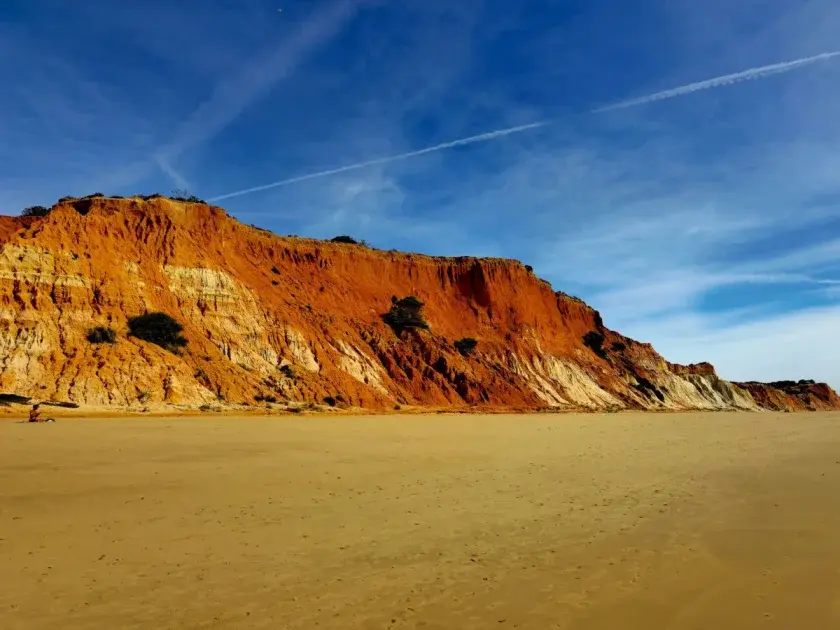
- Praia da Falésia (Albufeira/Olhos de Água): One of the longest beaches in the Algarve (6 km), with consistently excellent water quality and red sandstone cliffs that create a visually unique contrast. Blue Flag certified uninterruptedly for more than 15 years.
- Praia da Rocha (Portimão): The quintessential urban beach of the Algarve, with the highest concentration of support services and a lifeguard post recognised as a national model. Facilitated access for people with reduced mobility.
- Meia Praia (Lagos): At 4 km long, one of the easiest beaches to enjoy without crowds outside July and August. Excellent water quality and a classified inland dune system.
- Praia de Quarteira (Loulé): Urban beach with full services, including fitness equipment on the beach and a seafront promenade that facilitates access for all visitors.
To explore more beaches in this region, see our guide to the best beaches of the Algarve and our Algarve beach directory.
Centre of Portugal: The Region with the Most Blue Flags
The Centre region is, in absolute terms, the one that concentrates the largest number of Blue Flag beaches in Portugal. The combination of cooler North Atlantic waters — which tend to have excellent microbiological quality — with municipalities such as Leiria, Marinha Grande and Peniche that have invested heavily in certification, results in a dense map of certified beaches. Notable beaches include Nazaré, São Martinho do Porto (ideal for families with its calm, sheltered bay), and the multiple Blue Flag stretches around Peniche and Baleal.
North: Minho Beaches with Certified Quality
Northern Portugal beaches have different characteristics from those in the south: cooler water, darker sands, and generally lower visitor density. For 2026, Blue Flag beaches in Minho and Douro include some of the most qualified in the country: Moledo and Forte beach in Caminha (exceptional water quality next to the River Minho estuary), Ofir in Esposende (extensive, uncrowded, with classified dune), and Matosinhos (the most urban northern beach, directly connected to Porto Metro).
Lisbon and Setúbal: Cascais and the Blue Coast
The coast between Cascais and Costa da Caparica concentrates some of the most visited beaches in the country. Usage pressure is higher, but water quality generally remains at the level required for Blue Flag certification. Key beaches include Carcavelos (closest Blue Flag beach to Lisbon, direct train access), Sesimbra and Portinho da Arrábida (exceptional water quality protected by the Arrábida Natural Park), and the numbered stretches of Costa da Caparica. See our complete Cascais beaches guide for detailed access information.
How to Verify Blue Flag Status in Real Time
The Blue Flag can be suspended during the bathing season if criteria are no longer met. To check the current status of any Portuguese beach, there are three official sources:
- ABAE (abae.pt): The official programme website in Portugal. Contains the updated list of all certified beaches, water quality analysis results per beach, and the date of the last analysis. Information is updated regularly throughout the bathing season.
- SNIAMB — National Environment Information System (sniamb.apambiente.pt): Managed by the Portuguese Environment Agency (APA), provides historical and real-time data on bathing water quality in Portugal, including classifications under the European Directive.
- Blue Flag App (iOS and Android): Allows you to locate nearby Blue Flag beaches in any participating country, with basic information and an interactive map.
Blue Flag vs. Praia de Ouro: What Is the Difference
In Portugal, there is frequent confusion between two certifications that can coexist at the same beach: the Blue Flag and the Praia de Ouro (Golden Beach).
The Blue Flag is an international programme with rigorous criteria on water quality, safety, environmental management and information. The focus is on responsible and sustainable management of the bathing space. The Praia de Ouro is a national certification (also managed by ABAE) that recognises beaches that go beyond Blue Flag criteria and meet additional requirements for service quality, accessibility and sustainability. A beach can hold both certifications simultaneously. For families with children, the Praia de Ouro adds the guarantee of superior quality services. For more on the best family beaches, see our family beach guide.
FAQ — Blue Flag Portugal 2026
How many beaches have a Blue Flag in Portugal in 2026?
Portugal typically has between 330 and 360 Blue Flag beaches per year, placing it among the five countries with the most certifications in the world. The definitive list for 2026 is published by ABAE in May/June. Portugal frequently leads the European ranking by number of certified beaches, alongside Spain, Greece, France and Italy.
Does the Blue Flag guarantee the water is clean?
The Blue Flag is the most reliable guarantee available on bathing water quality in Portugal. For a beach to obtain and maintain certification, water analyses must record "Excellent" or "Good" results according to the European Bathing Water Directive. However, water quality can vary after heavy rain (which can transport agricultural or urban contamination to the sea) or following extreme weather events. In such cases, a red flag or specific warning is placed at the beach, regardless of Blue Flag certification.
What is the best Blue Flag beach in Portugal for families?
For families with young children, the best Blue Flag beaches are those that combine calm water, full support services, and good accessibility. Nationally, the standouts are: Praia de São Martinho do Porto (natural sheltered bay, calm waters), Praia da Rocha in Portimão (full services, ramp access), and Praia de Sesimbra (exceptional water, fishing village atmosphere). For a full list, see our family beaches guide.
Can a beach lose its Blue Flag during the bathing season?
Yes. The Blue Flag can be suspended or withdrawn at any time during the bathing season if criteria are no longer met. The most common reasons include: unsatisfactory water quality analysis results, absence of lifeguards during mandatory hours, an environmental accident nearby (hydrocarbon spill, effluent discharge), or failure to meet signage and public information criteria. Suspension is communicated immediately by ABAE and is visible on the official website.
How do I know if a specific beach has a Blue Flag this year?
The most direct way is to consult the official ABAE website at abae.pt, which maintains the updated list of all certified beaches in real time. You can also check the Portuguese Environment Agency website (apa.pt) under the bathing waters section, or use the official Blue Flag app available for iOS and Android.
Conclusion
The Blue Flag is far more than a blue-and-white flag hoisted on a beach: it is the result of a rigorous evaluation process that guarantees bathers the best conditions of safety, environmental quality and services. Portugal, with more than three decades of participation in the programme and consistently among the world leaders in number of certified beaches, has every reason to be proud of its coastline.
For the 2026 bathing season, check the definitive list at abae.pt when it is published in May/June, plan your holiday in advance, and explore our beach directory to find the Blue Flag beaches closest to your destination in Portugal.