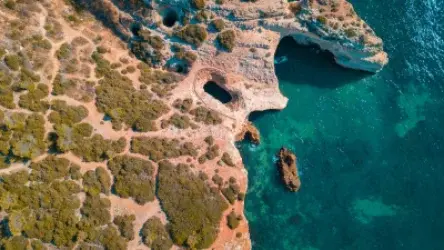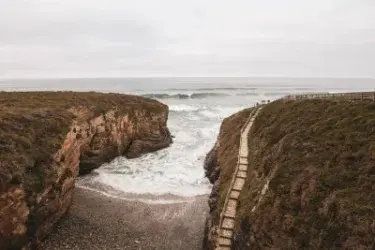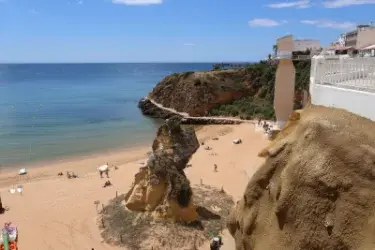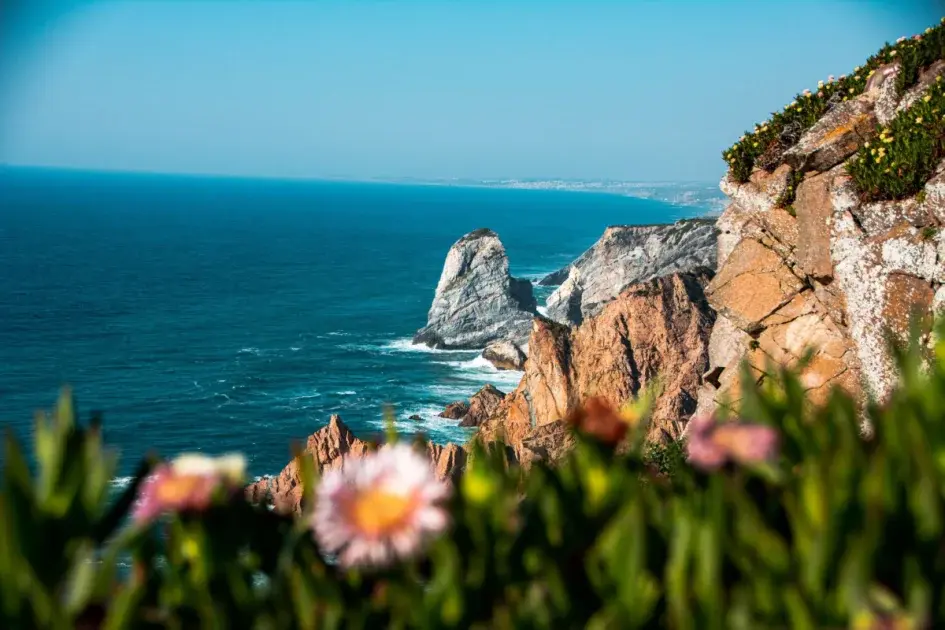
Sintra is world-famous for its fairy-tale palaces and UNESCO World Heritage landscape. But just a few kilometres to the west lies a different Sintra — one that faces the full force of the Atlantic, where wild beaches sit beneath dramatic cliffs and the light at sunset turns the ocean silver. The Portuguese call this stretch the Costa da Lua (Moon Coast), a name that captures both the silvery quality of light here and the sense of standing at the very edge of the known world. After all, just 6 km from Praia da Ursa stands Cabo da Roca — the westernmost point of continental Europe.
Unlike the Algarve's sheltered coves, Sintra's beaches demand a little preparation: the water is cold (17–20°C in summer), afternoon northerly winds can be strong, and some beaches are completely unsupported by services. The reward is equally outsized: dramatic scenery, uncrowded sands in September, and experiences that feel genuinely off the beaten track even in one of Portugal's most-visited regions.
This complete 2026 guide covers all seven key beaches of the Sintra coast, with access details, parking, lifeguard seasons and the unique highlights of each — including the dinosaur footprints at Praia Grande (110–125 million years old), the historic 1904 electric tram to Praia das Maçãs, and the natural ocean pool at Azenhas do Mar.
Praia da Ursa: The Most Spectacular and Most Wild
Praia da Ursa is, by near-universal agreement, the most photogenic beach on the Sintra coast — and the most demanding to reach. There is no road to the beach. There are no lifeguards, no beach bar, no facilities of any kind. The only access is a 2.5 km round-trip trail that descends 150 metres in elevation over the final 400 metres before the sand. The reward: two enormous rock stacks rising from the Atlantic in the middle of the beach — the Ursa (the Bear) and the Homem (the Man) — creating a scene of almost prehistoric grandeur.
Tidal conditions dramatically affect the size of the beach: at low tide Ursa opens into a generous crescent of sand; at high tide the available beach can become quite narrow. Check tide tables before setting out.
How to Get to Praia da Ursa
Access is by car or bicycle to the trailhead only. From Sintra town centre, follow the N247 towards Azóia and Cabo da Roca. The trail starts approximately 1 km before the Cabo da Roca viewpoint, along the Estrada do Cabo da Roca: look for a small dirt parking area beside a red and white gate. GPS coordinates of the car park: 38.7755, -9.4966.
The trail to the beach is approximately 1.2 km one way. The first 800 metres are easy, offering stunning coastal views. The final 400 metres involve a steep descent over loose rock — firm-soled shoes are essential. Allow 20–25 minutes down and 30–40 minutes back. Budget about 1 hour for the round trip, not including beach time.
Best time to visit: September and October, when swell is more moderate, the trail is dry, and late-afternoon light is extraordinary. Avoid strong north-wind (Nortada) mornings in July and August. Sunrise and sunset at Praia da Ursa are among the finest on the entire Lisbon coast.
Praia da Adraga: The Perfect Balance of Drama and Accessibility
Praia da Adraga is widely cited as the best beach in Sintra for those seeking dramatic scenery with at least basic services. Framed by two limestone headlands, with approximately 600 metres of golden sand, Adraga is more sheltered than Ursa — the flanking cliffs provide some protection from the north wind — while remaining a genuinely Atlantic beach with real swell and lateral currents.
Located in the parish of Almocageme, near the southern end of the Sintra coast, Adraga is accessible by car, has a seasonal lifeguard, and is home to a legendary seafood restaurant right on the beach edge. The sandy floor makes bathing more accessible than some of the rockier Sintra beaches. Families with older children enjoy it well; the strong swell and currents mean it is not ideal for very young children or weak swimmers.
How to Get to Praia da Adraga
By car from Sintra: follow the N247 towards Almocageme, then follow signs for Praia da Adraga. The free car park is directly at the beach entrance — capacity approximately 80 vehicles. In July and August, arriving after 10:00 AM risks finding no space; an alternative is to park in Almocageme village (about 1.5 km away) and walk down. GPS coordinates: 38.8007, -9.4739.
By public transport: Praia da Adraga has no direct bus service. The closest option is Scotturb 441 to Almocageme, followed by a 1.5 km walk.
Lifeguard season: 15 June to 15 September, 09:00–19:00. Outside this period the beach is open but unsupervised.
The Restaurante Adraga, open since the 1980s, serves fresh grilled fish, fish soup, and clams right at the edge of the sand. Reservations are strongly advised in high season — weekend waits can exceed an hour.
Praia Grande: Dinosaur Footprints and the Best Surf on the Moon Coast
Praia Grande do Rodízio is the largest beach on the Sintra coast — approximately 1.5 km of sand — and the one with the most complete facilities: a large car park, seasonal lifeguard, beach bar, restaurants, and accessible boardwalks over the sand. It is also the preferred beach for surfers and bodyboarders, with consistent waves that work best in north and northwest swells.
But Praia Grande's most unique feature is written in its rocks: the largest concentration of dinosaur footprints on the Portuguese coast, with approximately 66 tracks across 11 separate trails, dated to 110–125 million years ago (Early Cretaceous). Discovered in 1981 by geologist José Madeira, the prints belong to at least three dinosaur types: theropods, sauropods, and ornithopods.
How to See the Dinosaur Footprints
The footprints are on the rock slabs at the southern end of the beach, at the base of the cliffs. For the best visibility, visit in early morning or late afternoon when raking light creates shadow in the impressions. A handrailed trail leads up the cliffs with a dedicated viewing platform. Access is free and always open. Please do not cover the prints with sand or place objects on them — they are protected geological heritage.
How to Get to Praia Grande
By car from Sintra: N247 towards Colares, then N247-3 to Praia Grande. Paid parking in high season (~€2–3/hour), free off-season. GPS coordinates: 38.8340, -9.4550. By public transport: Scotturb 439 bus from Portela de Sintra station (take the CP suburban train from Lisbon Rossio, ~37 min), journey Portela de Sintra to Praia Grande ~35 min. Frequency: 1–1.5 hours in low season; more frequent in July/August.
Lifeguard season: 15 June to 15 September, 09:00–19:00.
Praia das Maçãs: The Village with the Centenarian Tram
Praia das Maçãs stands apart from all other Sintra beaches by having a genuine village identity: a main street with traditional taverns, small craft shops, family guesthouses and a summer atmosphere that recalls the Portuguese coastal resorts of the 1980s. It is the most 'urban' beach on the Moon Coast, in the very best sense. The sand stretches for about 700 metres, and the Rio das Maçãs river flows into the sea here — creating a shallow, calm water zone near the mouth that is especially popular with families with young children.
The most iconic element of Maçãs is the Sintra Electric Tram: the oldest tram in continuous operation in the Iberian Peninsula, first running in 1904, which travels 13 km from Sintra station to Praia das Maçãs through quiet valleys and farmland of the Serra. The journey takes approximately 45 minutes in wooden carriages painted yellow and blue. The tram is as much a tourism attraction as the beach itself.
Sintra Tram — Practical Information 2026
- Operation: Mid-June to mid-September (summer); weekends in spring and autumn.
- Summer schedule: Approximately 3 departures per day from Sintra (Estefânia) station; confirm exact times at visitsintra.travel or at the station ticket office.
- Adult ticket (one way): €5; ages 7–18 and seniors 65+: €2.50; children 0–6: free (if not occupying a seat).
- Journey time: ~45 minutes, Sintra to Praia das Maçãs.
- Bus alternative: Scotturb 441 from Portela de Sintra, ~20 min, frequency ~1 hour.
How to Get to Praia das Maçãs
By car from Sintra: N247 towards Colares, then follow signs to Praia das Maçãs. Village parking, partially paid in August. GPS coordinates: 38.8508, -9.4773. Lifeguard season: 15 June to 15 September, 09:00–19:00.
Azenhas do Mar: Portugal's Most Photogenic Ocean Pool
If there is one image that represents Sintra's coast to the world, it is the white-washed village of Azenhas do Mar perched on its clifftop, with a natural seawater pool at its base. The photograph has been shared millions of times and appears in countless travel guides — but seeing it in person carries a scale and atmosphere that no screen conveys.
The village of Azenhas do Mar is itself a remarkable sight: whitewashed houses built directly onto the cliff rock, some literally cantilevered over the sea, with the Restaurante Azenhas do Mar occupying a privileged position on the headland with full Atlantic views. The natural ocean pool at the cliff base is fed by the tidal cycle: at low tide a rocky beach opens and the pool is ideal for swimming — crystal-clear water, 1.5 to 2.5 metres deep, accessible to children and adults alike. At high tide the beach access is limited.
How to Get to Azenhas do Mar
By car from Sintra: N247 towards Colares, then N247 to Azenhas do Mar. Village parking (free, very limited in August). GPS coordinates of the ocean pool: 38.8376, -9.4561. By public transport: Scotturb 441 from Portela de Sintra with a stop at Azenhas do Mar (~20–25 min). The stop is in the upper part of the village; allow 10 minutes on foot to reach the pool.
Entry to the pool is free and access is 24 hours. There is no permanent lifeguard — this is classified as an unsupervised beach. Consult tide tables: best visited at low tide or as the tide is going out. The famous cliff-top photograph is taken from the N247 road above the village — you don't need to descend to the beach to get that shot.
Praia do Magoito: Golden Fossil Cliffs and Family-Friendly Sand
Praia do Magoito sits at the northern end of the Sintra coast and has a unique geological characteristic: its cliffs are formed from fossilised Pleistocene sands (approximately 100,000 years old), which give them an unusual golden-orange colour — very different from the grey schist typical of the Sintra coastline. The beach itself extends about 600 metres, with a generous width even at high tide, and the Ribeira de Magoito stream flows into the sand — creating a shallow warm zone where children love to play.
The village of Magoito, just above the beach, is quiet and authentic: one main street with a café-restaurant and little else. There is none of the resort atmosphere of Maçãs, nor the full services of Praia Grande — which for many visitors is exactly the appeal.
How to Get to Praia do Magoito
By car from Sintra: N247 north towards Mafra, exit for Magoito after Colares. Free village parking. GPS coordinates: 38.8867, -9.4370. By public transport: Scotturb 441 or 460 from Portela de Sintra with a Magoito stop. Lifeguard season: 15 June to 15 September, 09:00–19:00.
Comparison Table: Which Sintra Beach Should You Choose?
| Beach | Length | Access | Lifeguard | Best For |
|---|---|---|---|---|
| Praia da Ursa | ~400 m | Trail only (2.5 km) | No | Photography, adventure, solitude |
| Praia da Adraga | ~600 m | Car (car park) | Jun–Sep | Couples, scenery, seafood |
| Praia Grande | ~1.5 km | Car + bus | Jun–Sep | Surf, families, dinosaur prints |
| Praia das Maçãs | ~700 m | Car + tram/bus | Jun–Sep | Families, village life, tram ride |
| Azenhas do Mar | Ocean pool | Car + bus | No | Photography, architecture, snorkelling |
| Praia do Magoito | ~600 m | Car + bus | Jun–Sep | Families, geology, calm atmosphere |
Getting to the Sintra Beaches from Lisbon
Sintra's beaches are 40–55 km from central Lisbon, depending on your destination beach. By car, the fastest route is the A37 (CREL ring road) and A16 towards Sintra, then south on the N247 coastal road. Allow 45–60 minutes from central Lisbon — avoid weekend summer mornings between 9:00 and 11:30 AM when the N247 can back up considerably.
By public transport, the base route is always: train from Lisbon Rossio to Sintra (CP Sintra line, ~40 min, ~€2.35) then Scotturb bus or electric tram to your chosen beach. The Sintra line is frequent and comfortable; the Sintra-to-beach leg can involve 30–60 minute waits between buses in low season.
Water Temperature and Best Time to Visit
The Sintra coast is significantly affected by the coastal upwelling current that intensifies along Portugal's western coast from May to August: north winds push warm surface water offshore, and cold deep water rises to replace it. In practice, water temperatures on this coast can be 3–5°C colder than the Algarve, and may dip below 15°C even in mid-August.
- May–June: 14–17°C (cold; surfing and walks yes, bathing requires a wetsuit)
- July–August: 16–20°C (highly variable; warm days with 20°C exist, but average is 17°C)
- September–October: 18–21°C (often the best time — warmest water of the year, quieter beaches, stunning late-afternoon light)
- November–April: 13–15°C (cold; deserted beaches, dramatic scenery, quality surf)
The best time to visit Sintra's beaches is September and early October: water reaches its annual maximum temperatures (18–21°C), the sands become progressively quieter after August school holidays, and photographic light in the late afternoon is exceptional. For those who don't mind cold water, June is also excellent: energetic sea, good surf, and the landscape still lush from spring rains.
Cabo da Roca: The End of Europe, 6 km from Praia da Ursa
No visit to the Sintra coast is complete without a stop at Cabo da Roca (GPS: 38.7831, -9.5000), the westernmost point of continental Europe. Just 6 km from Praia da Ursa along the N247, the Cape rises 140 metres above the Atlantic in an almost vertical cliff, topped by a lighthouse built in 1772 that still guides ships today. The Portuguese poet Luís de Camões immortalised this place in his epic Os Lusíadas with the line "Where the land ends and the sea begins".
Access is free and the car park is large (paid in high season, ~€2/hour). A visitor centre sells an official certificate proving your visit to the westernmost point of continental Europe — a uniquely physical souvenir (€13). The craft shop and café operate daily. Cabo da Roca combines naturally with Praia da Ursa or Praia da Adraga on the same day trip.
Frequently Asked Questions about Sintra Beaches
Can you visit Sintra's beaches without a car?
Yes, but with some limitations. Praia Grande, Praia das Maçãs, Azenhas do Mar, and Praia do Magoito are all accessible by bus (Scotturb routes 439, 441, 460) from Portela de Sintra station (CP suburban train from Lisbon Rossio). Praia da Adraga requires an additional 1.5 km walk from the Almocageme bus stop. Praia da Ursa is accessible only on foot from a trailhead that itself requires a car.
Which Sintra beach is best for families with young children?
Praia das Maçãs is the top recommendation: lifeguard-supervised, with a river mouth creating a shallow calm zone for small children, a village with restaurants and ice cream, and the tram ride making the journey itself an adventure. Praia Grande is a strong second choice for families with older children — the dinosaur footprints are a genuine highlight, and it has the most complete services on the coast.
Is the water safe for swimming at Sintra beaches?
In terms of water quality, yes — all lifeguarded beaches hold Excellent or Good classifications from the APA (Portuguese Environment Agency). In terms of temperature, it is cold compared to the Algarve (16–20°C in summer). In terms of sea conditions, it can be rough — always check the marine forecast at ipma.pt and follow the flag system and lifeguard instructions.
Where exactly are the dinosaur footprints at Praia Grande?
The footprints are on rock slabs at the southern end of Praia Grande, at the base of the cliffs. There are 66 tracks dated to 110–125 million years ago (Early Cretaceous), from theropods, sauropods, and ornithopods. Access is free with a handrailed viewing path and platform. Best viewed in early morning or late afternoon light when raking illumination highlights the relief of the impressions.
Does the Sintra tram run year-round?
No. The Sintra Electric Tram operates mainly in the summer season (mid-June to mid-September) and at weekends in spring and autumn. It is generally suspended during winter. Check the current timetable at visitsintra.travel before your visit.
Conclusion: The Moon Coast Deserves More Than a Day Trip
The beaches of Sintra are among the least over-exploited coastal destinations within an hour of Lisbon. Their Atlantic identity — cold water, lively winds, dramatically beautiful cliffs — is unlike any other Portuguese beach zone, and that is precisely what makes them special. If you have one day, choose between Praia da Ursa (for the most wild experience) or the Praia Grande and Praia das Maçãs combination (for the most complete and family-friendly day). With two days, combine a morning at Adraga with an afternoon at Cabo da Roca, and save the second day for Praia Grande with the dinosaur footprint walk.
To plan other stops along the Portuguese coast, explore our complete guide to the beaches of Cascais, just 20 km south along the Estoril coast, or our guide to Portugal's coastal hiking trails for combining beaches with clifftop walking. For a full overview of the Lisbon region coast, see our guide to the best beaches near Lisbon.