Portugal boasts over 800 kilometres of coastline, crystalline rivers, sheltered lagoons and some of the most consistent Atlantic winds in Europe. It comes as no surprise that the country has become one of the top destinations in Europe for water sports — from kayaking and stand-up paddleboarding (SUP) to kitesurfing and windsurfing. Whether you are planning an active holiday or simply want to try something new on a beach morning, this guide covers the best spots in Portugal for each discipline, region by region.
Unlike surfing — already well documented — activities such as sea kayaking, SUP, kitesurfing and windsurfing are growing rapidly in popularity, with an increasingly accessible network of schools and rental centres. Portugal has exceptional natural conditions for all of these disciplines, and the best season for most runs from April through October.
Key Takeaway: Portugal offers world-class conditions for kayaking, SUP, kitesurfing and windsurfing along its entire coast. The Algarve is the top destination for cave kayaking and SUP; Guincho and Óbidos Lagoon are the benchmark kite and windsurf spots; Ria de Aveiro and Ria Formosa are perfect for beginners. Best season: April to October.
Kayaking in Portugal: Caves, Rias and Estuaries
Sea and river kayaking is one of the fastest-growing water sports in Portugal, thanks to the sheer variety of natural settings available. You can paddle through the open ocean to explore caves inaccessible on foot, glide through protected coastal lagoons, or drift down tranquil rivers surrounded by pristine nature. Rental and guided tour options are widely available, making the activity accessible even to complete beginners.
Benagil Caves, Algarve — The Iconic Kayaking Spot
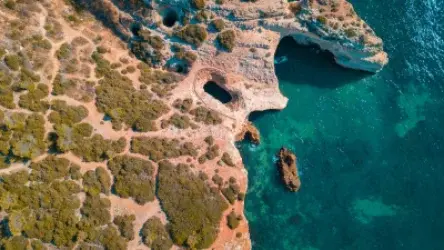
Benagil Cave, near Lagoa, is arguably Portugal\'s most photographed kayaking destination. The only way to access the cave\'s extraordinary domed interior — with its natural skylight illuminating a private beach below — is by sea, and kayaking lets you do it at your own pace. Several companies at Praia de Benagil and nearby Carvoeiro offer rental and guided tours. Best time: May to September, early morning to avoid congestion. Difficulty: Easy to Moderate (watch for currents near cave entrances).
Ria Formosa, Algarve — Kayaking in a Protected Natural Park
The Ria Formosa Natural Park — more than 18,000 hectares stretching from Faro to Tavira — is a paradise for lagoon kayaking. Its calm, ocean-sheltered waters make it suitable for all abilities. You can explore barrier islands, spot flamingos and seahorses, and discover fishing villages only reachable by water. From Tavira, several operators run half-day and full-day tours. Difficulty: Very Easy (ideal for families and first-timers).
Ria de Aveiro — Portugal\'s Kayaking Venice
The Ria de Aveiro is one of Portugal\'s largest coastal lagoons and a top destination for canoeing and kayaking. Its winding channels allow you to explore at your own pace — from leisurely paddles past salt flats and traditional moliceiro boats to longer routes through wildlife reserves. Murtosa, nicknamed the "Green Venice," is one of the most popular starting points. Difficulty: Easy.
River Lima and River Minho, Northern Portugal
In the far north, the Minho and Lima rivers offer spectacular scenery for river kayaking. A paddle along the River Lima between Arcos de Valdevez and Ponte de Lima passes lush riverbanks, medieval bridges and granite villages — a memorable experience blending nature and culture. See our River Lima route guide for full details. Difficulty: Easy to Moderate (depending on seasonal flow).
SUP (Stand Up Paddleboarding) in Portugal: Best Flat Waters and Scenic Routes
Stand up paddleboarding has taken Portugal by storm in recent years. The discipline blends exercise, balance and nature, and can be practised on flat water or in small surf. It is ideal for families, couples and solo travellers who want to explore the coastline from a unique perspective. Board rentals are available at virtually every major beach during summer.
Alvor Lagoon, Algarve — The Ideal SUP Destination
The Ria de Alvor, near Portimão, is widely regarded as one of Portugal\'s best SUP spots. The calm, shallow lagoon — sheltered from ocean swell — is perfect for beginners and for those who want to paddle through a biodiversity-rich ecosystem: migratory birds, seagrass meadows and coastal wildlife. Schools with rentals and lessons operate along the lagoon edge. Best season: April to October. Difficulty: Very Easy.
Arrábida Natural Park — SUP in Crystal-Clear Waters
The turquoise waters of the Arrábida Natural Park offer an Atlantic rarity: visibility of up to 10 metres on calm days. SUP here is a genuinely special experience — you can look straight down through your board at rocky seabeds and fish, explore protected coves and reach sections of coastline unreachable on foot. Difficulty: Easy to Moderate (watch for southerly winds).
Ofir Nature Reserve and River Cávado, North
At the mouth of the River Cávado, the Ofir Nature Reserve offers SUP paddling through white sand dunes and coastal pine forest. At low tide, you can navigate narrow channels into zones of absolute stillness, accompanied by herons and kingfishers. Difficulty: Easy (on the lagoon); Moderate (approaching the ocean).
Kitesurfing in Portugal: Atlantic Winds for Every Level
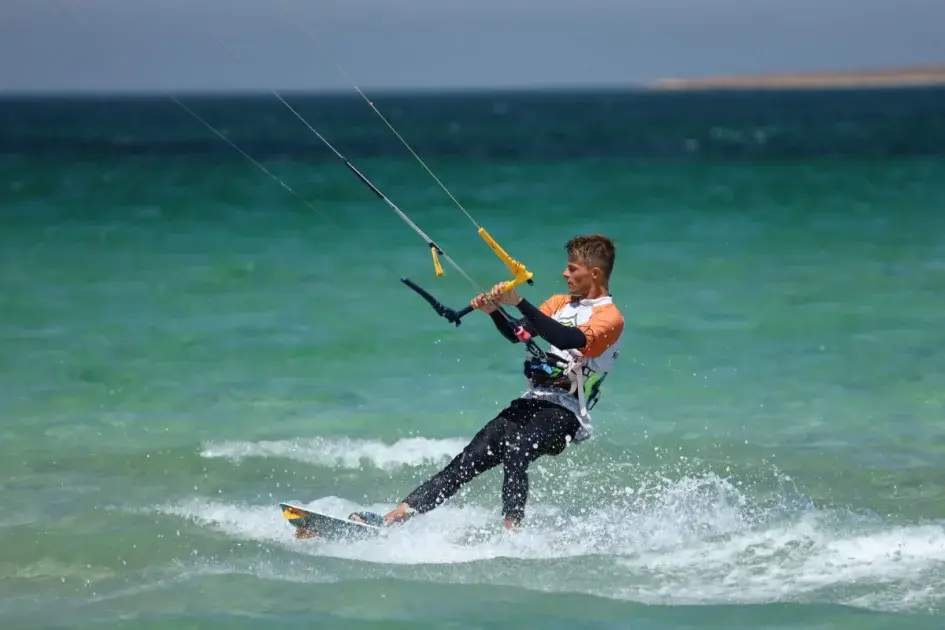
Portugal is one of Europe\'s most complete kitesurfing destinations, with spots suitable for every level — from flat-water lagoons for beginners to ocean beaches with consistent wind and waves for experienced riders. The dominant wind is the Nortada — a northerly that blows reliably from May to September, particularly along the coast north of Lisbon. In the south, thermal summer winds deliver near-daily sessions across the Algarve.
Guincho Beach, Cascais — The Most Challenging Spot
Guincho is without question Portugal\'s most celebrated kitesurfing spot. Located 10 km from central Cascais, this Atlantic beach receives the full force of the Nortada — winds of 20 to 40 knots are common in July and August. This is a spot for experienced riders: the wind is gusty and irregular, waves can reach 2 to 3 metres, and lateral currents demand constant awareness. For beginners, Guincho is a place to watch, not to learn. Dominant wind: N/NW. Best season: June to September. Level: Intermediate to Advanced.
Óbidos Lagoon — The Kitesurfing School Par Excellence
Portugal\'s largest saltwater lagoon (6.9 km²) is the go-to destination for learning kitesurfing and windsurfing. Just one hour from Lisbon, it offers unique conditions: flat, ocean-protected water, consistent multi-directional wind, and ample space to manoeuvre safely. Several IKO-certified schools operate here. The same location is excellent for wingfoiling, SUP and dinghy sailing. Dominant wind: N/NW/SW. Level: Beginner to Advanced.
Cabedelo Beach, Viana do Castelo — The Best of the North
At the mouth of the River Lima, Praia do Cabedelo is northern Portugal\'s top kitesurfing spot. The combination of consistent wind, relatively calm estuary water and open ocean waves makes it versatile for all styles — freeride, wave and freestyle. The town of Viana do Castelo, with its Minho architecture and local gastronomy, makes an excellent base for a week of kiting. Dominant wind: N/NW. Best season: May to September. Level: All levels.
Alvor Lagoon, Algarve — Kite with Guaranteed Sun
In the Algarve, the Alvor Lagoon is the reference spot for kitesurfing. Flat lagoon water, thermal summer winds and reliable sunshine make it a popular choice for combining learning with a beach holiday. Schools along the shore offer state-of-the-art equipment and certified instructors. Dominant wind: SW/W (thermal). Best season: May to September. Level: Beginner to Intermediate.
Windsurfing in Portugal: Atlantic Tradition with World-Class Winds
Windsurfing has a long tradition in Portugal. The country has hosted stages of the PWA World Windsurf Championship and boasts internationally recognised spots. The Nortada wind that sweeps the Portuguese Atlantic coast from May to September is among the most consistent in Europe, making Portugal a prime destination for windsurfers of every level.
Guincho Beach — High-Performance Windsurfing
The same powerful winds that draw kiters to Guincho make it an equally iconic windsurf spot. Ocean swell and the Nortada combine for memorable wave-riding sessions. This is a demanding spot, suited to experienced windsurfers with equipment designed for strong wind conditions. Level: Advanced.
Óbidos Lagoon — Windsurfing for Everyone
For those learning or seeking a relaxed session, Óbidos Lagoon is the best option. The Escola de Vela da Lagoa, with over 27 years of experience, runs windsurf courses for all ages. Flat water and consistent wind create a safe, progressive learning environment. Level: All levels.
Costa Nova and Praia da Barra, Aveiro — Windsurfing with Unique Scenery
The striped palheiro houses of Costa Nova provide a uniquely photogenic backdrop for windsurfing. The northerly wind blows reliably through summer, and the beach configuration allows sessions both in the ocean and in the calmer lagoon-side waters. Level: Intermediate.
Schools, Lessons and Equipment Rental
Portugal\'s network of water sports schools and rental centres has expanded significantly in recent years. Key references by region:
- Algarve: Schools in Alvor (kitesurf, SUP), Vilamoura (wakeboarding, jet ski), Sagres (surf, SUP, kayak) and Lagos (kayak, snorkelling, SUP)
- Lisbon and Cascais: Kitesurf schools at Guincho and Fonte da Telha (Costa da Caparica); SUP and kayak at Arrábida and Setúbal
- Silver Coast: Escola de Vela da Lagoa de Óbidos (windsurf, kitesurf, SUP, sailing); surf and SUP schools in Peniche and Nazaré
- Aveiro: Canoeing and SUP centres on the Ria de Aveiro; kitesurfing at Costa Nova and Murtosa
- North: Kitesurf and windsurf schools in Viana do Castelo (Cabedelo); kayak and canoe on the Lima, Minho and Cávado rivers
Average costs: a two-hour introductory kitesurfing or windsurfing lesson runs €60–€120. SUP board rental costs €15–€25/hour. Single kayak rental ranges from €10–€20/hour; double kayaks from €20–€35/hour.
When to Go: Season and Conditions by Sport
- Kayak and SUP (beginners): May to September — calm morning seas, comfortable water temperatures (19°C–24°C in the Algarve)
- Kitesurfing and windsurfing (Nortada coast): June to September — most consistent winds on the Atlantic coast north of the Algarve
- Kitesurfing and windsurfing (Algarve): May to October — thermal summer winds; more moderate and regular conditions
- Cave kayaking (Algarve): April to October — preferably early morning (less boat traffic, calmer sea)
- Wave windsurfing (Guincho): September to November — more consistent swell, strong winds, less crowded
Use Windguru or Windy (both available as mobile apps) for real-time wind and sea forecasts. Our interactive beach map can help you locate the nearest spots to your base.
Safety on the Water: Essential Rules
- Know your limits: Do not kitesurf or windsurf in strong winds without proper training. Atlantic currents are unpredictable.
- Wear a buoyancy aid: Mandatory for open-sea kayaking and SUP. Most reputable rental centres include safety gear in the price.
- Check the forecast: Never enter the water without reviewing the wind and swell forecast for the next few hours. A calm SUP session can become dangerous with unexpected wind.
- Tell someone your plan: Always let someone know where you are going and when you expect to return, especially in remote areas.
- Use designated zones: Many beaches have designated areas for water sports, separate from swimming zones. Respect the signage.
- Sun protection: Water reflects UV radiation significantly. Apply high-factor sunscreen and reapply every two hours.
Water Sports and Environmental Responsibility
Most of Portugal\'s top water sports spots sit within areas of exceptional ecological value — natural parks, marine reserves, estuaries and rias. Responsible practice is essential to protect these habitats for future generations.
When kayaking or SUP paddling in areas such as Ria Formosa, Ria de Aveiro or Arrábida Natural Park, do not disturb wildlife (especially nesting birds and dolphins), take all rubbish with you, and respect exclusion zones that some natural parks establish during sensitive periods. Many Portuguese schools and operators have adopted sustainable tourism practices, including regular beach clean-ups and eco-friendly equipment.
Explore more active outdoor options in Portugal with our guides to hiking trails in Gerês with river beach stops and the best spots for snorkelling and diving in Portugal.
FAQ — Water Sports in Portugal
What is the best kitesurfing spot in Portugal for beginners?
Óbidos Lagoon is unanimously regarded as the best place to learn kitesurfing in Portugal. Flat water, consistent wind and several accredited IKO schools make it the ideal learning environment. Alvor Lagoon in the Algarve is another excellent option, particularly for those who want warm, sunny conditions during their lessons.
Can I kayak to Benagil Cave without a guide?
Yes — if you have basic paddling experience and the sea is calm, you can rent a kayak and explore Benagil Cave independently. However, a guided tour is recommended for a first visit, both for safety reasons and to discover lesser-known caves in the same area. Always check sea conditions before heading out.
What is the best time of year for SUP in Portugal?
The best period for SUP in Portugal is May to September, when mornings tend to be calm, water temperatures are comfortable (18°C–24°C) and rental centres are fully operational. Avoid afternoon sessions in July and August in the Centre and North of Portugal, when the Nortada wind can make paddling difficult for beginners.
Do I need a licence to kitesurf in Portugal?
There is currently no mandatory licence for kitesurfing on public beaches in Portugal. However, IKO certification is strongly recommended and required by many schools as a prerequisite for progressing to higher levels. Some specific spots may have local regulations — always check with the school or the local harbour authority before riding a new spot.
Where can a beginner learn to windsurf in Portugal?
For beginners, Óbidos Lagoon is the top choice — flat water, ample space and schools with decades of experience. Alvor Lagoon in the Algarve is another excellent option. Avoid Guincho for learning: the gusty wind and strong currents make it unsuitable for those without solid prior experience.
How much does a kitesurfing lesson cost in Portugal?
An introductory kitesurfing lesson (typically 2 hours on land and water) costs between €60 and €120, depending on the school and region. A full beginner course (8–12 hours) runs approximately €350 to €600. Algarve prices tend to be slightly higher than those in the Centre and North. Always check what is included: insurance, equipment, buoyancy aid, etc.