Why Sesimbra Stands Apart from Every Other Beach Near Lisbon
When people think of beaches near Lisbon, Cascais, Estoril and Costa da Caparica tend to dominate the conversation. Sesimbra, however, holds a secret that its visitors repeat year after year: it offers a rare combination that few coastal destinations in Portugal can match — calm, family-friendly beaches in the town bay, wild coves reachable only on foot or by boat, world-class diving in a protected marine park, a Moorish hilltop castle with sweeping Atlantic views, and a living fishing tradition that still animates the harbour every evening.
Having spent considerable time exploring and documenting Portugal's coastline, we consistently find that Sesimbra surprises even experienced travellers. Those who arrive expecting a pleasant urban beach invariably leave wanting to return — and with snorkelling masks packed for next time.
This guide covers everything you need to make the most of Sesimbra in 2026: the best beaches by visitor profile, how to get there (including by public transport), parking, what to do beyond the beach, where to eat fresh fish, and the best times to visit.
The Best Beaches in Sesimbra: From Family-Friendly to Wildly Remote
Sesimbra packs remarkable beach diversity into a short stretch of coast. Within less than 10 km you will find everything from a fully serviced town beach to coves of near-cinematic beauty that see only a handful of visitors even in August.
Praia do Ouro and Praia da Califórnia — The Heart of the Village
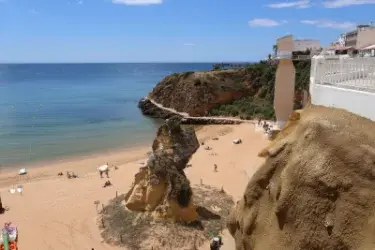
In the centre of Sesimbra, the 17th-century Santiago Fortress divides the main beach into two sections: Praia do Ouro (Golden Beach) to the west and Praia da Califórnia to the east. Both share the same defining characteristic — calm, sheltered water protected from northerly winds by the natural shape of the bay. Fine golden sand, lifeguards from June to September, showers, toilets, beach bars, restaurants, and equipment hire are all on hand.
Praia do Ouro holds a Blue Flag certification and is particularly popular with families with young children thanks to the gentle, shallow water. Praia da Califórnia receives slightly more afternoon breeze and tends to attract water sports enthusiasts. Both are within a five-minute walk of the historic centre and fishing harbour.
Best for: families, older visitors, those arriving without a car, full-day visits with restaurants close by.
Praia do Ribeiro do Cavalo — The Inaccessible Gem
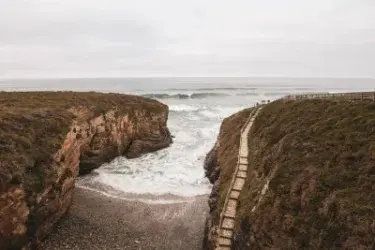
If you can only choose one reason to visit Sesimbra, make it this one. Ribeiro do Cavalo is consistently cited as one of the most beautiful beaches in Portugal, and much of its beauty comes precisely from its difficulty of access — which keeps it relatively uncrowded even at the height of summer.
To arrive on foot, follow the dirt track from Sesimbra's harbour towards the improvised car park at the clifftop. The trail descends for 10 to 15 minutes over steep, loose-soiled terrain — wear closed shoes with grip, not flip-flops. The climb back up takes 15 to 20 minutes. The beach itself is a sheltered cove with strikingly clear turquoise water, rocky beds ideal for snorkelling, and partial natural shade from the surrounding cliffs.
Alternatively, in summer you can take a short boat trip from Sesimbra harbour: the crossing takes about 10 minutes and a return ticket costs approximately €12 per person (one-way: €7). This is the more comfortable option if you are travelling with young children or full diving gear.
GPS coordinates: 38.4315° N, 9.1042° W
Best for: snorkelling, photography, couples, adventure seekers.
Note: no facilities on the beach (no toilets, no bar, no shower). Bring water and sunscreen.
Praia da Baleeira (Praia do Paraíso) — The Harbour Refuge
Tucked alongside Sesimbra's fishing harbour, Praia da Baleeira is a smaller, more sheltered cove flanked by low rocks. It is popular with divers and snorkellers for its easy access and clear water. From here you can watch the fishing boats come and go in the late afternoon — one of the most authentic scenes Sesimbra has to offer.
Praia do Meco — The Wild Atlantic Shore
About 10 km north of Sesimbra, Praia do Meco stretches for over 7 km of golden sand with no buildings in sight. It is an open Atlantic beach with stronger swell than the bay beaches, popular for surfing and bodyboarding. The northern end has a long-standing unofficial naturist zone. The sunset here, facing the open Atlantic, is spectacular.
To reach Meco from Sesimbra, follow the EN379 road. There is no direct public transport — a car is needed.
Diving and Snorkelling in the Luiz Saldanha Marine Park
Sesimbra is not just about beautiful beaches. It is also the gateway to the Professor Luiz Saldanha Marine Park, established in 1998 and considered Portugal's largest marine park, covering 52 km² and 38 km of protected coastline. Over 1,100 macroorganism species have been catalogued here, and some studies suggest the total biodiversity approaches 2,000 species.
Snorkelling for Beginners
The beaches around Sesimbra — particularly Ribeira do Cavalo, Baleeira and Portinho da Arrábida (technically within Arrábida but accessible by boat from Sesimbra) — are excellent for surface snorkelling. Water visibility frequently reaches 20–25 metres, and even at just a few metres depth it is possible to spot octopuses, cuttlefish, starfish, sea urchins, moray eels and a wide variety of rocky-bottom fish species.
Scuba Diving — The Best Sites
For certified divers, the marine park has immersion sites that rival the best in Atlantic Europe. Highlights include:
- Jardim das Gorgónias (Gorgonian Garden) — a field of orange sea fans at 18–28 metres, one of the most photographed dive sites in the country.
- River Gurara wreck — a Nigerian cargo ship sunk in 1989, now an artificial reef densely populated with marine life between 16 and 32 metres.
- Pedra do Leão — rocky formation at 15–22 metres frequented by large meagre, bream and sea bass.
- Ponta da Passagem — moderate currents that attract rays and schools of mullet.
Several certified dive centres operate in Sesimbra (Haliotis, Bolhas Tours, Day Dream Experience) offering discover scuba dives from around €50 and guided dives for certified divers. Book ahead in July and August.
How to Get to Sesimbra — Car, Bus and Boat
By Car from Lisbon
Sesimbra is about 40 km south of Lisbon. The most direct route follows the A2 motorway (direction Setúbal) then the EN10 road towards Sesimbra, or the A33 (via Almada) with an exit for Sesimbra. In normal traffic the drive takes 35 to 45 minutes. On summer weekends, allow 1h to 1h15 due to heavy inbound traffic approaching the village.
By Bus from Lisbon
TST (Transportes Sul do Tejo) operates line 207 between Setúbal bus terminal and Sesimbra, with connections from Lisbon via Sete Rios (with a change). The direct journey takes around 1h15 from Lisbon and costs approximately €4.55 for a single ticket. Check updated timetables at tsuldotejo.pt, as summer schedules differ from winter ones.
Alternatively, you can take the Lisbon–Setúbal ferry (Transtejo/Soflusa) and then a bus from Setúbal to Sesimbra — longer, but a more scenic journey.
Parking in Sesimbra
Parking in the village is the main challenge in July and August. Arrive before 9:30 am to find a spot near the beach. There is a large free car park next to the Santiago Fortress and a slightly larger paid car park about a 10-minute walk from the beach. For Praia do Ribeiro do Cavalo, park near the harbour and take the trail or the boat.
What to Do in Sesimbra Beyond the Beach
Sesimbra Castle
Standing 220 metres above the village, Sesimbra Castle has Moorish origins from the 11th century and was recaptured by Portugal's first king, Afonso Henriques. The medieval walls are well preserved and the panoramic view over the bay and the Atlantic is among the most impressive on Portugal's Atlantic Arc. Entry is free and can be combined with a picnic on the surrounding grounds. Access is by car along the road climbing from the village (free parking at the top).
Santiago Fortress
On the main beach, the 17th-century Santiago Fortress served as a coastal defence against pirates and invaders. It now houses an underwater archaeology museum displaying artefacts recovered from the seabed in the surrounding area. Entry is free and worth a 30 to 45-minute stop.
Fishing Harbour and Market
Sesimbra maintains an active artisanal fishing fleet. In the late afternoon, between 5 pm and 7 pm, you can watch the boats return and the harbour come to life — one of the most authentic experiences the village offers. Fresh fried cuttlefish, prawns and sole are guaranteed at the quayside restaurants shortly afterwards.
Where to Eat: Fresh Fish and Seafood in Sesimbra
Sesimbra is synonymous with choco frito (fried cuttlefish). Locally caught cuttlefish, fried in olive oil and served with lemon, is the village's most iconic dish, but the gastronomy goes well beyond that. Waterfront restaurants serve fresh safio (conger eel), sole, wild sea bass and percebes (barnacles). A few places we recommend based on visits:
- Restaurante Ribamar — on the seafront, specialising in catch of the day and regional shellfish. Reservation essential in summer.
- Tasca do Isaías — simpler and more affordable, with excellent choco frito and habitual queues at lunchtime.
- Casa Mateus — good for roasted conger eel and razor clam rice.
Most waterfront restaurants are open daily in summer and close on Mondays or Tuesdays in winter — check before you go. For more fish and seafood restaurant recommendations near Portuguese beaches, see our complete gastronomic guide.
Best Time to Visit Sesimbra
Sesimbra works well in almost every season, which sets it apart from many Portuguese beach destinations.
- June and September are the ideal months: air temperatures between 22 and 27°C, sea already warm (18–21°C), far fewer crowds than July and August, and no need to book restaurants weeks in advance. For sea temperature data by region, see our sea temperature guide for Portugal.
- July and August are the busiest months. The sheltered bay protects from waves but the beaches fill quickly. Ribeiro do Cavalo and Baleeira remain less crowded thanks to their harder access.
- October to May mean far fewer visitors, cooler but still diveable water (especially with a wetsuit), and green countryside surroundings. The bay beaches are perfectly walkable on sunny winter days for hiking and sport fishing.
For a full guide to off-season beach visits in Portugal, see our article on Portuguese beaches in winter.
Sesimbra vs Arrábida: How to Choose
Sesimbra and Arrábida are often compared, and with good reason — they are less than 15 km apart and share the same marine park. The essential difference is this: Sesimbra is a living village with gastronomy, history and full infrastructure; Arrábida is a purer nature experience with access-controlled beaches and fewer facilities. For a day combining beach + meal + culture, Sesimbra wins. For maximum nature and the bluest water, Arrábida has the edge.
If time allows, do both: arrive early at Sesimbra, snorkel at Ribeiro do Cavalo in the morning, have lunch in the village, and stop by the Arrábida Natural Park on the way back to Lisbon.
Frequently Asked Questions about Sesimbra
How far is Sesimbra from Lisbon by car?
In normal traffic, Sesimbra is 35 to 45 minutes from Lisbon by car (approximately 40 km via the A2/EN10). On summer weekends, allow 1h to 1h15 due to heavy traffic approaching the village.
Is there public transport to Sesimbra from Lisbon?
Yes. TST line 207 connects Sesimbra to Sete Rios terminal (with a change in Lisbon). The journey takes around 1h15 and a single ticket costs approximately €4.55. Check updated timetables at tsuldotejo.pt.
Is Praia do Ribeiro do Cavalo worth the effort?
Absolutely. The 10 to 15-minute descent along the clifftop trail is demanding but manageable for any reasonably fit adult. The beauty of the cove and the quality of the water more than justify the effort. Alternatively, you can take a boat from Sesimbra harbour for around €12 return.
Can I go scuba diving in Sesimbra without a certificate?
Yes. Several local dive centres offer guided discover dives for beginners from around €50, including all equipment and a certified instructor. No previous experience is required.
Does Sesimbra have camping nearby?
There are campsites near Sesimbra, particularly in the Aldeia do Meco area and on the edge of the Arrábida Natural Park. For an overview of coastal camping options in Portugal, see our coastal camping guide.
Conclusion
Sesimbra is, in our view, one of the unmissable stops on the Portuguese coast — especially for anyone based in Lisbon looking for an alternative with more authenticity and variety than Cascais or Caparica. In a compact space it brings together everything that makes Portugal so special: Moorish history visible in the castle walls, a living fishing tradition at the harbour, European-class marine biodiversity in the park, and beaches for every taste, from the urban and family-friendly to the wild and cinematic.
Plan your visit for June or September, arrive before 9:30 am if driving in summer, and book a table at one of the harbour restaurants in advance. Sesimbra takes care of the rest.
Explore more beach guides at praiasdeportugal.com and discover Portugal's most complete coastal destinations.