Total Solar Eclipse, 12 August 2026: the Best Beaches in Portugal to Watch It
Over the past few days, our newsroom at Praias de Portugal has fielded an unusual number of questions about a subject we don't normally cover: astronomy. The reason is simple. On Wednesday, 12 August 2026, in the early evening, Portugal will witness its deepest solar eclipse in more than 100 years — a phenomenon that won't be seen from mainland Portugal again until 2144. Because this eclipse happens exactly as the Sun is sinking toward the horizon, Portugal's west-facing beaches become, for one evening, the country's best natural observatory.
We cross-checked the official figures released by Porto Planetarium, the dedicated science platform Eclipse2026.pt, and NASA against our own experience recommending beaches along the Portuguese coast. This guide explains what's actually going to happen, at what time, where the coverage is deepest, which beaches offer the clearest sea horizon to watch it, and — most importantly — how to do it without risking your eyesight.
What Makes This Eclipse So Rare
A total solar eclipse happens when the Moon lines up exactly between the Earth and the Sun, completely blocking the solar disc for a few seconds or minutes along a narrow strip of the Earth's surface. On 12 August 2026, that path of totality crosses Greenland, Iceland, northern Russia, a stretch of the Atlantic Ocean, and northern Spain, before ending in a tiny sliver of Portuguese territory: a patch of Montesinho Natural Park, between Rio de Onor and Guadramil, in Bragança district, where totality lasts only about 25 to 26 seconds.
Outside that narrow band, the rest of mainland Portugal, the Azores and Madeira will all see a deep partial eclipse — the Sun won't be completely covered, but the coverage is so high (above 90% across almost all of the mainland) that daylight visibly changes and the temperature noticeably drops in the minutes before the peak. According to Porto Planetarium, Portugal hasn't seen an eclipse of this magnitude in over 100 years, and the next chance to see a total eclipse from mainland Portuguese territory won't come until 2144. In other words, for the vast majority of us, this is a once-in-a-lifetime opportunity.
Times and Coverage Percentage by Region
The eclipse begins on mainland Portugal at around 6:33–6:42 pm, reaches maximum coverage between 7:30 pm (Bragança) and 7:38 pm (Faro), and ends between 8:23 pm and 8:31 pm — mainland Portugal time (WEST). In the Azores, which run on a different time zone, the phenomenon unfolds between 6:33 pm and 6:39 pm, Azores local time. In Madeira, maximum coverage occurs at around 7:46 pm.
| Region / City | Starts | Maximum | Ends | Sun Coverage |
|---|---|---|---|---|
| Bragança (totality band) | ~6:33 pm | ~7:30 pm | ~8:23 pm | 100% (~26s totality) / 99.9% in the surrounding area |
| Porto and the northern coast | ~6:36 pm | ~7:33 pm | ~8:26 pm | ~98% |
| Lisbon and the Lisbon coast | ~6:39 pm | ~7:36 pm | ~8:29 pm | ~94.5% (Sun only 10° above the horizon) |
| Faro and the Algarve | ~6:42 pm | ~7:38 pm | ~8:31 pm | 92.8% |
| Madeira (Funchal) | — | ~7:46 pm | — | up to 77.6% |
| Azores | ~6:33 pm (local time) | ~6:36 pm (local time) | ~6:39 pm (local time) | 72.5% to 77.6% |
These times are approximate and vary by a few minutes depending on your exact location within each region — for the precise time at your location, check the interactive map on Eclipse2026.pt or NASA's dedicated eclipse page.
Why Beaches Are the Best Place to Watch a Sunset Eclipse
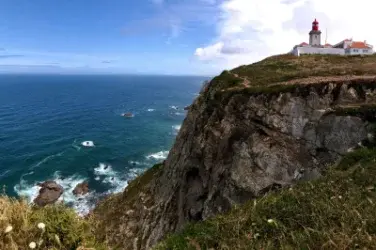
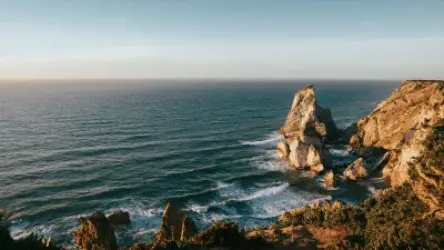
There's one detail that changes everything about this eclipse: it happens almost at sunset, with the Sun very low — in Lisbon, for instance, the Sun will be only 10 degrees above the horizon at the moment of deepest coverage. That means you need a completely clear western horizon, free of hills, buildings or trees, to see the phenomenon at all. That's exactly what the Portuguese coastline offers: an open line of water stretching to the Atlantic, unobstructed, all the way from Minho to the Algarve.
Beaches facing directly west — the same ones we already recommend in our guide to Portugal's best sunset beaches — are therefore also the best eclipse-watching spots. South-facing beaches (much of the Algarve) or beaches shielded by tall cliffs to the west will see the Sun disappear behind rock before or during the eclipse, missing part of the show.
The Best Beaches in Portugal to Watch the Eclipse
Costa Vicentina and the Western Algarve
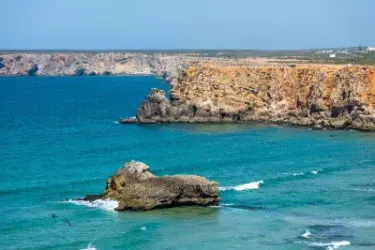
In our view, this is the region with the best conditions in the country: a west-facing coastline, fewer of the typical August low clouds, and an uninterrupted Atlantic horizon. Praia do Amado, Praia de Odeceixe and Praia da Arrifana, all covered in detail in our Costa Vicentina guide, sit on cliffs with a wide-open sea view — ideal for watching the eclipse as the Sun sinks into the Atlantic.
Greater Lisbon
Guincho Beach and Adraga Beach, in Cascais and Sintra, face almost perfectly west and are the closest options to the capital. Costa da Caparica, with its long, unobstructed sandy stretch facing west, is another excellent choice for anyone on the south bank of the Tagus.
Central Portugal
Nazaré and São Pedro de Moel offer elevated viewpoints over the Atlantic, while the Costa Nova area, near Aveiro, pairs the eclipse with the already-famous striped houses reflected in the lagoon — a rare photographic setting.
Northern Portugal
Matosinhos and Espinho, near Porto — the region with the second-highest coverage in the country (~98%) — plus Viana do Castelo further north, all guarantee a clear Atlantic horizon and easy access from the region's main urban centres.
Azores and Madeira
Coverage is lower in these regions (72.5% to 77.6%), but any west-facing coastal spot — such as the coastline near Funchal, in Madeira, or the west coast of São Miguel, in the Azores — still delivers a visibly darkened sunset.
For totality chasers: Trás-os-Montes
Bragança has no sea beach, but it's the only place in mainland Portugal where the Sun disappears completely, if only for 25 to 26 seconds. Anyone willing to travel there can also use the trip to explore the region's river beaches the next day — we've already covered them in detail in our guide to the river beaches of Trás-os-Montes, a good way to cool off after an evening spent waiting for those precious seconds.
How to Watch Safely: Certified Glasses and Mistakes to Avoid
This is the most important point in this whole article: at no point during the partial eclipse (that is, along the entire Portuguese coast outside the narrow totality band in Bragança) is it safe to look directly at the Sun without proper protection — not even for a few seconds, "just to take a quick look." Even with 99% of the Sun covered, the light and radiation still getting through are enough to cause permanent, painless retinal damage, with the person not feeling any pain at the time.
Essential rules, summarised from the recommendations on the official Eclipse2026.pt platform:
- Always use glasses certified to the EN ISO 12312-2 standard — ordinary sunglasses, even dark or polarised ones, do not offer enough protection.
- Free certified glasses are available through more than 600 opticians in the Club da Visão network and at several Ciência Viva science centres across the country — check availability in the days before the event.
- Never use eclipse glasses to look through binoculars, cameras or telescopes without their own dedicated solar filter — concentrated light can instantly damage both the glasses and your eyes.
- To photograph the eclipse on a phone, avoid looking directly at the Sun through the screen for extended periods, and consider a solar filter for the lens.
- If you can't get certified glasses in time, there's a safe alternative: a simple pinhole projector made from two pieces of card (one with a small hole), which projects the eclipse image indirectly — never look directly at the Sun through the hole itself.
What to Bring and How to Plan Your Evening at the Beach
Since the peak moment coincides with the end of a summer afternoon, it's worth treating this as a small event, not just an ordinary beach trip:
- Certified glasses for everyone in your group, including children — sharing safely isn't really possible during the eclipse's peak, when everyone will want to look at the same time.
- Arrive early. Expect much higher than normal turnout at west-facing beaches that day, especially the best-known ones in the western Algarve and along the Cascais/Sintra coastline — arriving one to two hours before sunset should secure you a spot and parking.
- Bring a layer. The temperature drop during peak coverage is noticeable even in high summer, especially with the typical late-afternoon coastal breeze on the west coast.
- Check the IPMA cloud forecast in the days right before the event — the west coast can see typical August coastal cloud cover, so it's worth having a backup plan (another nearby beach with better conditions).
- Bring a power bank and a charged phone if you plan to take photos — mobile network usage will likely spike that evening, with thousands of people in the same area, which can slow things down.
Frequently Asked Questions
Do I really need special glasses if the eclipse isn't total where I am? Yes. Everywhere in Portugal outside the narrow totality band in Bragança, the Sun is never 100% covered, so looking directly at it without ISO 12312-2 certified glasses can cause permanent retinal damage, even when the Sun is almost entirely covered.
What time should I be at the beach on 12 August 2026? The eclipse reaches its maximum between 7:30 pm (north) and 7:38 pm (south) on mainland Portugal. We recommend arriving between 6:00 pm and 6:30 pm to secure a good spot, especially at beaches popular for sunset watching.
Which beach has the highest percentage of eclipse coverage in mainland Portugal? Coverage increases from south to north and northeast: Faro gets around 92.8%, Lisbon around 94.5%, and Porto around 98%. Full totality (100%) only occurs in a small rural area of Bragança district, which has no sea beach.
Can I photograph the eclipse with my phone without glasses? You can photograph it, but you shouldn't look directly at the Sun through your phone screen for long periods, and you shouldn't point your phone at the Sun at full zoom for extended periods without a solar filter, as this can damage the camera sensor. Always use certified glasses for direct, naked-eye viewing.
What if it's cloudy that day? Some of the light drop and general darkening remain noticeable even with scattered clouds, but dense cloud cover can block the view completely. Check the IPMA forecast in the days beforehand and have a backup beach nearby, ideally in an area with a track record of clearer skies in the late afternoon.
Conclusion
The total solar eclipse of 12 August 2026 is, without exaggeration, the most significant astronomical event most of us will ever see from Portuguese soil — and our west-facing coastline offers some of the best vantage points in Europe to witness it safely, with the Sun disappearing into the Atlantic. Get your certified glasses in advance, pick a beach with a clear western horizon, and arrive early. To round out your planning, also check our guide to the best beaches for watching the Perseids, our guide to coastal wind conditions (nortada) to gauge the chance of low cloud in your area, and our beach safety guide before you head out.